


Spoiler Alert: It needs AI as the execution layer instead
There is a new type of software or application everywhere: A Copilot. Sales Copilot. Customer Services Copilot. Self Services Copilot. Coding Copilot. Security Copilot. And now: Grid Copilot. Many of them.
Let me be clear what I mean. In this post, I refer to a Copilot as the bare / pure conversational, ChatGPT-style UX. A language model on top of the existing application stack, waiting for a human to type a question.
In a grid context: Why is this line overloaded? What should I do about this contingency? Give me the “optimal” switching plan / sequence.
Ask. Get an answer. The human decides. The human acts.
I am not saying this is useless. I am saying it is step one. And the industry is about to mistake step one for the destination.
A Copilot is AI as a feature. The grid needs AI as the execution layer.
Those are not the same product.
The Copilot is a Knowledge-Worker Metaphor
The metaphor comes originally from aviation. Pilot and copilot. Working together. Interacting closely. The pilot stays in control, the copilot assists.
It’s a great model for knowledge (based) work, where the unit of work is a given question asked based on experience. And the pace is set by whoever asks it.
The grid is not this kind of a knowledge worker. It is a physical, distributed, dynamic system running continuously under the laws of physics. Congestion on a critical corridor does not become less urgent just because nobody opened the chat window and knew which question when to ask.
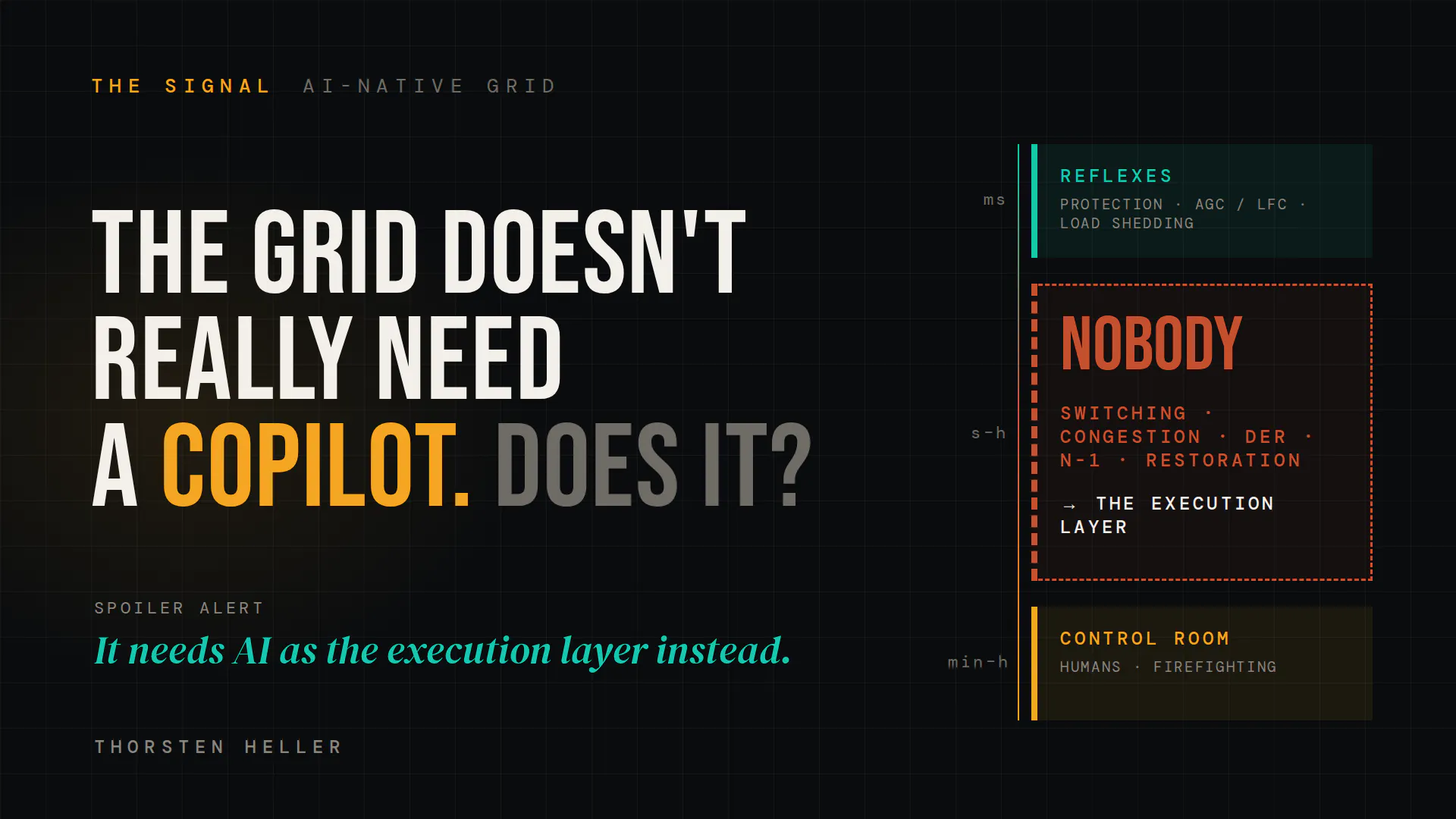
Now, the grid already has autonomy. Or some autonomous control. Anyone with an OT background will say so immediately, and they are right. Protection clears faults in milliseconds. AGC / LFC holds frequency. Load shedding acts without asking. The grid has had those automatic responses or reflexes for decades. None of them need(ed) an LLM. Nor a copilot.
The grid also has slow “cognition”. The control room. Trained humans. Minutes to hours. Mainly firefighting style cognition.
What the grid does not have is anything in between. Meaning between the autonomous decisions and the human cognition.
No layer that continuously perceives the operational state, reasons about it, anticipates what comes next and then acts inside a defined envelope or defined boundaries on the seconds-to-hours timescale. Switching. Congestion management. DER dispatch and curtailment. N-1 anticipation. Restoration sequencing. Voltage coordination across a network with thousands of inverters.
That layer is where the operator does most the work today. In this slow cognition layer. And it is the layer the tasks to do for operators are growing fastest.
A pure conversational-style Copilot does not fill it. It gives the slow layer a faster way to ask questions.
The Operator is the Integration Layer
Alarm on the screen. The operator investigates. Topology (as operated) from the ADMS. Asset details from the Asset Management or the GIS. Or both. History from the historian. Forecasts from a third system. Protection settings from a fourth. Run a power flow. Evaluate consequences. Decide.
This scenario is quite real because the information needed for the decision is scattered across diferent systems that were never built to share one view of the grid.
The operator is the integration layer. The operator is semantics of the data model. The operator is the reasoning engine. The operator is the final API between dozens of silo’ed applications.
We built incredibly sophisticated software around the grid. And we still ask highly trained humans to connect the dots.
Putting a chat window on top of this architecture does not solve the core problem: the fragmentation. It hides it. The LLM becomes one more consumer of inconsistent data and produces fluent answers from whichever system it happened to query. Say hello Data Morgana. Say hello to hallucinations.
In an sales / services workflow that costs you an unhappy customer. In a control room it costs you a wrong switching order. Delivered with high confidence.
We don’t need a kind of ChatGPT for that.
Intelligence needs a Ground Truth
An LLM does not know the grid. It does not know the current topology, the state of every asset, the constraints that apply right now, or which data it can trust. It does not know anything about the “as operated”.
Real grid intelligence needs Deep Grid Data*. Topology. Asset models. Real-time measurements. History. Forecasts. Market positions. Protection settings. Constraints. Physics. Not as silos with an API each, no. But one coherent, continuously maintained representation of the grid.
*What I mean with Deep Grid Data? Just read it here!
And even that is not enough. Because the as-built model in the GIS and the as-operated network in the ADMS are often not the same. They disagree. SCADA conflicts with AMI. The asset management systems says (or believes) the transformer was replaced. The topology model says it wasn’t.
Every one of those gaps is a place where an AI reasons correctly but from wrong premises.
This is what I call Grid Ground Truth*. The fused, reconciled, provenance-tracked operational state of the grid. The correct one. The reality. The truth. Now and here. Not a state estimator, which solves electrical quantities on a model it assumes to be right. Not a digital twin, which simulates on whatever state it is handed. Ground truth answers the question every autonomous system must answer before it is allowed to act:
What do we actually know, how sure are we, and where did it come from?
Without it, how can the AI tell good data from bad data?. With it, AI can create the outcomes we expect. And the grid needs.
*Btw, I wrote about the Grid Ground Truth in more detail here.
From Feature to Execution Layer
So what is AI as the execution layer? Clearly not one giant model.
But a system. A system of systems. Or a network of systems. An LLM for interaction and explanation. ML models that detect what conventional analytics miss. Physics models that check whether an action is feasible. Optimisation that picks the best feasible one. Domain rules for what is never allowed. And agents that execute bounded workflows on top of all of it.
Here the distinction between an agent and agentic AI matters*.
In case you want to understand the difference between agents and agentic AI in more detail, read here my post on the agentic AI architecture driving the future grid!
An agent is one scoped, autonomous component. One job. Operating continuously. Reporting exceptions instead of asking permission. A feeder-anomaly agent. A battery-dispatch agent. A restoration-sequencing agent. A Demand-Response agent.
Agentic AI is the architecture where many such agents perceive a shared trusted state, coordinate, and act toward goals no single agent could achieve alone. Agentic AI is like the orchestration or choreography av agents performing intelligent workloads.
The Copilot is neither. It is a front end.
Agentic workloads are where the real value is. And these agentic workloads require the Grid Ground Truth underneath to be safe at all.
Today the operator sits in the loop: observe, analyse, decide, act.
In the agentic grid the machine takes more of that loop: perceive, understand, predict, decide (within defined boundaries), act (within defined envelopes).
The human moves up a level. Objectives. Constraints. Policies. Strategies. Boundaries. Exceptions. And ultimately: trust.
Where Cognition stops and Control begins
If AI is going to decide / act on the grid, the most important design decision is the boundary between cognition and control. I have written about it the Cognition / Control Boundary before.
And in my post on the cognition / control boundary, I argue for a hard one.
On one side, cognition. Models, agents, optimisers. They perceive, reason, predict, propose. This side is probabilistic. It can be wrong. It is “allowed” to be wrong, because nothing it produces reaches a breaker directly.
On the other side, control. A deterministic layer that validates every proposed action against the trusted state, physical limits, protection coordination, operational policy, and the authority the system has actually been granted. It executes only what passes.
This boundary is what turns “within trusted boundaries, it will act” from a policy or slogan into a design. It defines the failure mode. When cognition is wrong, the action is rejected or escalated. When control is wrong, that is a conventional engineering defect, and the industry knows how to test and certify those. Accountability attaches to something deterministic and inspectable. Not to a model’s weights.
An LLM should never hold the breaker. It should be able to explain why the control layer opened it.
Autonomy is earned
We cannot decide that the grid is now autonomous. Autonomy in critical infrastructure is earned. Validation. Testing. Explainability. Track record. Time.
Autonomy is not a feature you just switch on. It is a level of trust you earn. Think about it like a journey: The journey of trust.
In practice it is the successive widening of authority over time or earned trust. An agent observes and explains. Then it recommends, and every recommendation is logged against what the operator actually did. Then it acts inside a narrow, reversible envelope / boundary. A curtailment band. A tap-changer range. A pre-approved switching set. Each stage produces the evidence for the next. The envelope widens when the record justifies it. It narrows the moment it doesn’t.
The ladder is not the insight. The insight is that each rung has a measurable entry criterion, and the system knows when it doesn’t know. A grid ground truth with provenance and confidence makes that possible. A Copilot querying six inconsistent systems does not.
The Control Room becomes a Governance Layer
I (and many experts I have the peasure working with) don’t believe in the dark control room. The grid is too important. The consequences are too big. There will always be situations where human judgement matters.
But the job changes.
Today the control room operates software. Tomorrow it supervises intelligence. Eventually it governs autonomous operations. The question shifts from “what should I do?” to “what should the system be allowed to do?”
That is a much bigger transformation than a chat window.
The Grid does not need a Copilot but a AI Nervous System
A nervous system doesn’t sit next to the body and give advice. It connects sensing, cognition and action. Reflexes for the fast layer. Deliberation for the slow one. And everything in between, so the body doesn’t need conscious attention for every movement.
That is what the grid is missing.
So, does the grid need a Copilot? For a while, yes. Conversational access to grid intelligence will help operators investigate, understand, and eventually supervise.
But a Copilot on top of fragmented data is AI as a feature. Step one. And on its own, close to a waste, because it spends the industry’s attention on the easiest part of the problem.
The hard part is underneath. A trusted state of the grid. Agentic workloads reasoning over it. A control boundary deciding what they are allowed to do.
The human will not leave the control room. The human’s job will move from operating / firefighting the grid to governing an intelligent one.
That is a harder future than giving the grid just a Copilot. It is also the only one worth building.
Disclaimer: This peace was originally published on the AI-native Power Grid Newsletter on Substack.