


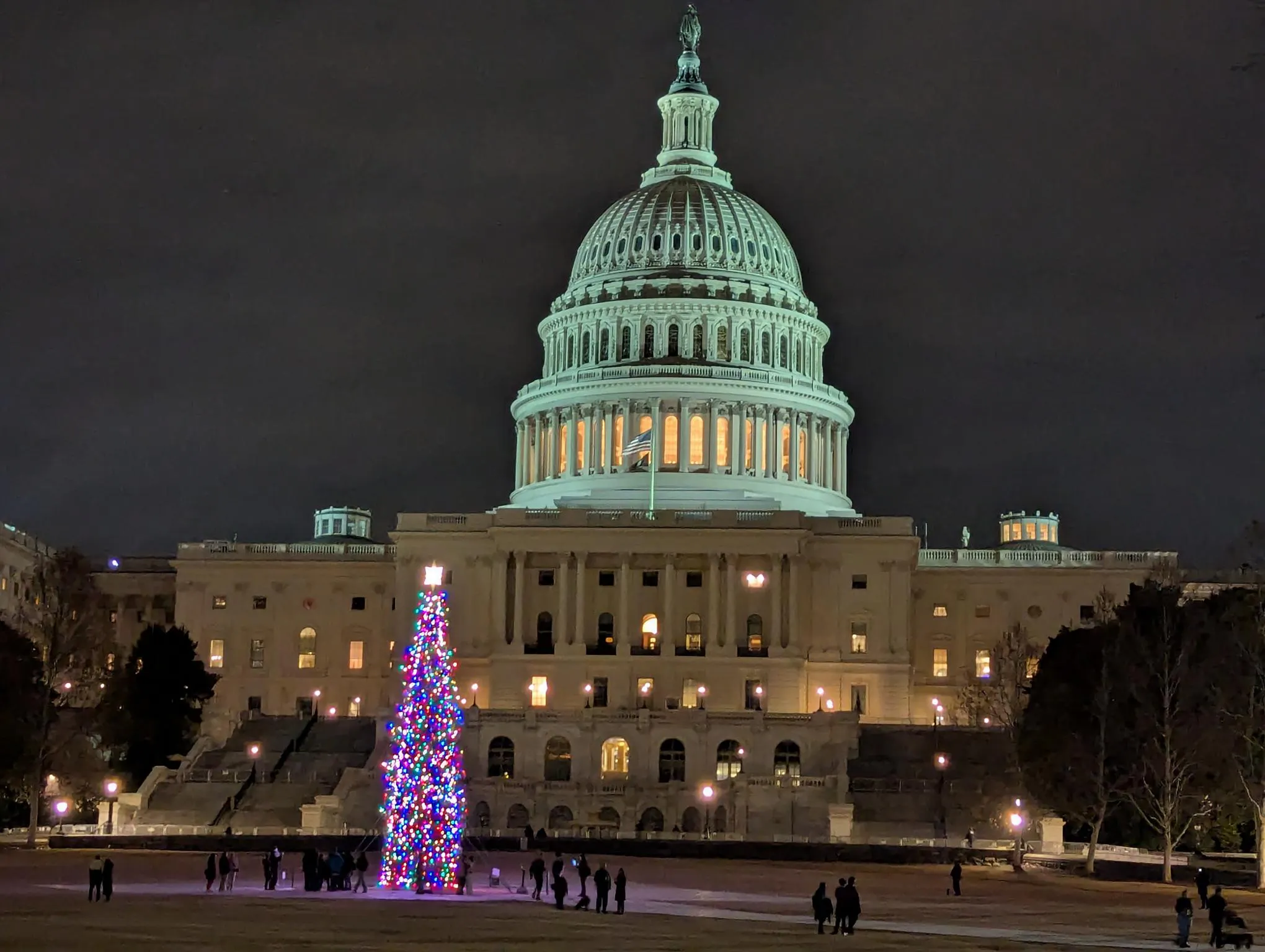
I spent last week visiting my daughter in Washington DC. When we went to see the Capitol Christmas display, I fully expected to see a notice reading something like “Space available – will partition to suit requirements. Current tenants have ceased to perform useful work and have been permanently sent home. Inquire in small white building adjacent to large construction site at 1600 Pennsylvania Avenue.”
I say this because it’s clear that Congress, which is designated by the Constitution as the primary branch of government, has no intention of standing up to the executive branch, even when the latter’s actions are clearly damaging the wellbeing of American citizens. This was vividly demonstrated last week, when the Interior Department announced it is pausing the leases for “all large-scale offshore wind projects under construction” in the United States…” This applies to five projects being constructed offshore of the East Coast.
Of course, these projects are all fully permitted and underway; one is about 90% complete. The developers have already invested hundreds of millions of dollars in them, all of which will be completely lost if the projects are shut down for good. I’m sure that, when this issue comes before the courts, they will all (including the Supreme Court) come down firmly on the side of requiring the government to honor its contractual commitments. There shouldn’t even be a question about this, since most investment will come to a standstill if the federal government’s commitments are only valid until the next administration takes office.
However, the real question isn’t how the courts will rule, but when they will do so. The developers are collectively spending at least $10 million per week on these projects, and if it appears in 2-3 weeks that it will be months before there’s a judicial resolution to this issue, they may decide not to keep throwing good money after bad and cancel the projects altogether.
Of course, this will be disastrous for coastal states that are counting on the power generated by these projects to meet the rapidly expanding growth in electricity demand, driven primarily by data centers now under construction or at least planned.
Unfortunately, if these projects are cancelled, they will have plenty of company. A report[i] by Cleanview (which was reposted by Andy Bochmann last week on LinkedIn) states that “..1,891 power projects with a combined 266 GW of generation capacity have been canceled in 2025—equivalent to roughly one-quarter of America's entire current electricity generation capacity. To put this in perspective, this is more capacity than the total electricity generation of Texas, the nation's largest power producer.” Moreover, 93% of these cancellations were for clean energy projects.
Of course, projects have been cancelled for many reasons, not just the current administration’s antipathy toward renewable energy. Another reason is that local opposition is often killing new projects linked to data center growth.
The Executive Summary continues:
These project cancelations will affect nearly every American. The 266 GW of lost capacity threatens higher electricity prices for households and businesses as supply fails to keep pace with surging demand—a dynamic already visible in PJM's double-digit annual price increases.
Beyond higher bills, the cancelations represent a massive economic loss. We estimate that the 1,891 projects canceled this year would have generated $400 billion in investment—capital that would have flowed disproportionately to rural communities in need of economic revitalization.
The current trajectory is unsustainable: America is simultaneously approving unprecedented electricity demand while canceling the generation needed to meet it, creating policy incoherence that threatens grid reliability, affordability, and the country's competitiveness in the global AI race.
In my first post on this subject, I stated at the end that it’s probably time for the coastal states affected by the offshore wind cancellations to consider placing a moratorium on new data center construction. After all, those states were counting on these wind farms to provide a lot of the extra generation capacity needed to power those data centers.
However, since power generation projects in general are being cancelled nationwide, maybe we should look at a nationwide moratorium – as opposed to, for example, simply allowing the new data centers to be built without additional generation capacity. Since electricity demand will need to be constrained in some way, we’ll in effect be agreeing that the best way to deal with the potential shortage is to use “price rationing” – i.e., making end consumers pay for increased power use by new data centers.
This doesn’t quite sound fair to me, but what do I know?
If you would like to comment on what you have read here, I would love to hear from you. Please email me at [email protected] or comment on this blog’s Substack community chat.
Tom Alrich’s Blog, too is a reader-supported publication. You can view new posts for one month after they come out by becoming a free subscriber. You can also access my 1300 existing posts dating back to 2013, as well as support my work, by becoming a paid subscriber for $30 for one year (and if you feel so inclined, you can donate more than that!).
[i] Actually, the Executive Summary of the report.