


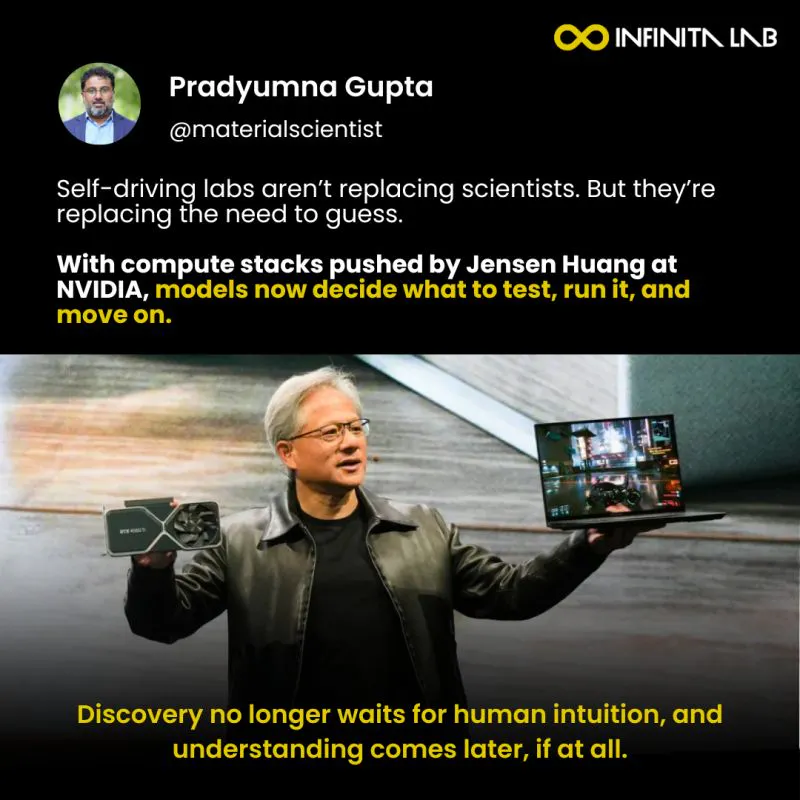
The real shift in 2026 isn’t that robots can run experiments.
It’s that they don’t need your hypothesis anymore.
At places like Argonne National Laboratory and Lawrence Berkeley National Laboratory, autonomous platforms are now running closed-loop experiments where:
📍model → proposes synthesis conditions
📍robot → fabricates and tests
📍model → updates the next experiment in minutes
No human deciding what to try next.
A concrete example here is that electrolyte optimization workflows now explore thousands of composition–processing combinations (salt ratios, solvent blends, additives) guided by Bayesian/active learning. Humans would test ~20–50 in the same time.
But there's an uncomfortable part as well.
The system doesn’t care about your mechanism.
It optimizes outcomes, not explanations.
That means:
It finds solutions in non-intuitive regions of phase space
It exploits interactions you wouldn’t test
It converges on materials you can validate… but not fully rationalize
This ties directly to what we discussed earlier:
AI breaking explainability → now experimentation itself is becoming model-driven.
Leaders like Jensen Huang (compute stack) and DOE lab directors are quietly aligning around this:
compute + robotics = the new scientific method.
Well, there's a contrarian truth as well:
The bottleneck in materials science was never lab equipment.
It was human-led hypothesis selection.
Self-driving labs didn’t automate experiments.
They removed the need to guess which experiment matters.
#SelfDrivingLabs #MaterialScience