


Part 1: The Destination
By Dr. Mani Vadari, President, Modern Grid Solutions
Note to readers: This is the first in a two-part series. Part One describes the destination — the integrated future we need to build. Part Two will focus on the journey — the practical steps, decisions, and tradeoffs required to get there.
How We Got Here: The Forces That Shaped Three Centuries
For three centuries, each era has been defined by its dominant force — from steam and steel to computing and the internet. Today, a new shift is emerging from the convergence of four layers: energy, computing, data, and intelligence. Together, they will form the new engine for the century ahead.
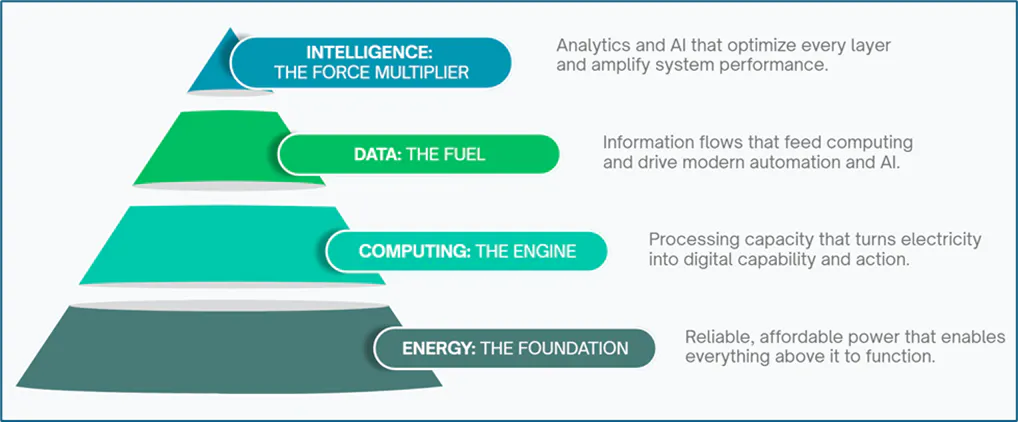
Over my 40+ years in power systems, I’ve watched these layers develop in parallel, but rarely in sync. Even as they’ve begun to converge, the value has remained fragmented. We haven’t reached the point where the whole is greater than the sum of the parts.
We know how to build energy systems, embed computing, and generate data. And the intelligence tools are far beyond the Expert Systems and Artificial Neural Networks I worked with during my Ph.D. What's new is the speed and scale, and the need to integrate these forces to develop something greater.
This century will test our ability to do that. If we can’t, progress will stall. If we can, the opportunity is almost boundless. And based on what I’ve seen across industries and across my own career, I believe we are moving in the right direction — unevenly at times, but unmistakably forward.
Energy: The Foundation
Without enough energy, the world stops — cars don’t move, factories don’t run, homes don’t function, and computers don’t compute. Every modern breakthrough — AI, automation, electrification, digital services — depends on reliable, abundant, affordable electricity. Energy is the foundation layer, and everything else sits on top of it.
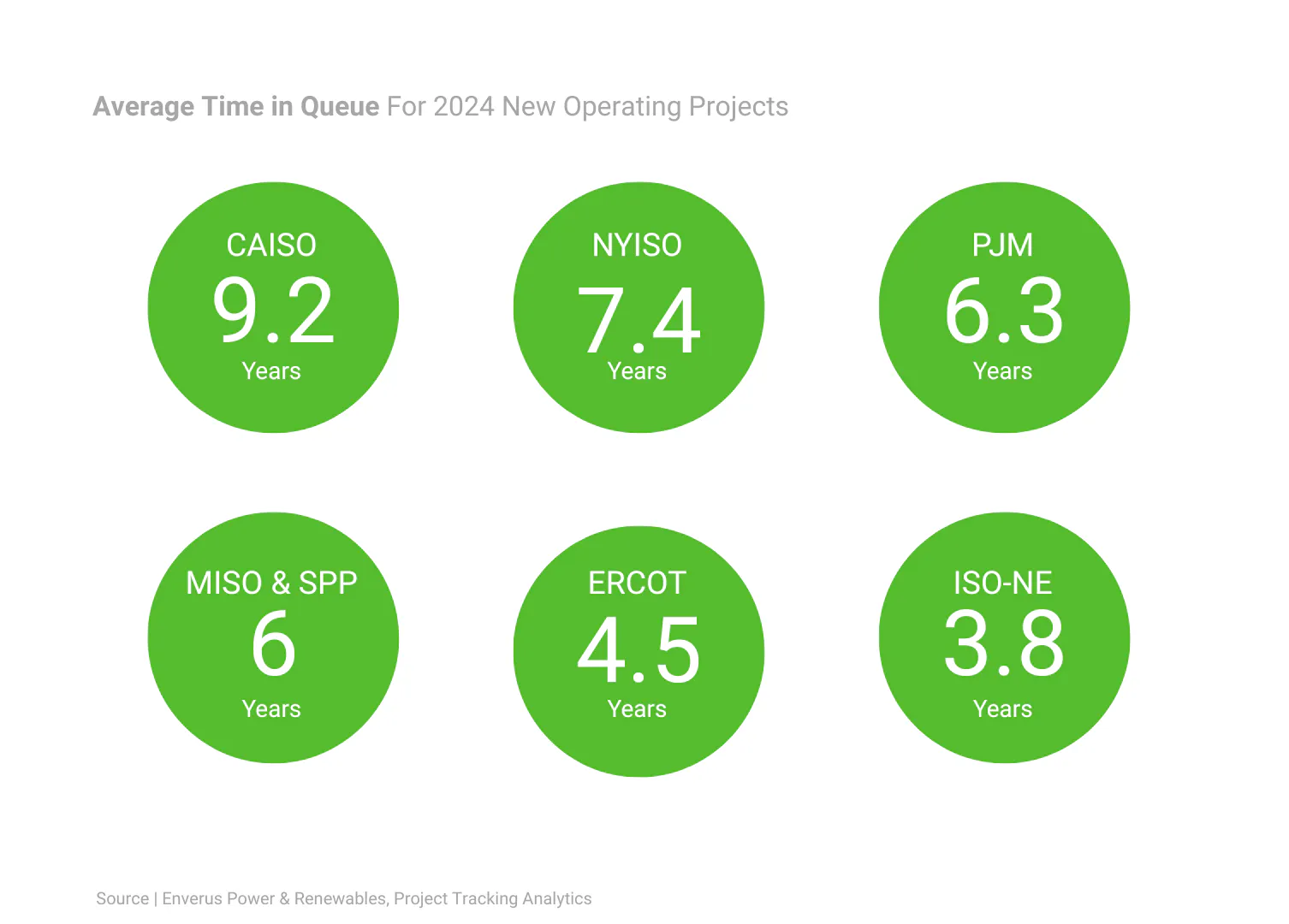
Most proposed energy projects never reach operation, and those that do often wait years in interconnection queues. Image source: Enverus. iii
But demand is rising faster than the systems can adapt. Data centers that once requested 50 MW are now routinely requesting 500 MW or more, and gigawatt-scale campuses are becoming common. According to the U.S. Department of Energy, data centers consumed about 4.4% of U.S. electricity in 2023 and are projected to reach 6.7-12% by 2028.0F[i]
The challenge isn’t just demand, it’s timing. Developers move at the speed of capital, while utilities move at the speed of regulation and construction. Some utilities are now quoting four- to ten-year interconnection timelines. One told Google it would take 12 years just to study a request.1F[ii]
Energy is the foundation layer, but it’s also the constraint. Unless we rethink how we plan, build, and operate the grid, that constraint will set the ceiling on innovation.
Computing: The Engine
If energy is the foundation, computing is the engine that turns that power into digital capability. Every digital service — every email, every web query, every AI model, every automated workflow, even the control systems that run the grid — depends on computing. Hyperscale computing and AI clusters have turned data centers into digital factories. Just like factories of the past, they need land, power, cooling, communications, and interconnection — real physical assets. Computing is the new physical industry.
And the engine has become so power-hungry that it can no longer choose its own geography. Developers used to build where the fiber was. Now they build where the megawatts are. The availability of power — not land, not fiber, not capital — is increasingly the determining factor in where computing can grow.
But the engine is running hotter than the grid can support. These new factories are scaling faster than the infrastructure around them — expanding footprints, accelerating timelines, and driving demand in ways the existing system wasn’t built to absorb. The result is a widening mismatch between how quickly computing can grow and how long it takes to deliver the physical capacity it depends on.
Data: The Fuel
If computing is the engine, data is the fuel. It’s the raw material for automation, AI, and modern decision-making. But data isn’t weightless. It has a physical footprint, which is also measured in megawatts.
Every byte created or consumed requires computing and energy. Every byte stored, processed, or moved consumes energy and requires more computing. AI and machine learning have intensified this dynamic: training modern models requires massive datasets and massive amounts of energy. As global data creation accelerates, so do the energy and computing required to support, manage, and extract intelligence from it. More data means more storage. More storage means more computing. More computing means more energy.
It’s estimated that the world generated 173.4 zettabytes of data in 2025, and that is set to triple by 2029 to over 525 zettabytes. iv
Data is the fuel layer, but it’s also a growing load on the foundation, with data processing outpacing almost every other aspect of energy consumption.
Intelligence: The Force Multiplier
At the top sits intelligence — the force multiplier that unlocks the value of the other three layers. Intelligence turns raw data into actionable insight, computing into capability, and relegates energy into a critical tool that drives productivity.
Utilities already operate with intelligence systems in their control rooms: Energy Management Systems (EMSs) for transmission, Outage Management Systems (OMSs) for outage response, and Advanced Distribution Management Systems (ADMSs) for distribution, to name a few. These platforms take in real-time data from SCADA, AMI, and field sensors and translate it into operational decisions. They show that intelligence in the grid isn’t new, but the scale and speed of today’s computing and data demands require intelligence that spans the four layers across all industries, not just the utility footprint.
The electric grid is only one example. We’re seeing the same convergence across other sectors where energy, computing, and data are becoming inseparable. In manufacturing, smart factories now run on sensor-rich equipment, edge computing, and AI systems that optimize quality and throughput in real time — all of which depend on reliable power. In buildings, advanced management systems combine energy data, occupancy patterns, and on-site computing to automate comfort, cost, and carbon. These industries show the same pattern: intelligence sits at the top, but intelligence depends on everything beneath it. Intelligence without energy is inert. Intelligence without computing is theoretical. Intelligence without data is blind. The force multiplier only works when the layers beneath it are aligned.
As intelligence becomes more capable and more deeply embedded across industries, it also requires thoughtful governance and built‑in safeguards. These measures ensure the technology enhances productivity and decision‑making without crossing clearly defined societal red lines, and that it is always applied with the right intent and approach.
Why Integration Is So Hard
These four layers evolve at different speeds. Technology sprints. Infrastructure crawls. Policy lags. Developers want speed. Utilities want certainty. Regulators want prudence. Communities want benefits without disruption — and everyone wants those benefits to remain affordable.
Building physical infrastructure takes time. New generation and transmission face regulatory reviews, community resistance, and long‑lead equipment. And because customers must be protected from higher bills, utilities can’t overbuild or take on the risk of stranded assets. The system is built for reliability and affordability, not speed — and that creates friction with fast‑moving demand. It’s not that anyone is wrong; it’s that the four layers aren’t aligned.
Coordinated planning that treats energy, computing, data, and intelligence as one interconnected ecosystem is missing.
What Success Looks Like
Success in the next century will come from integration:
Energy (The Foundation): Reliable, affordable energy systems — from electricity to thermal and industrial power — built for flexibility, speed, and scale so everything above them can function and thrive.
Computing (The Engine): Processing infrastructure placed where it can deliver the most value — aligning with energy availability, operational need, and the ability to support local or global digital demand.
Data (The Fuel): Governance and digital infrastructure that manage the volume, movement, and storage of data so the fuel stream strengthens, rather than overwhelms, the systems that depend on it.
Intelligence (The Force Multiplier): Analytics and AI that anticipate needs, optimize operations, and coordinate across systems, making every layer more adaptive, efficient, and effective.
Each layer strengthens the others. Success comes when energy, computing, data, and intelligence operate as one system rather than four silos — not just in the energy sector, but across industries. Whether it’s buildings that optimize comfort and carbon in real time, manufacturers running sensor-rich production lines, or cities coordinating transportation, energy use, and digital services, the pattern is the same: progress accelerates when these layers are aligned and slows when they aren’t.
The Century of Integration
The Industrial Age gave us machines. The Computing Age gave us processing power. The Internet Age gave us global connectivity. This century will be defined by our ability to integrate energy, computing, data, and intelligence — intentionally, intelligently, and at scale.
Bottom Line: Integration is the destination. But knowing the destination is only half the challenge. The next step is understanding how we get there — the practical steps, decisions, and tradeoffs that turn this vision into reality. That journey is the focus of the next article. Stay tuned!
[i] https://escholarship.org/uc/item/32d6m0d1
[ii] https://www.networkworld.com/article/4117329/google-warns-transmission-delays-are-now-the-biggest-threat-to-data-center-expansion.html
iii https://www.enverus.com/ebooks/2025-interconnection-queue-outlook-report
iv https://www.statista.com/statistics/871513/worldwide-data-created/