


Topic: Predictive Vegetation Intelligence - A New Operating Model for Grid Reliability
Integrating Satellite-Based Vegetation Indices with Agentic AI
by Kamathenu Thenatchi , Rubini PE and Shruti Jain
Vegetation Risk Is Growing Faster Than Traditional Controls
Electric utilities today operate in an environment defined by expanding infrastructure, climate volatility, and increasing regulatory scrutiny. Vegetation growth near overhead power lines poses a complex and compounding risk, directly impacting reliability, asset health, safety, and wildfire exposure.
Key Vegetation-Related Risks
Vegetation encroachment can result in:
Line faults and flashovers caused by branch or tree contact
Equipment damage to conductors, insulators, and transformers
Unplanned outages, particularly during storms or high-wind events
Wildfire ignition, especially in dry or fire-prone regions
These risks are amplified by the sheer scale of modern transmission and distribution networks, which often span thousands of kilometers across remote, rugged, and inaccessible terrain. In many cases, vegetation hazards remain undetected until they result in outages or safety incidents—by which point mitigation becomes urgent, costly, and highly visible.
Conventional vegetation management approaches suffer from structural limitations including manual patrols, helicopter inspection, reactive trimming, etc.
Together, these methods enforce a reactive operating model, where vegetation is managed after thresholds are already breached. This limits utilities’ ability to anticipate risk, optimize maintenance resources, and demonstrate defensible, data-driven decision-making to regulators and stakeholders.
The industry needs a fundamentally different approach—one that provides continuous visibility, early risk detection, and intelligent prioritization at scale
Proposed Solution
To address these challenges, we recommend a satellite-driven, Agentic AI–enabled vegetation risk management solution that combines multispectral satellite imagery, vegetation indices, and autonomous decision-making agents into a closed-loop operational system.
What Changes with Agentic AI
Satellite imagery alone enables observation. Agentic AI enables action.
In the proposed model:
Satellite-derived vegetation indices act as machine-readable environmental signals
Autonomous AI agents continuously interpret these signals
Risks are detected, forecasted, prioritized, and acted upon with minimal latency
Human oversight is preserved through explainable, auditable workflows
This transforms vegetation management from periodic inspection cycles into continuous, adaptive risk governance.
System Architecture and Agentic AI Workflow
Agentic AI represents a fundamental shift in how vegetation risk is monitored and managed across transmission and distribution infrastructure. Rather than treating satellite analytics as a passive source of information or a static decision-support tool, Agentic AI introduces autonomous, goal-oriented software agents capable of observing environmental conditions, reasoning over complex data, making informed decisions, and initiating actions across the vegetation management lifecycle. These agents operate continuously, enabling a closed-loop and self-improving system that evolves as new data and outcomes become available.
Within the proposed architecture , AI agents function as digital operators that augment human planners, engineers, and field crews. They are designed to reduce manual workload, improve situational awareness, and accelerate decision-making while preserving essential human oversight. Importantly, the system maintains transparency and explainability, ensuring that agent-driven recommendations can be reviewed, validated, and audited in accordance with regulatory and operational requirements.
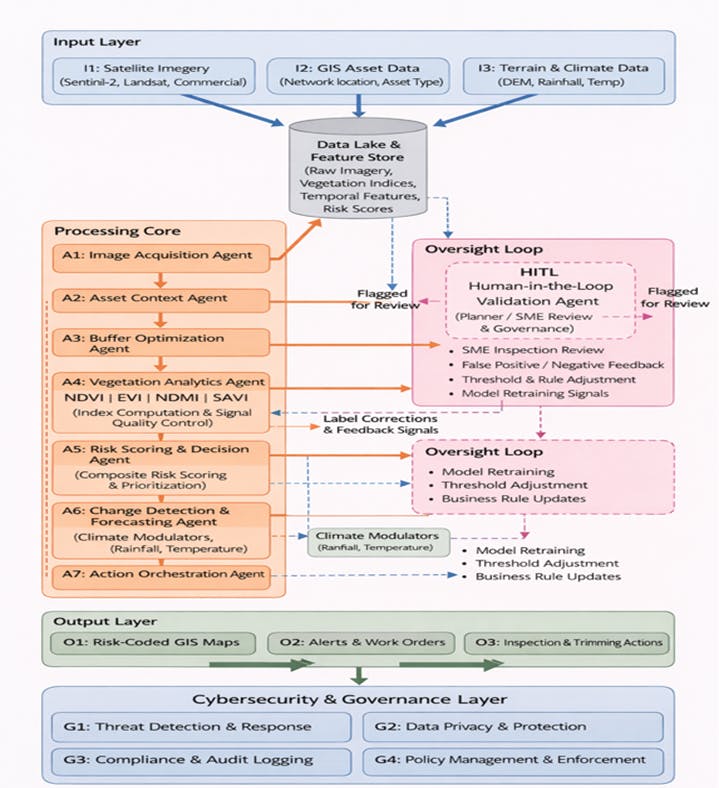
The proposed system architecture is organized as an agent-enabled workflow in which each stage of vegetation monitoring and risk management is supported by specialized AI agents. These agents collaborate across data ingestion, spatial analysis, temporal reasoning, and operational execution, transforming raw satellite observations into actionable maintenance decisions.
a) Image Acquisition Agent
The workflow begins with the Image Acquisition Agent, which serves as the primary interface between satellite data sources and the vegetation monitoring system. This agent continuously monitors the availability of multispectral imagery from public and commercial satellite platforms, including Sentinel-2, Landsat 8/9, and high-resolution commercial providers. It evaluates incoming imagery based on cloud cover, spatial resolution, and revisit frequency requirements, selecting the most appropriate data for each monitoring cycle.
Over time, the agent learns seasonal cloud patterns and regional data quality characteristics, allowing it to optimize source selection and minimize data gaps. When imagery fails to meet predefined quality thresholds, the agent automatically triggers reprocessing workflows or requests alternate data sources. This ensures a reliable and consistent imagery pipeline with minimal manual intervention, forming a robust foundation for downstream analytics.
b) Asset Context Agent
Once imagery is acquired, the Asset Context Agent integrates satellite data with the utility’s geospatial asset information. This agent ingests and validates GIS layers representing transmission lines, distribution circuits, substations, and related infrastructure. It enriches these spatial assets with contextual metadata such as voltage class, vegetation clearance requirements, and historical vegetation-related incidents.
By analyzing asset characteristics and operational context, the agent dynamically classifies infrastructure as transmission or distribution and adjusts subsequent analysis logic accordingly. It also detects inconsistencies in asset geometry or alignment, ensuring spatial accuracy between infrastructure data and satellite imagery. The result is a context-aware analytical environment in which vegetation risks are evaluated relative to the specific characteristics and criticality of each asset.
c) Buffer Optimization Agent
The Buffer Optimization Agent is responsible for defining and refining the spatial corridors within which vegetation risk is assessed. Rather than relying on static buffer distances, this agent dynamically adjusts buffer zones based on terrain slope, vegetation type, asset voltage level, and applicable regulatory standards. During periods of extreme weather or accelerated vegetation growth, buffer parameters can be temporarily expanded to reflect elevated risk conditions.
Through continuous learning, the agent evaluates which buffer configurations yield the most accurate and actionable risk detections, gradually reducing false positives and unnecessary alerts. This adaptive approach results in smarter, more precise risk corridors that better reflect real-world operating conditions.
d) Vegetation Analytics Agent
At the core of the analytical process is the Vegetation Analytics Agent, which computes vegetation indices such as NDVI, EVI, and NDMI within the defined buffer zones. This agent selects the most appropriate indices based on geographic context, seasonal conditions, and vegetation density. For example, it may prioritize EVI in dense forest environments where NDVI saturation can occur, or emphasize NDMI during drought periods to assess moisture stress and fire risk.
The agent continuously evaluates the quality and consistency of index outputs, detecting sensor anomalies or unusual patterns that may require human review. By dynamically adapting index selection and thresholds, the agent ensures that vegetation signals remain reliable, interpretable, and operationally relevant.
e) Change Detection and Forecasting Agent
Vegetation risk is inherently temporal, and the Change Detection and Forecasting Agent is responsible for analyzing how vegetation conditions evolve over time. This agent performs multi-temporal analysis of vegetation indices to identify normal seasonal growth cycles as well as abnormal or accelerated growth trends that may indicate impending clearance violations.
By incorporating climate variables such as rainfall and temperature, the agent improves its ability to forecast vegetation behavior under varying environmental conditions. It estimates the time remaining before vegetation is likely to breach safety clearances, enabling utilities to plan interventions proactively rather than reactively
f) Risk Scoring and Decision Agent
Outputs from the various analytical agents are synthesized by the Risk Scoring and Decision Agent, which computes composite vegetation risk scores for individual asset segments. These scores reflect multiple factors, including vegetation density, growth rate, proximity to infrastructure, asset criticality, and historical incident patterns.
The agent continuously refines its scoring logic based on observed outcomes, learning which risk patterns are most strongly associated with real-world incidents. Importantly, the decision-making process is designed to be explainable, allowing utilities to justify prioritization decisions to regulators, auditors, and internal stakeholders. The result is a transparent and defensible prioritization of vegetation management actions.
g) Action Orchestration Agent
The Action Orchestration Agent bridges the gap between analytics and field operations. When risk thresholds are exceeded, this agent generates alerts and initiates follow-on actions by creating work orders in maintenance and workforce management systems. It recommends appropriate inspection or mitigation methods, such as drone surveys, targeted trimming, or ground inspections, based on risk severity and asset context.
To prevent alert fatigue and operational overload, the agent intelligently bundles nearby tasks, optimizes crew routing, and escalates unresolved risks when necessary. This coordinated approach ensures that analytical insights translate efficiently into real-world action.
h) Human-in-the-Loop Validation Agent
Human oversight remains a critical component of the system, supported by the Human-in-the-Loop Validation Agent. This agent presents explainable insights, visualizations, and recommendations to planners and field supervisors, enabling informed review and decision-making. Feedback from inspections and maintenance activities is captured and fed back into the system, allowing agents to learn from false positives, false negatives, and evolving operational realities.
Through this continuous feedback loop, the system improves accuracy, builds trust among users, and aligns autonomous behavior with utility policies and regulatory expectations
Conclusion
Climate variability, wildfire exposure, and regulatory expectations are increasing faster than traditional vegetation programs can adapt. Utilities that continue to rely solely on reactive inspections will face rising operational risk and cost pressure.
Satellite-based, Agentic AI–enabled vegetation management offers a scalable, defensible, and future-ready path forward. one that aligns reliability, safety, cost efficiency, and compliance in a single operational framework.