


Deep Grid Data, Grid Ground Truth, Trusted State, Digital Twin, Grid Foundation Model
Many new ideas. Many new concepts. Many new terms. I use many of these words in my own posts. I meet them in vendor pitches, keynotes or presentations. I use them in many discussions. With co-workers, industry experts, clients or partners. Quite often I am not sure, what we all really mean by these words or whether we are mixing them up.
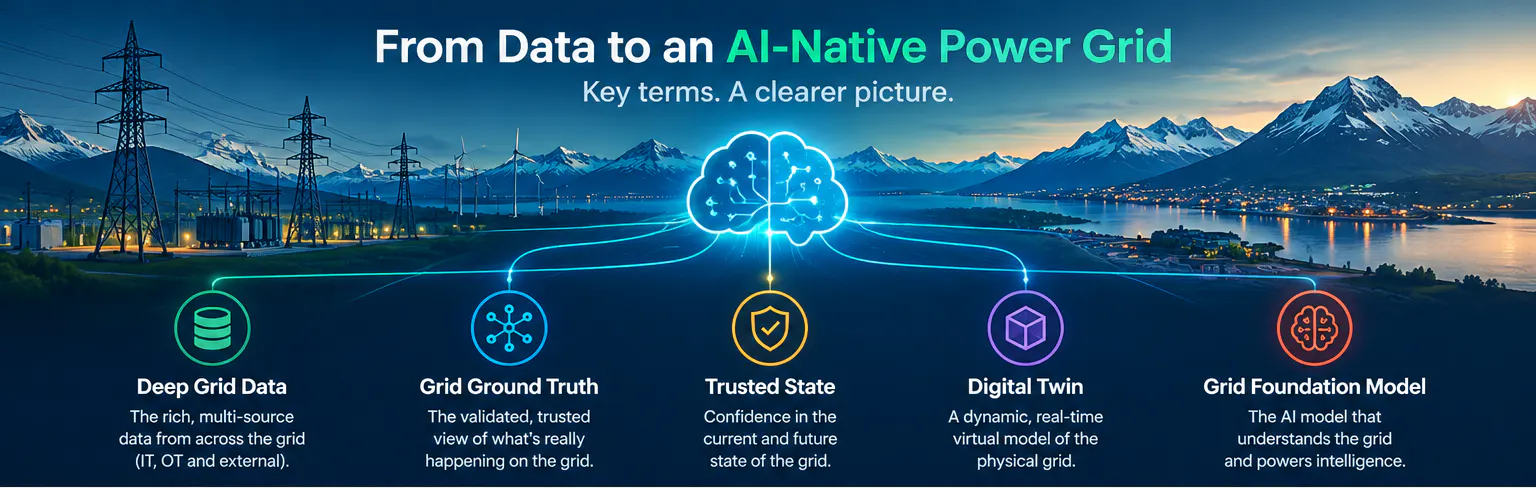
Five of them come up almost the time: Deep Grid Data, Grid Ground Truth, Trusted State, Digital Twin and Grid Foundation Model. They are not the same thing. Each term has its own meaning. But they build on each other and are somehow interconnected. Mixing them up create a real risk for your journey towards the AI-native Power Grid. So let’s try to explain these terms.
Deep Grid Data: what you collect
Deep Grid Data is operational data that carries enough context, physics, time, trust and history or experience, so that AI can both be trained and act on it. It is that deep, so AI can do more than just analyse or crunch it.
Most grid data today, at least from my experience, is shallow. A value or measurement plus a timestamp. Or a meter reading, but no information on the topology. Deep Grid Data adds context: where the value comes from and where it sits in the network, how it was collected or created, which physical laws it has to follow, how it changed over time, how it was manipulated or crunched, and what insight or learnings operators already got from it.
And of course trust. But trust in this context means: can we trust this reading? Is it correct? Is it collected or estimated? Trust like the quality of a single data point or value. We should not confuse this with “Trusted State” which we will look at further down.
Some IT folks or data architects will now say: we have this already. This is what our enterprise data lake is built for. Not sure I would agree. A data lake stores manages (raw) data. Deep Grid Data is about what .else information the data carries. It’s bout the topology context. The physics. The time. The trust. The experience. Putting shallow data into a lake just gives you a lake full of shallow data.
Grid Ground Truth: what you reconcile
Grid Ground Truth is the continuously updated and reconciled record of the network model. It is checked and validated against all sources. Not just against the one source (or business unit) someone historically had defined as the network model master.
The sources are as-built models, as-operated state, historian and real-time live snapshots. Each of them has its own perceived truth. None of them is right on its own. A typical example: the GIS says (or believes) the feeder connects through switch B. In the field it is connected through switch C. And it has done so for the last two years. Nobody ever updated the record. You would only find out the moment you would check the as-planned (GIS) with your as-operated (SCADA, ADMS, EMS) against each other.
And it never stops. The network changes every day. So the mismatch between the different records is getting bigger very day. That is why Grid Ground Truth is not a one-time cleanup project. It is a continuous process.
But two important things the Grid Ground Truth is not:
State estimation: State estimation checks and corrects the measurements aligned with a network model assuming that this model is correct. Grid Ground Truth checks the model itself.
CIM network model: The CIM model is typically one of the sources that Grid Ground Truth is based on. But the CIM model itself does not check itself against the various sources. So it drifts quickly.
Trusted State: what you certify
Trusted State is a certified, time-stamped snapshot of Grid Ground Truth. The validated reconciliation of the network at a given time, with confidence, provenance* and a clearly defined accountable owner. This is the picture, the real picture, of the grid that AI is allowed to reason and act on.
*Provenance in the context of data science and AI: Data provenance is the documented history of a piece of data. It tracks where the data came from, who created or collected it, and every transformation, modification, or movement it has undergone across systems
But why do we need a Trusted State on top of the Grid Ground Truth? Because the Grid Ground Truth changes all the time. The grid is “living”. So think about the Grid Ground Truth as a living record.
But an AI that is supposed to automate grid operations cannot take a decision on something that A) nobody has checked against defined rules and signed off, B) changes while the AI is deciding, or C) cannot be reproduced and audited later.
Trusted State solves exactly these three challenges: A) it is certified with a named owner, B) it is time-stamped, and C) it keeps its provenance.
The trust here is about the correct state of grid at a given time. Trusted State gives you a certified snapshot. And someone who owns it / stand behind it.
Digital Twin: what you simulate
A Digital Twin, at least in my definition, is a model of the network. You use it to simulate, visualise, analyse and test changes before you do them in the real physical grid. A new connection, a switching plan, a storm scenario.
A Digital Twin is useful, for sure. But, and I know I sound negative now, a digital twin for me is more like a smarter tool or more fancy toy. A twin shows what you input to it. You feed it with a wrong topology and it will simulate a wrong grid. But it will simulate this wrong grid very precisely. So yes, a Digital Twin is great for simulations, scenarios, planning. But it is not solving the hard problems: the Trusted State.
And that is exactly the reason why I don’t see a twin as a competitor to Trusted State. The Digital Twin only makes sense when using the Trusted State as input. Or in one sentence: a Digital Twin shows the input. Trusted State certifies the input.
Grid Foundation Model: what you learn
A Grid Foundation Model is a large AI model that is pre-trained on huge volumes of grid data, events, topologies, power flows or time series. Simply spoken, a Grid Foundation Model learns how grids typically behave. Similar to a large language model that learns how languages work.
You can use and adapt a Grid Foundation Model to many different tasks, for example forecasting, power flow approximation or anomaly detection. You can integrate it and orchestrate it in your agentic workflows to build intelligent solutions spawning across different tasks, systems or organizational units.
For training, a Grid Foundation Model learns from Deep Grid Data. The deeper the data, the better the model.
In operation, a Grid Foundation Model should only reason using Trusted State as its input. Like a Digital Twin, if you let your Grid Foundation Model work on an old or wrong picture of the network, it gives you wrong answers. Still, with high confidence.
So, what is then the difference between those two? The Digital Twin calculates from an explicit physical model. The Grid Foundation Model learned patterns from data. It learned how a grid typically behaves in given situations, even without an explicit definition of the physical model. That is its strength, but also its weak spot: rare situations are, by definition, not typical. The Digital Twin is better at explaining why something happens. The Grid Foundation Model is faster and generalises better. I think of them as complements. And both need the same Trusted State underneath.
How They fit together
In one line: Deep Grid Data is what you collect, Grid Ground Truth is what you reconcile, Trusted State is what you certify, and then on top of that, the Digital Twin is what you simulate, and the Grid Foundation Model is what your learn.
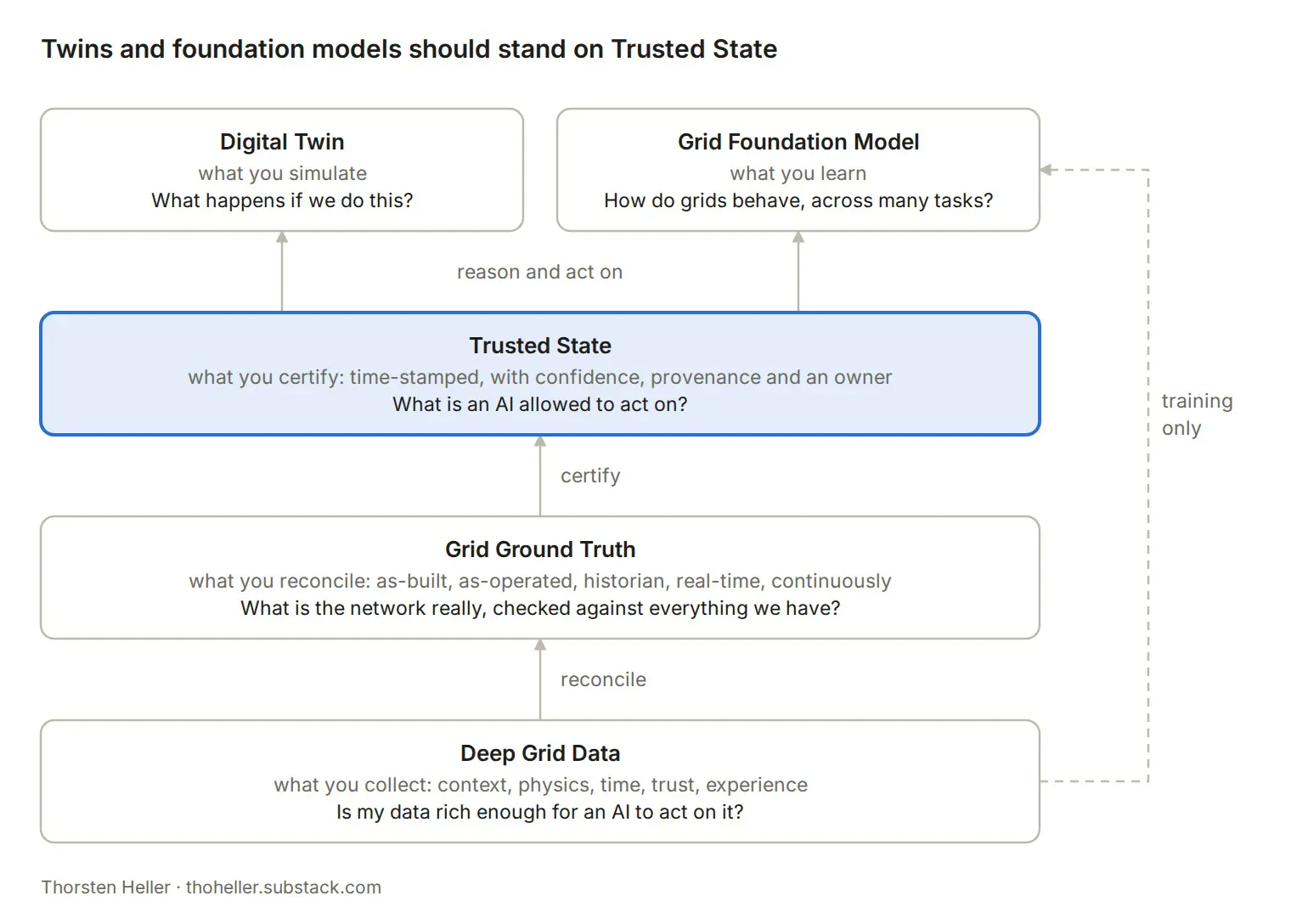
This is my proposed layering to get the terms right. It builds up from collecting Deep Grid Data, reconciling the Grid Ground Truth, certifying a snap-shot into the Trusted State, and then the Dgital Twin or The Grid Foundation Model sitting on top using Trusted State as input.
There is one exception that breaks the layering: For training the model, the Grid Foundation Model goes down directly to access Deep Grid Data. But only for training. When running the Grid Foundation Model in operations, meaning when it acts, it must use the Trusted State like everything else.
And thinking the big picture of an AI-Native Power Grid: On top you have the cognition/control boundary I have written about earlier: where AI moves from reasoning to acting on the grid.
Why the Order is important
Right now, most of the discussions, vendor pitches, keynotes or presentations are focussed on the top of the picture: Agentic workload orchestration, digital twin, grid foundation models. I guess also most of the money goes there.
I get that. Agentic AI, Digital Twin, Grid Foundation Model, they get the headlines. They are visible. They all make great and fancy demos.
But the most important layers, the layers below, the hidden layers, here is where the hard work is. And these layers are often missing or not prioritised.
An AI model can only be as good as the foundation it stands on. So my advice: Build your AI architecture from the bottom!
Disclaimer: This post was originally published on the AI-native Power Grid Newsletter on Substack, but adapted for the Energy Central community.