


AI is impacting utilities both externally, through increased demand for resources from data centers and other technologies, and internally on their operations. Utilities are leveraging AI platforms and solutions to improve their own efficiency and increase safety across their daily operations. But it is not enough to simply adopt these tools. To achieve the desired outcomes, AI must be deployed systematically and responsibly, with humans in the lead and technology guardrails in place.
At CGI, a global technology and professional services company, these safeguards are built into AI platforms from the start. CGI’s industry solutions are safely and responsibly leveraging AI agents to help utilities enhance customer communications, share critical data quickly, address outages faster and increase overall grid reliability.
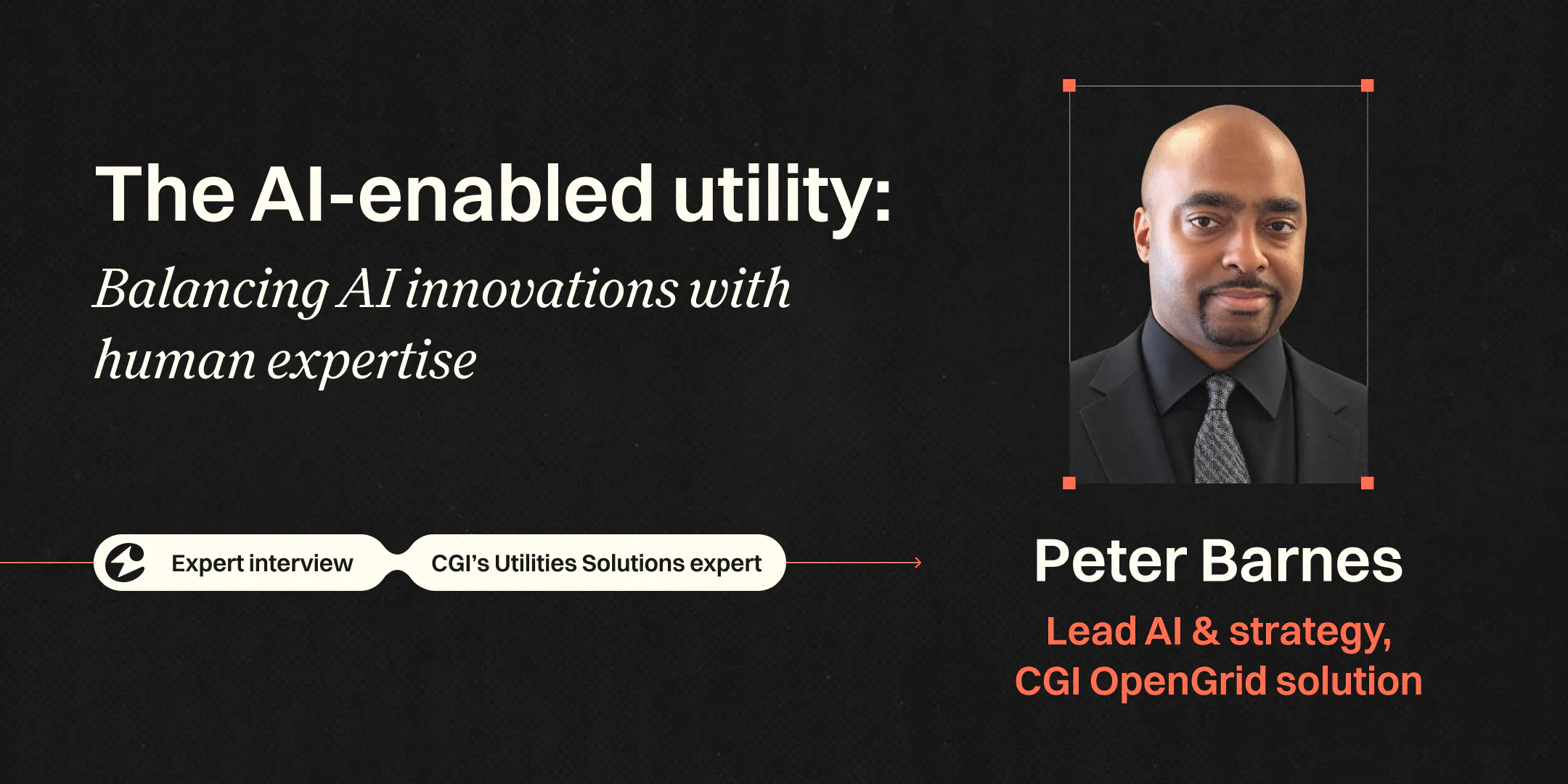
To help us learn more about how utilities can responsibly incorporate AI into their operations, we spoke with Peter Barnes, an expert in CGI’s Utilities Solutions practice.
(This interview has been condensed and edited for clarity.)
Tell me about your background. How did you get to where you are today?
I've been in the utility industry for the last 35 years. I started off doing programming for the original outage management systems, back when there were very few players in that arena. Since then, I really branched into field service management, enterprise asset management, and distributed energy resource management.
Now, I lead AI and strategy for CGI's OpenGrid solution. It's a suite of solutions that helps utilities use data and technology to improve how they manage their networks, assets and field operations.
That's me in a nutshell; 35 years of helping our customers help their customers keep the lights on.
One tool that you’re focused on is agentic AI for utilities. Can you break down exactly what that means?
An agent is a bit of software or a process that uses artificial intelligence to accomplish a task. It could reach out to do research or use available tools to search the web for a keyword or task you have given it. Agentic AI is the coordination of several of these agents into essentially a little task force that goes out and executes the instructions you provide.
What are the benefits of using agentic AI for utilities? Can you walk me through some examples of how they could use this in a day-to-day workflow?
One relatively simple thing the agent can do is scheduling. An agent might be able to observe schedules as you send crews out into the field and rebalance work based on what it's observing in real time. That's an interesting way for utilities to reduce the amount of time it takes to get things done, or to see trends and patterns that an algorithm or a human might not capture.
Another area is asset management. An agent might be able to observe your entire asset portfolio and make smarter decisions about when to maintain or inspect assets based on changing conditions. It might look at how many times a field worker has intervened on a particular device, how many times the weather's been bad, or how many times poles in the vicinity have been replaced due to rotting.
You can even bring in computer vision, where artificial intelligence can actually look at things. Let's say a field technician is doing an inspection and, just barely within their field of vision, there is something that should be fixed. They might not notice it, but computer vision can essentially see the entire field of view. If it finds something that needs to be managed or repaired, the AI agent can generate a work order or inspection order to address it.
Essentially, the agents can handle all this background processing to review everything going on and collaborate on which work should be prioritized and initiated quicker. One agent can go out and read information, another can look at the 10 years of history in the database, and another can check to see if there are any new customer calls or jobs that have come in. Those agents are collaborating in the same way that humans would.
When you talk to utilities about using these tools, what has the response been like?
Utilities have been incredibly open to it. They are excited about the use of AI, but with that excitement comes the necessity for risk management.
There are all kinds of guardrails you need to put in place, and at CGI, we have established a responsible AI framework to help you do just that. It is a single guiding light for responsible use of artificial intelligence with humans in the loop, so that it doesn't just go off by itself and create chaos.
With our secure agentic framework and platform, industry solutions can connect to AI agents with security-first, role-based access control to ensure the agents are doing only what is authorized. In addition, we can connect databases, providing access to the corpus of everything that has been stored about assets and the utility's data.
Our platform allows utilities to use ChatGPT, Claude and Co-pilot, or use local models and have it all installed in their own data center or in the cloud, without having to constantly reach out to the internet to send their questions or documents.
What would you say to someone at a utility who might not trust this software?
Trust is the most important part of leveraging these agents. Observability is really the key: How did this agent come to its decision? You, as the utility, need to understand how those decisions were reached and where there's room for correction. And you need an easy method of making those corrections. Getting utilities to a level of trust that allows some transactions to happen is a major focus for the industry and for us at CGI.
Another area of trust comes from security. Security needs to be built in from the beginning. Security, including governance, is one of the most important priorities because ungovernable AI pilots can be highly problematic. One way to ensure governance and security is to maintain a “human in the loop” approach, especially when it comes to actually making the decisions. There are some decisions, let's say, when you're talking about network management, that you don't necessarily want AI to make. To be truly responsible, having a human in the loop and the right governance in place will be paramount.
At CGI, we are helping organizations look at these processes and establish the right frameworks and approaches to ensure trust. Utilities know that AI is the future, and we are working to help them safely and effectively realize its benefits.
On the workforce side, what could this mean for utility workers? What would you say to those who might be concerned that AI agents will impact their roles?
I see AI as a force multiplier, with humans and technology working together to help utilities get the lights back on quicker and safer. It also helps utilities reduce their overall costs by ensuring they don't roll unnecessary trucks or schedule inspections too late.
Our philosophy of responsible AI keeps humans in the loop throughout the processes. There are utility functions that currently rely on local knowledge. They rely on the fact that someone has been a dispatcher for 20 years, or that someone has been doing this task and optimizing things this way for that long. AI can be the tool that collects and leverages the local knowledge from dispatchers, field technicians, supervisors, and planners to operate effectively.
Utilities can also use AI to write documents that previously required a lot of manual labor. Field technicians can just speak to the AI in natural language and have it fill out documentation directly in the field, without losing notes in their trucks or forgetting specific details.
AI is meant to augment the way humans work and are informed, not to replace them. It's really about being able to monitor everything that's going on and provide the best next action to dispatchers, field technicians, supervisors, and planners.
Can you talk about how CGI’s agentic AI was developed specifically for utility purposes?
The use cases come from looking at utility operations and seeing where efficiencies can be realized, processes improved, and where more situational awareness or background knowledge would be helpful without having to look it up yourself. That’s where we are focused: defining those utility agentic AI use cases and how we can bring them to utilities in a safe and reliable way.
It seems like this all depends on access to certain data. What steps would need to happen for that data to be available and incorporated into these models for utilities?
There are standard methods for gathering data from SCADA and smart metering to use in forecasting and in general network performance analysis. There is a lot of potential data we can capture and aggregate, but security has to be the paramount driver.
I think utilities will become more focused on keeping this data local to their own data center. With the potential for bad actors to use agents, it’s increasingly important to minimize the data sent out into the wild, ensuring it’s all kept within the utility's boundaries.
What’s the major takeaway for utility executives?
This is a fascinating time to be living in. It is absolutely next-level, almost a science-fiction kind of time. It's extremely exciting from a technological perspective, and I'm personally very enthusiastic about what we can bring to bear for utilities as we move forward. The key is doing that responsibly by keeping humans in the loop, protecting the data and focusing on where AI can make a real difference in the work.