


As a distribution engineering manager, I had a problem that kept me up at night: we were frequently playing catch-up with customer load additions. A homeowner would install a Level 2 EV charger, upgrade from gas heat to a heat pump, or add an electric water heater, adding load we were simply unaware of. Sure, each was just a few kW here and there. But, multiplied across individual service runs and transformers sized decades ago, you're looking at real invisible load growth. As a result, we found out the hard way, with power quality problems or when an undersized transformer gave up. This created a costly and irritating unplanned outage and a rush to fix it, often on overtime.
Fast forward to today, and this visibility challenge has gone from annoying to mission-critical. With electrification policies driving everything from vehicle charging to building heating, utilities can't afford to be reactive anymore.
These types of load additions require an electrical permit, but don’t necessarily trigger a conversion to the utility. The good news? There's finally a better way to get ahead of these changes.
That's why I got excited when Shovels, a company using AI to make sense of building permit data from thousands of municipalities nationwide, launched in the Esri Living Atlas. Living Atlas is a massive data repository accessible to all Esri ArcGIS customers.
I had a chance to sit down with Ryan Buckley, CEO of Shovels, to dig into how permit data can help utilities actually see around corners for once and plan distribution upgrades before the equipment fails.
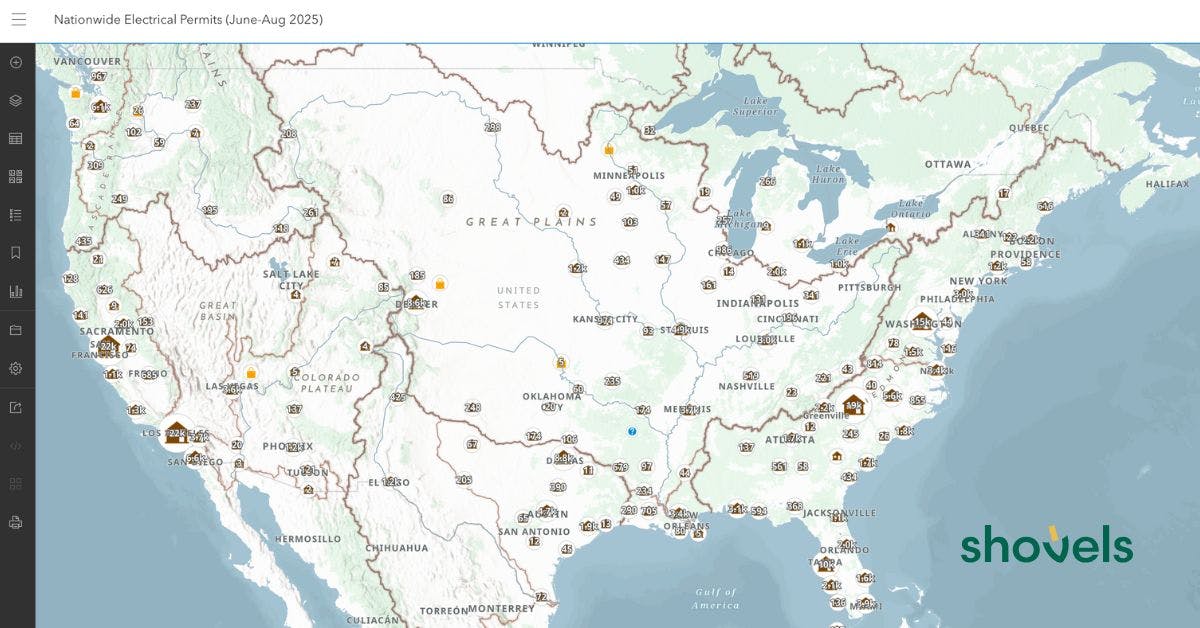
Shovels Nationwide Electrical Permits (June-Aug 2025) layer. Permit categories include: battery, electric meter, EV charger, and solar.
Pat Hohl: The lack of visibility into customer electrification has been a pain point for utilities for years. How did you decide this was an area Shovels could help?
Ryan Buckley: The problem has only gotten more acute. Utilities are planning for massive changes to the grid, including vehicle electrification. Utilities are often flying blind. They're mostly cobbling together data from DMV records, trying to get information from car dealers, and offering incentive programs to get customers to self-identify. It's a lot of work for incomplete data.
The real issue is that utilities don't actually need to know if someone bought an EV, they need to know if someone is going to charge it at home. And when they do, it's almost like adding another house to that property in terms of electrical load. That's the signal that matters for system planning.
Pat Hohl: So how does building permit data help solve this, and what exactly does Shovels do to make the information actionable?
Ryan Buckley: Everything that changes the electrical load at a property requires a permit. EV charger installations, heat pump upgrades, panel upgrades, pool equipment, it all shows up in the permit record. The challenge has always been that permit data is incredibly fragmented. There are thousands of jurisdictions, each with its own formats, terminology, and systems.
We use AI to collect, clean, and standardize this data from municipalities across the country. Our platform processes permits into a consistent format with clear classifications; you can see exactly where EV chargers are being installed, where heat pumps are going in, what type of electrical work is happening, and where.
Pat Hohl: You're now in the Esri Living Atlas. For utilities that use ArcGIS for network management, this makes your information very accessible.
Ryan Buckley: It's an easy button. Every utility we talk to asks the same question: "How does this plug into our existing Esri maps?" Now they don't have to integrate anything or set up new systems. The data is already available in the Esri Living Atlas. They can add it to their maps with a few clicks and start analyzing where electrification is happening in their service territory.
Our sample layer focuses on electrical permits so utilities can see the density and types of electrical work across different areas. You can filter down to specific subcategories: just EV chargers, just heat pump installations, whatever matters most for your planning needs.
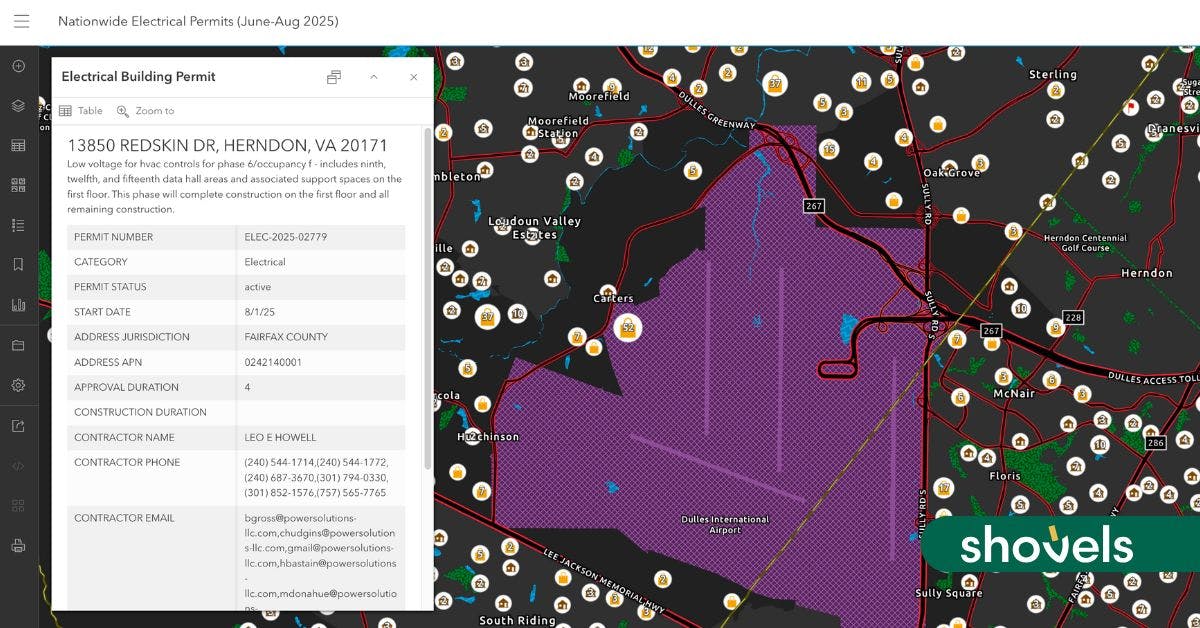
Deep dive into permit details, including address information, permit descriptions, statuses, dates, contractor info, and more.
Pat Hohl: What's unique about your approach compared to other data sources that utilities might use?
Ryan Buckley: We're capturing the actual building activity at the hyperlocal level—the specific address where work is permitted. This isn't proxy data, surveys, or opt-in programs. It's a comprehensive coverage of permitted electrical work across your service territory.
The other advantage is that we're forward-looking. Permits are filed before the work happens, so you're seeing signals of load changes before they hit your system. That gives you time to plan reinforcements, identify transformer upgrades, or prioritize where to focus your system load and upgrade efforts.
Pat Hohl: Who do you anticipate would benefit most from this type of visibility?
Ryan Buckley: We're seeing interest from several groups. System planners use it to understand where electrification is clustering and plan proactive upgrades. Engineering teams use it to validate capacity models and identify potential overload risks. And increasingly, operations teams are using it to correlate known permit activity with service issues or planned maintenance.
The common thread is that everyone needs to see the same thing: where is our system being stressed by new electrical loads, and how can we stay ahead of it?
Pat Hohl: What should utilities do next if they want to explore this?
Ryan Buckley: Start by checking out our layer in the Esri Living Atlas. From there, we can talk about deeper integrations, such as pulling the whole dataset into their GIS workflows, setting up automated alerts for high-activity areas, or layering in our contractor data to understand who's doing the work.
The key insight is that this data already exists; we've just made it accessible and usable for utility planning.
Pat Hohl: Thanks for sharing how you're helping utilities gain visibility into electrification trends. Where can readers learn more?
Ryan Buckley: Visit us at shovels.ai or check out our Esri Living Atlas feature layer directly in ArcGIS. We're always happy to walk through specific use cases and show how permit data can support your system planning efforts.
Ryan Buckley is the CEO and co-founder of Shovels, where he leads the company's mission to turn fragmented public records into standardized intelligence for the built world. Prior to founding Shovels, Ryan worked in public policy and data analytics. You can reach him at [email protected].