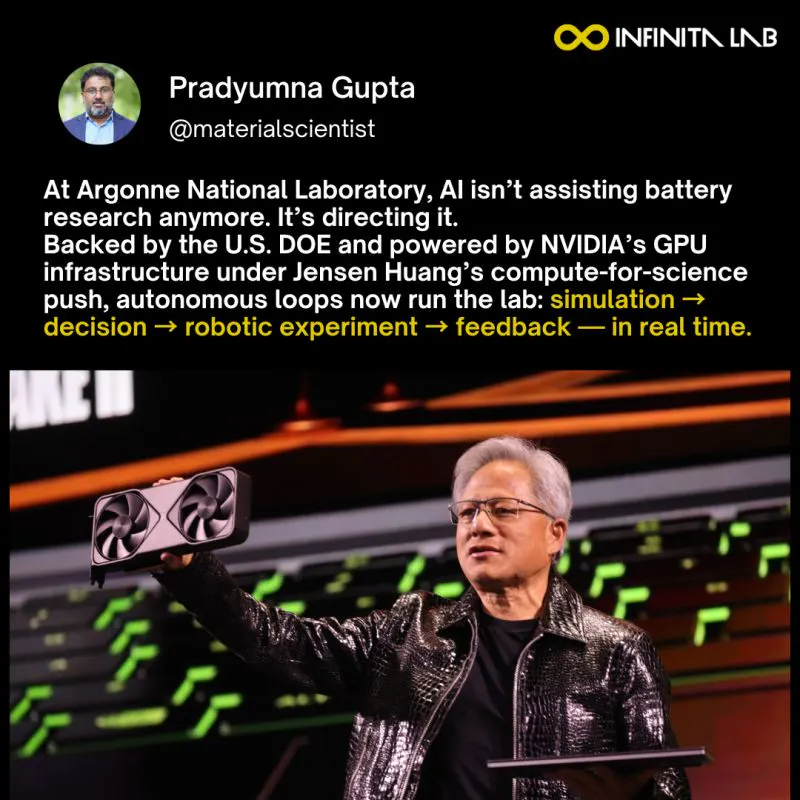
This is the continuation of a pattern we’ve been tracing... from AI breaking explainability, to databases becoming discovery engines, to GPUs becoming the lab.
Now it’s showing up physically, on the lab floor.
AI + Robotics are no longer assisting battery research at U.S. national labs.
They are running it.
At Argonne National Laboratory, battery discovery has crossed a threshold.
AI models don’t just predict promising cathodes or electrolytes. They direct robotic experimentation in real time. Synthesis parameters, cycling protocols, failure tests, even next-material selection are decided algorithmically as data streams in.
This closes the loop we’ve been talking about:
simulation → data → decision → experiment → feedback.
Why this matters in 2026:
Battery demand is now driven by grid-scale storage, data centers, and cobalt-light chemistries. The design space is too large, too coupled, and too fast-moving for intuition-led discovery.
This is exactly where Jensen Huang’s compute-for-science strategy and the DOE’s investment in exascale + automation converge. GPUs aren’t accelerating individual calculations — they’re orchestrating entire research programs.
The deeper shift senior materials scientists must internalize:
Our value is no longer in guessing the right material.
It’s in designing the search space, constraints, and learning loops.
This isn’t a productivity boost.
It’s a structural transformation of materials science itself.
And once research becomes system-driven, labs that don’t reorganize around AI + robotics won’t just move slower... they’ll fall out of the game entirely.
hashtag#MaterialScience hashtag#Innovations hashtag#AI hashtag#Robotics