

Nokhum Markushevich
The effectiveness of var priority mode of advanced inverter’s VVC for increasing voltage was considered in [1]. In this article, we will briefly discuss the efficiency of the var priority mode used for reducing voltage and compare it with the use of this mode for increasing it.
In the former case, the changes of the DER’s kW and kvars affect the voltage in the same direction: both reduction of kWs and reduction of injection of kvar reduce the voltage. In the latter case, the changes of the kWs and kvars affect the voltage in different directions: reduction of kW reduces the voltage, while increase of kvar injection increases the voltage.
Another difference is based on the notion that the available DER’s kvars are limited by the AC current of the inverter. In this case, going from a lower voltage at the DER’s terminals to a higher voltage increases the available kvars, while going from a higher voltage to a lower lowers the available kvars.
In many publications, it is assumed that the advanced inverters are limited by the DER’s kVAs. In this case, the change of the available kvars depends only on the change of the DER’s kWs.
Table 1 present a sample case for increasing voltage. The reactance/resistance (x/r) ratio of the upstream from DER circuit is 1.5, which may be consistent with a mix of overhead primary distribution and underground secondaries. It is assumed here that a low voltage (0.94 pu) is present at the DER’s terminals at different initial kWs of the DERs, and the voltage should be increased from 0.94 pu to, at least, 0.95 pu by reducing the corresponding initial kWs of the DER to utilize the increased available kvars.
Table 1. Changes of available kvars and voltages, when the priority mode is used to increase voltage from 0.94 pu by reducing DER’s kW by 5% of rated kW from different initial kWs.
Initial DER
kW, %
Change of available kvars, %
Voltage change due to 5% kW reduction, pu
Based on kVA limit
Based on Amp limit
Based on kVA limit
Based on Amp limit
100
12.5
39.7
0.010
0.038
95
9.3
16.9
0.006
0.014
90
7.5
11.2
0.004
0.008
85
6.3
8.6
0.003
0.005
80
5.4
6.9
0.002
0.004
75
4.8
5.8
0.001
0.003
70
4.2
4.9
0.001
0.002
65
3.7
4.2
0.000
0.001
60
3.3
3.6
0.000
0.000
55
2.9
3.1
0.000
0.000
As seen in Table 1, the increase of voltage by 0.01 pu (from 0.94 pu to 0.95 pu) is possible only if the initial DER’s kW is 100% in the case of the kVA limit, and is above 90% in the case of Amp limit. It means that the var priority mode is expected to be more efficient, if the Amp limit is assumed. However, is less likely that the low voltage occurs when the kW injection of the DERs is at maximum.
Table 2 present a sample case for reducing voltage from 1.06 pu to, at least, 1.05 pu. The X/R ratio of the upstream from DER is the same.
Table 2. Changes of available kvars and voltages, when the priority mode is used to reduce voltage from 1.06 pu by reducing DER’s kW by 5% of rated kW from different initial kWs
Initial DER
kW, %
Change of available kvars, %
Voltage change due to 5% kW reduction, pu
Based on kVA limit
Based on Amp limit
Based on kVA limit
Based on Amp limit
100
12.5
6.9
-0.017
-0.011
95
9.3
5.7
-0.013
-0.010
90
7.5
4.9
-0.011
-0.009
85
6.3
4.3
-0.010
-0.008
80
5.4
3.8
-0.009
-0.007
75
4.8
3.3
-0.008
-0.007
70
4.2
2.9
-0.008
-0.007
65
3.7
2.6
-0.007
-0.006
60
3.3
2.3
-0.007
-0.006
55
2.9
2.0
-0.007
-0.006
As seen in Table 2 , the reduction of voltage by 0.01 pu (from 1.06 pu to 1.05 pu) is possible if the initial DER’s kW is above 85% in the case of kVA limit and is above 95% in the case of Amp limit. It means that the application of the var priority mode promises a better efficiency under the assumption of kVA limit.
The need in mitigation the overvoltage is more likely when the DER kW injection is at its maximum.
One of the major conditions affecting the efficiency of the var priority mode is the x/r ratio of the upstream from the DER circuitry.
Figure 1 and Figure 2 show a sample comparison between the effects of the var priority mode for two x/r ratios: 1.5 and 4.0. As seen in the figures, the mode has greater effect under a greater x/r ratio.
As seen in Figure 1, the increase of voltage by 0.01 in case of x/r = 4 is possible when the initial DER’s kW is above 90% in the case of the kVA limit, and is above 75% in the case of Amp limit (compare with 100% and 90% under x/r=1.5 respectively).
As seen in Figure 2 , the reduction of voltage by 0.01 is possible if the initial DER’s kW is above 75% in the case of kVA limit and is above 90% in the case of Amp limit (compare with 85% and 95% under x/r=1.5 respectively).
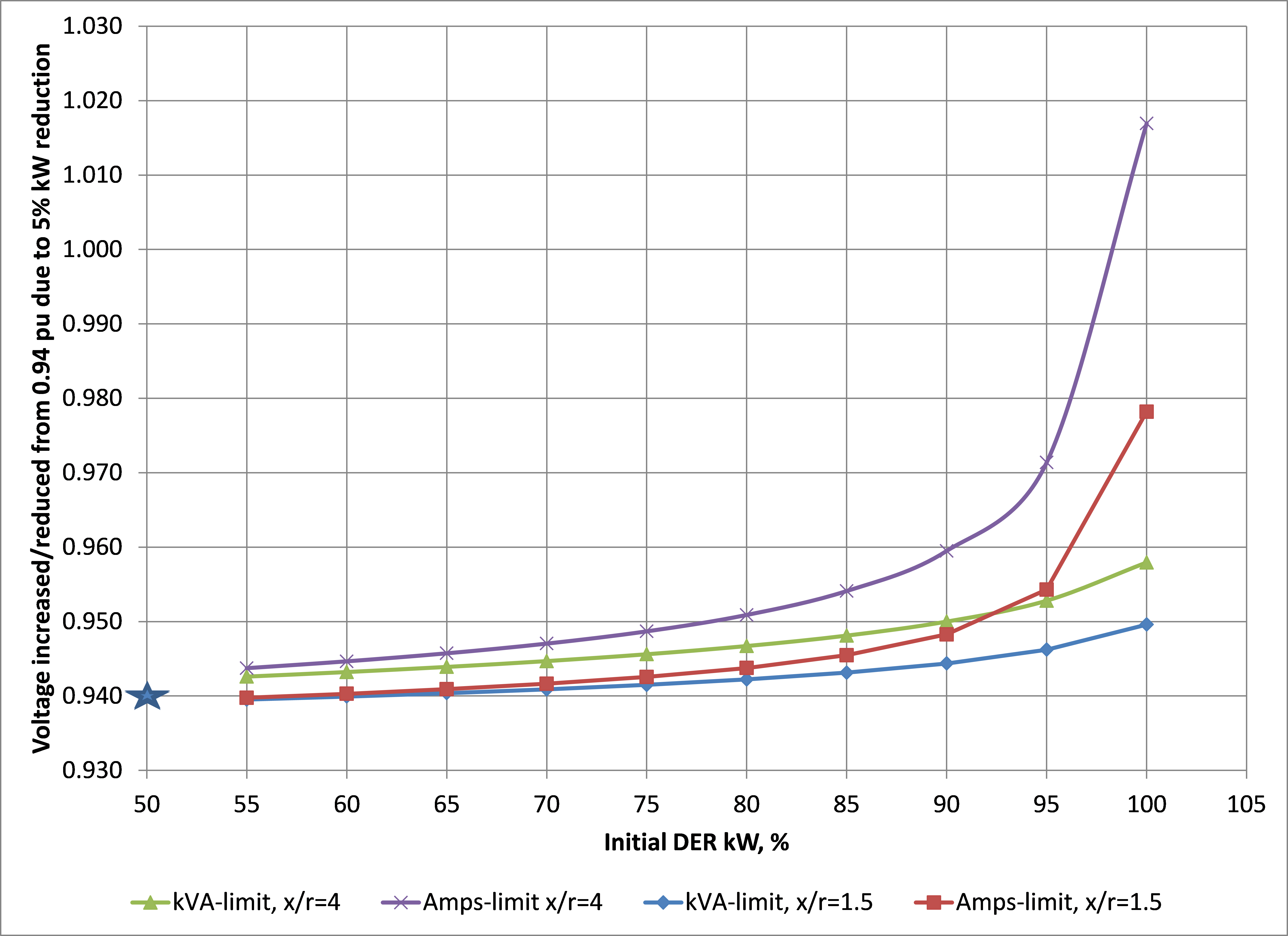
Figure 1. Voltage increase from 0.94 pu due to 5% kW reduction of DER’s injections for x/r ratio 1.5 and 4.
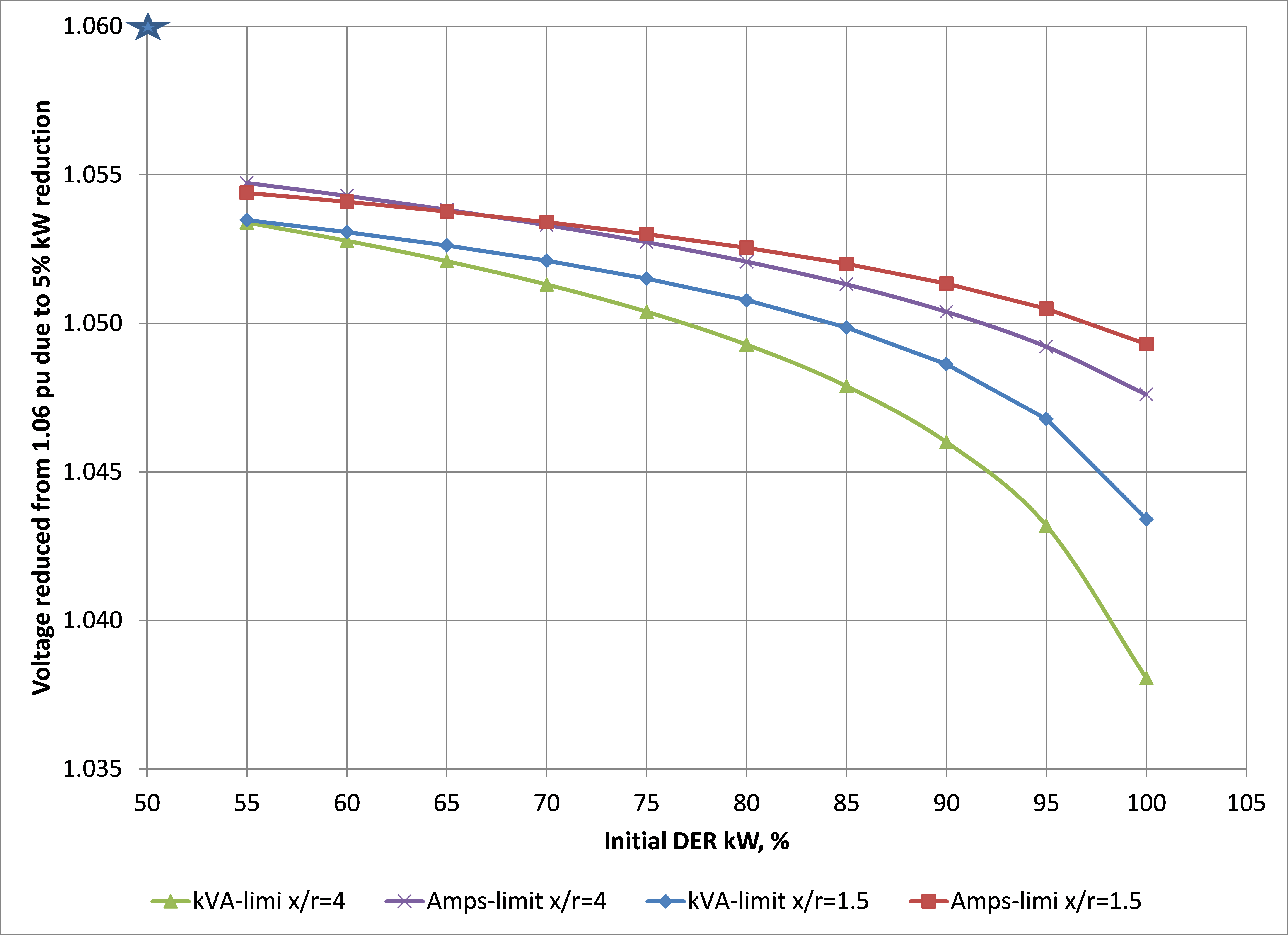
Figure 2. Voltage reduction from 1.06 pu due to 5% kW reduction of DER’s injections for x/r ratio 1.5 and 4.
In some cases, the overvoltage may result from reverse power flow caused by DERs without advanced inverters. In these cases, the overvoltage can be mitigated, predominantly, by curtailing these DERs, if possible. Other DERs with advanced inverters may contribute lo lowering the voltage in the critical nodes by using var priority mode, depending on their allocation in the circuit and other relevant conditions.
Many other operational and circuit conditions, which may change in different timeframes, affect the efficiency of the var priority mode [1]. Therefore, with the advances of the Active Distribution Networks, adequate information exchanges between major actors of these networks and timely processing of this information should be provided. Some of these issues were addressed in [2] – [6].
Conclusions.
The var priority mode is more effective for mitigating overvoltage than undervoltage.
The different assumptions about the constraints of the advanced inverters may significantly influence the expected effect of the var priority mode.
In order to take into account all necessary factors to efficiently apply the var priority mode in Active Distribution Networks, adequate information exchanges between the major actors involved in a DMS and their timely processing should be provided.
Reference.
Nokhum Markushevich, Var-priority Mode of DER Volt/var Control Function. Available: https://www.energycentral.com/c/ee/var-priority-mode-der-voltvar-control-function.
Information Exchange between Advanced Microgrids and Electric Power Systems. Available: https://www.scribd.com/document/376567099/Information-Exchange-between-Advanced-Microgrids-and-Electric-Power-Systems
Use cases, microgrids, IA use cases, Available: http://smartgrid.epri.com/Repository/Repository.aspx/
What will the Microgrids and EPS Talk about? Part 1. Available: http://www.energycentral.com/gridtandd/gridoperations/articles/2858
What will the Microgrids and EPS Talk about? Part 2. Available: http://www.energycentral.com/gridtandd/gridoperations/articles/2864
Nokhum Markushevich, Transmission Bus Load Model for Smart Distribution and Transmission Grids. Available: https://www.energycentral.com/c/iu/transmission-bus-load-model-smart-distribution-and-transmission-grids

