


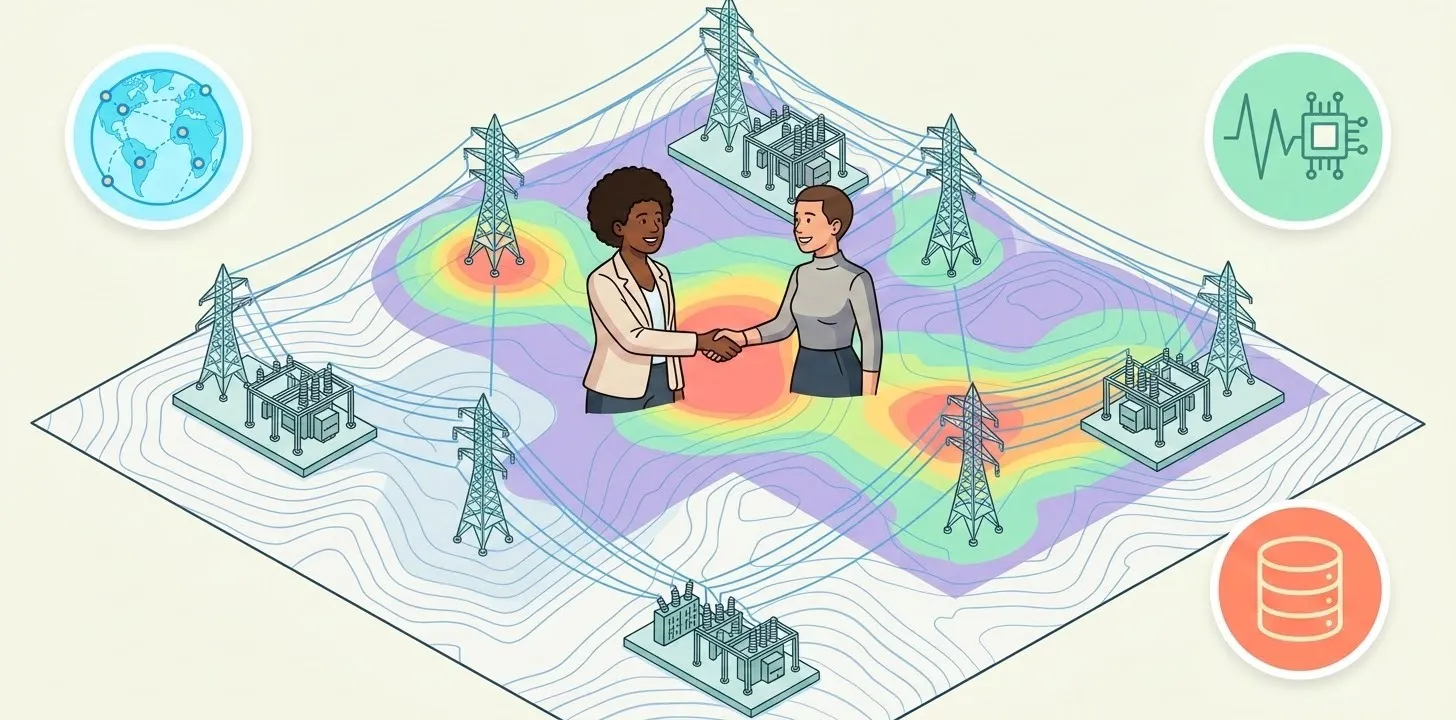
A professional and technical visual representing the convergence of electric utility grids and GIS, now including a central concept of two diverse people in professional attire shaking hands to symbolize collaboration. The image features a stylized, modern power grid network with transmission lines and substations. Overlaid on this network are vibrant, semi-transparent data visualization layers including heat maps for congestion, topographic contours, and digital icons representing spatial intelligence and power system analysis. The aesthetic is futuristic and precise, with a dark blue and teal color palette.
I have been fortunate to have had some remarkable influences in my career. Two stand out.
The first was my college professor, Homer Brown. He taught power system analysis using computers. What made him unique was that he wasn't just teaching algorithms; he invented one of them, the Z-Matrix method for short-circuit analysis, which is still used today. Homer sparked my fascination with power system modeling and the idea that computers could help us better understand how the grid behaves. Later, I ended up teaching many of these same algorithms.
The second influence was Esri President Jack Dangermond. Jack's vision was that GIS was never really about maps. It was about understanding relationships and helping organizations make better decisions. For me, those organizations became electric utilities.
For most of the industry's history, power system analysis and GIS have lived in separate worlds. Engineers built models to understand power flows, fault currents, and system reliability. GIS provided geographic context. The two occasionally met when network data was exported into engineering software, but that was about it.
Today, that separation no longer makes sense.
A New Approach
The industry is facing a fundamental shift. The grid deals with a stampede of interconnection requests driven by renewables, battery storage, data centers, electrification, and artificial intelligence infrastructure. At the same time, utilities are facing an onslaught of wildfires, flooding, severe storms, and extreme heat. The grid is becoming more stressed, more interconnected, and more difficult to plan.
Traditional approaches are struggling to keep up.
For years, interconnection studies focused on a simple question: Can this project connect to the grid?
That is still important, but it is no longer enough.
A better question is: How does this project influence the grid, and how does the grid influence the project?
Consider a large solar facility. Its output may flow across transmission lines hundreds of miles from its point of interconnection. Some of those facilities may already be congested. Others may cross regions vulnerable to wildfire, flooding, or extreme weather. Likewise, a large data center may create impacts far beyond the substation where it connects. Its demand may influence transmission loading, generation dispatch, and reliability conditions across an entire region.
These relationships are real, but they are often hidden inside engineering studies and planning models.
This is where I believe GIS, along with its GeoAI capabilities, and traditional power system analysis can come together in a transformational way.
Electricity Does Not Flow Along a Single Path
One of the most useful concepts in transmission planning is the Power Transfer Distribution Factor, or PTDF. PTDFs help us understand how power actually moves across a network. They remind us that electricity does not travel along a single path. It spreads across the system according to the network's connectivity and electrical characteristics.
Utilities have used PTDFs for years to understand congestion and transmission impacts. What GIS brings to the table is the ability to place those electrical relationships into geographic context.
A transmission line several hundred miles away may carry a meaningful portion of a generator's output. A transformer in another state may become a limiting factor for a proposed data center. A wildfire-prone corridor may be critical to delivering power between a resource and a load center.
Those are not just engineering relationships. They are geographic relationships as well.
Using GIS, utilities understand geography. They know where assets are located. They know where development is occurring. They understand environmental risks.
What has been much harder to visualize is how electrical influence spreads across the network and intersects with those geographic realities.
By combining load-flow analysis, PTDFs, GIS, and the ArcGIS Utility Network, utilities can begin to see those relationships in entirely new ways.
This is where GIS’s GeoAI capabilities and ArcGIS Utility Network become interesting. They can help identify patterns, dependencies, and risks that may not be obvious when information is scattered across multiple systems and reports.
Imagine combining transmission analysis results with interconnection queues, congestion history, asset condition data, weather forecasts, wildfire risk, flood exposure, and land-use trends within a common geospatial framework.
Suddenly, questions become easier to answer.
Which facilities are most critical to a project's success? Which environmental risks threaten key delivery paths? Which future projects may compete for the same transmission capacity? Which constraints are likely to emerge before they show up in a formal study?
Supporting the Future Grid
The future grid will be shaped by interactions between generation, load, transmission, geography, climate, and infrastructure risk. Understanding individual projects will remain important, but understanding how those projects influence one another across the network may become even more important.
Homer Brown helped me understand the physics of the grid.
Jack Dangermond showed me how geography can help us better understand the world.
The next step is bringing those two ideas together.
When electrical and geographic intelligence converge, utilities gain a new perspective on the grid, not simply where assets are located, but how they influence one another. One great example is a large transmission operator (which I am not permitted to name) that has integrated real-time EMS data into its GIS within the control room. Dispatchers value the ability to view their operations in a geographic context. While they do not dispatch directly from the GIS, it enables them to uncover insights and relationships that would not be apparent from the EMS alone.
That may be one of the most important opportunities GeoAI brings to the future of utility planning.
For more information on how GIS can transform the grid, visit the GeoAI and ArcGIS Utility Network websites.