


Thermodynamic Geoengineering and the case for energy-first thinking
Published originally Substack.
For the past decade, artificial intelligence has been sold as the master key to humanity’s biggest problems: climate change, productivity stagnation, and even governance itself. We are told that smarter algorithms will optimize energy systems, squeeze inefficiencies from infrastructure, and somehow allow us to grow without consequences.
This framing gets the causality backward.
Civilizations are not built on intelligence alone. They are built on an energy surplus. Always have been. And no amount of artificial intelligence can replace the thermodynamic reality that every computation, every optimization, and every act of “intelligence” consumes energy, and ends as waste heat.
The real question is not how AI can save the energy system.
It is whether the energy system can support AI without collapsing the climate system that sustains us.
Energy Comes First—Always
History is unambiguous. Every major leap in human complexity followed a rise in available energy:
· Agriculture followed stored solar energy.
· Industry followed fossilized solar energy.
· Electrification followed scalable thermal engines.
· Digital society followed cheap, dispatchable electricity.
Intelligence, human or artificial, amplifies energy. It does not replace it.
This is why today’s AI boom is colliding head-on with physics. Data centers do not merely require electricity; they concentrate energy use in space and time. They convert near-perfect electrical power into near-total waste heat. When deployed at scale, they are not “virtual” systems; they are thermal machines embedded in the climate system.
And that system is already overheating.
The AI–Energy Paradox
We now face a paradox that policymakers are reluctant to name:
· AI is being promoted as a climate solution
· AI is simultaneously accelerating energy demand faster than decarbonization can respond
Training frontier models, operating hyperscale inference clusters, and supporting always-on digital infrastructure require continuous, high-density power. Intermittent sources fail. Storage scales poorly. Nuclear is slow. Fossil fuels remain the default backstop—and every joule ends as heat.
No optimization algorithm can change that.
Efficiency gains are quickly consumed by scale. Lower cost per computation leads to more computation, not less. This is not a moral failure; it is a thermodynamic one.
The Real Scarcity Is Not Intelligence—It’s Heat Rejection
The planet does not care whether energy is labeled “green” or “dirty.” What matters is where the heat goes.
Global warming is not primarily a carbon problem. It is a heat-accumulation problem, buffered by the oceans and released on timescales far longer than political cycles. Even if emissions stopped tomorrow, ocean heat would continue to drive sea-level rise, extreme rainfall, and ecological stress for centuries.
This is the blind spot in most AI-for-climate narratives. They assume the challenge is managing emissions, grids, or markets. In reality, the challenge is managing planetary heat flows.
And that requires infrastructure that operates at the same scale as the problem.
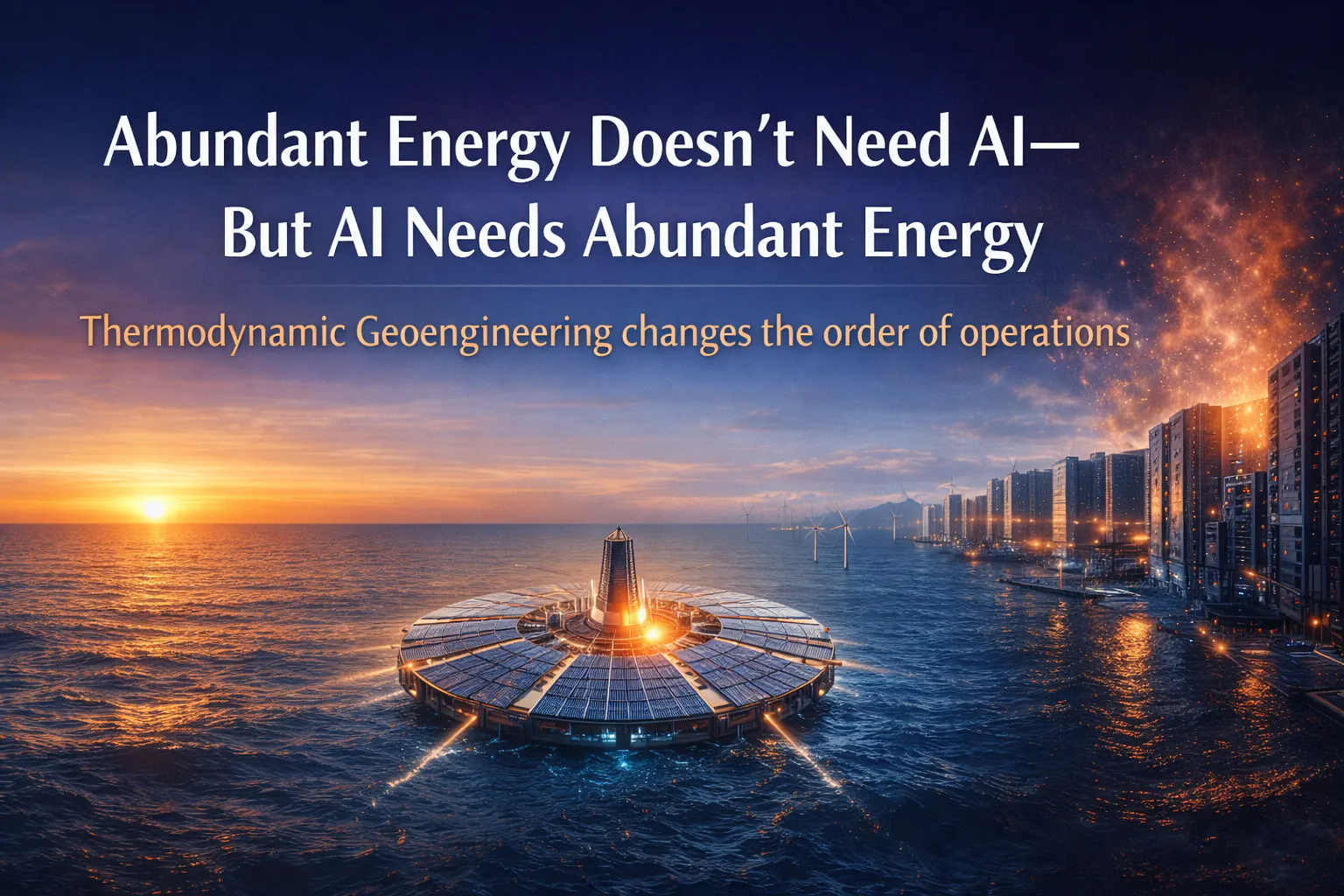
Thermodynamic Geoengineering: Energy Abundance by Design
Thermodynamic Geoengineering (TG) begins with a different premise:
If excess heat is the problem, treat it as a resource.
By converting the ocean’s accumulated thermal energy into electricity, hydrogen, and other practical work, while physically moving heat to the deep ocean.
TG addresses both sides of the equation:
· It creates massive, continuous energy abundance
· It directly cools the surface climate system
This is not speculative physics. It is classical thermodynamics applied at a planetary scale.
Crucially, TG does not require AI to operate. Heat engines worked before computers. They will work after them. The system is grounded in first principles, not algorithms.
But once energy becomes abundant, stable, and effectively negative-cost?
That is when AI becomes transformative rather than extractive.
What AI Becomes in an Abundant-Energy World
In a constrained energy system, AI is forced into triage:
· Which demand gets power?
· Which emissions are tolerated?
· Which sink absorbs the heat?
In an abundant energy system, AI’s role changes completely.
It becomes:
· A systems optimizer, not a rationing tool
· A scientific accelerator, unconstrained by compute scarcity
· A planning instrument for infrastructure, ecosystems, and adaptation
· A coordination layer for global heat-management systems
AI does not need to be “efficient” when energy is cheap and clean. It can be thorough. It can explore solution spaces that are currently off-limits because computation is expensive, and power is scarce.
Abundance unlocks intelligence—not the other way around.
Why This Order Matters
Reversing the order, deploying AI first and hoping energy catches up, locks us into a dangerous trajectory:
· Rising electricity demand
· Persistent fossil backup
· Accelerating waste heat
· Increasing climate instability
We are already seeing this tension in proposals to move data centers offshore, underground, or even into space, attempts to dodge heat rather than deal with it.
TG confronts the problem directly: move the heat, don’t hide it.
The Choice Before Us
We can continue to believe that more intelligent software will overcome physical limits. Or we can accept that physics sets the boundary conditions, and that intelligence operates within them.
Energy abundance does not require AI to exist. But AI, to be genuinely beneficial at a civilizational scale, requires abundance without cooking the planet.
Thermodynamic Geoengineering provides that foundation: a global cooling system that also serves as a global energy system. On that foundation, AI can finally do what it promises, enhance human capability rather than accelerate collapse.
The future will not be saved by intelligence alone.
It will be saved by aligning intelligence with thermodynamics.
That starts with energy, real energy, handled at the planetary scale.