


Over the period, the price of natural gas was influenced by a multitude of factors, such as volatile weather conditions across the U.S. and Europe, which played a pivotal role in determining supply and demand dynamics, as extreme weather events disrupted production and distribution channels to a certain extent. Conversely, the unusually robust increase in gas storage levels exerted downward pressure on prices. At the same time, the surge in liquefied natural gas exports has been a significant driver of price movements, as the global demand for LNG continues to drift higher.
Storage Levels USA
As of July 25, 2025, U.S. natural gas storage in the Lower 48 states reached 3,123 billion cubic feet (Bcf), representing a net weekly injection of 48 Bcf, according to the EIA. This level is 123 Bcf lower than the same week in 2024, but still 195 Bcf above the five-year average of 2,928 Bcf, placing current inventories well within the historical range.
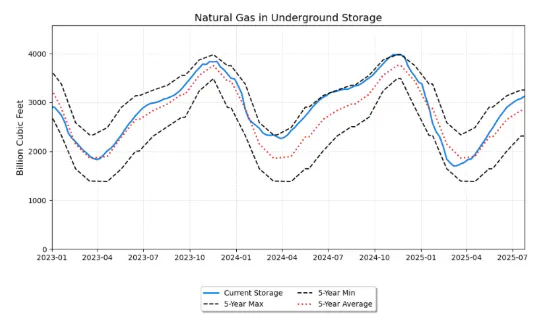
Regionally, the Midwest contributed the most to the injection, with gains of 19 Bcf. The Mountain and Pacific regions showed modest increases, while the Salt storage category reported a rare draw of 9 Bcf, suggesting localized demand or supply constraints. Despite a relatively hot summer and strong power sector demand, the overall injection pace has been robust, helping to maintain a comfortable storage cushion heading into the latter part of the injection season. This storage surplus continues to act as a stabilizing force on Henry Hub prices, buffering against short-term weather-driven volatility.
Weather Conditions
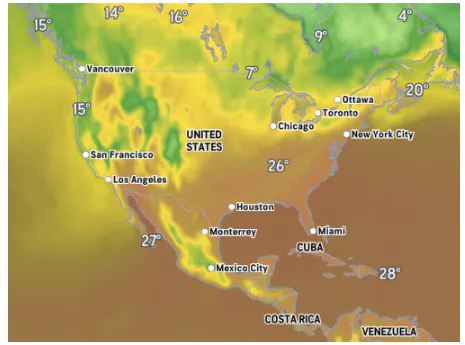
Over the past week, the U.S. experienced extreme heat and humidity due to the formation of a heat dome over a broad part of the country. Starting from July 21, states including Arkansas, Kansas, Missouri, northern Louisiana, Oklahoma, and Texas recorded daytime highs of 37–40°C, with heat indices reaching 43–44°C. Even nighttime temperatures remained elevated, not falling below 24–27°C, which is 5–15°C above seasonal norms. The heat wave gradually expanded into the Midwest and the Northeast, including New York, with temperatures exceeding 33–36°C. The Western U.S. was also hotter and drier than usual, with minimal precipitation and widespread temperatures above the seasonal average. The strongest anomalies were observed in the northern plains and the Northwest (e.g., Montana, Idaho, Wyoming), where deviations reached +3–5°C above the monthly norm.
Source: https://www.accuweather.com/en/us/national/current-weather-maps
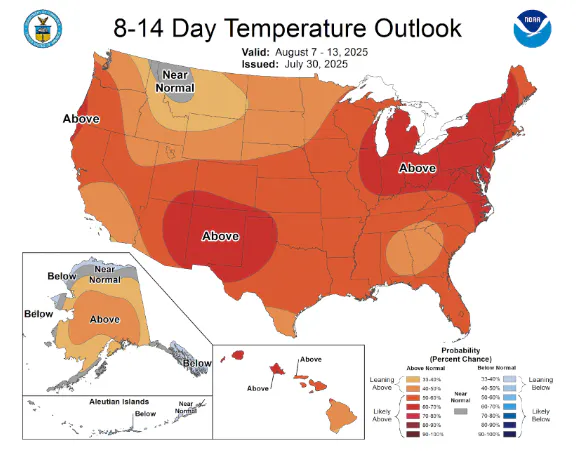
The forecast for early August suggests continued high temperatures across much of the country, especially in the Northwest, West, and Central regions. The highest probabilities for significantly warmer-than-average weather are centered over the central U.S., particularly in Colorado, New Mexico, and parts of surrounding states. The Midwest and Northeast, including key urban and industrial areas, are also expected to experience widespread heat. The West Coast, including California, shows a moderate warming trend. Meanwhile, Florida and parts of the Southeast may see near-normal to slightly above-normal temperatures, with a few areas showing lower confidence in persistent heat. Alaska presents a contrasting pattern, with below-normal temperatures expected over much of the state, especially the southern and western regions. In summary, the U.S. is forecasted to continue facing elevated summer heat in early to mid-August, potentially sustaining strong natural gas demand for cooling in both residential and commercial sectors.
Source: https://www.cpc.ncep.noaa.gov/
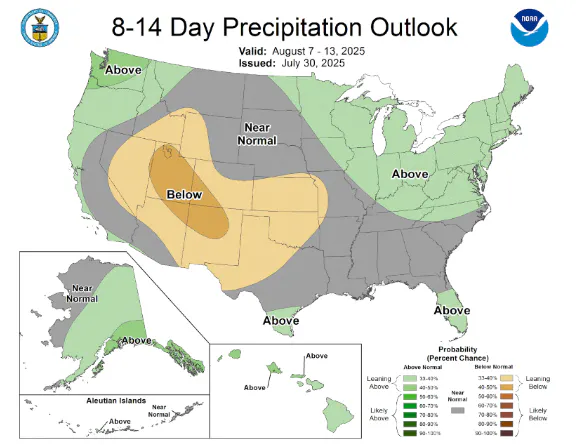
While brief rain showers may bring temporary relief in some southern and central states, the overall outlook remains hotter than average. The East and Southeast may see more rainfall, potentially moderating temperatures slightly.
Source: https://www.cpc.ncep.noaa.gov/
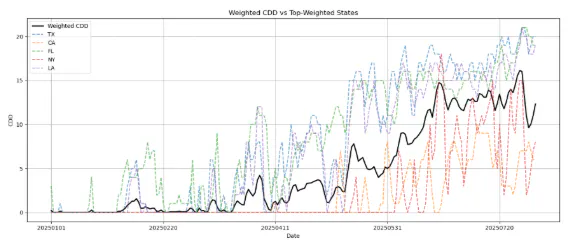
Cooling Degree Days (CDD) is a weather-based metric used to estimate energy demand for air conditioning. From mid- July through early August 2025, the weighted CDD has shown a strong upward trajectory, reflecting an intense and prolonged heatwave across much of the country. Florida (FL) and Texas (TX) led the surge with extremely high CDD values, indicating consistently high temperatures and a corresponding high demand for natural gas-fired electricity generation for cooling. Florida recorded the highest total number of CDD-active days this season (141), followed closely by Texas with 139 and Louisiana with 134—clear signs of extreme, sustained heat. California (48 days) and New York (48 days) had far fewer CDD-heavy days, contributing less to the overall demand spike. The steep rise in weighted CDD aligns with peak summer air conditioning use and explains the elevated natural gas consumption in the power sector, particularly in the South. If this heat pattern persists into August, as our forecasts indicate, demand for gas in the energy sector will remain high.
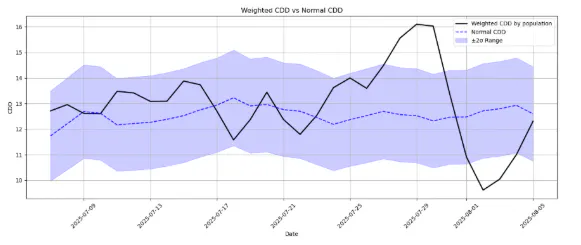
For most of the period, actual CDD values will consistently exceed the historical norm, particularly between July 26 and August 1, when CDD values spiked to reach a peak of nearly 16 days, well above the +2σ threshold. This indicates a significant heat wave that has driven up demand for air conditioning electricity and, as a result, natural gas consumption in the power sector. However, from August 2 onwards, CDD values will drop sharply below normal, indicating a short-term cooling trend that will temporarily reduce electricity demand. Despite this drop, the overall picture reflects a hotter-than-normal period, reinforcing the upward trend in gas consumption in late July and potential volatility should extreme heat return. Indeed, U.S. electricity generation jumped ~8.1% year-on-year in late July – a direct reflection of millions of Americans cranking up air-conditioning during the heatwave.
In Southern and Southeastern Europe – particularly Spain, Italy, Greece, and the Balkans – a hot and dry weather pattern continues, with temperatures reaching 30–40°C. The lack of precipitation is raising the risk of droughts and wildfires. In contrast, Central and Eastern Europe – including Germany, Austria, Poland, and the Balkan Peninsula – are currently experiencing a cold anomaly, with temperatures during the first days of August forecasted to remain below long-term averages, around 18–24°C. A gradual return to hotter conditions is expected by mid-August.
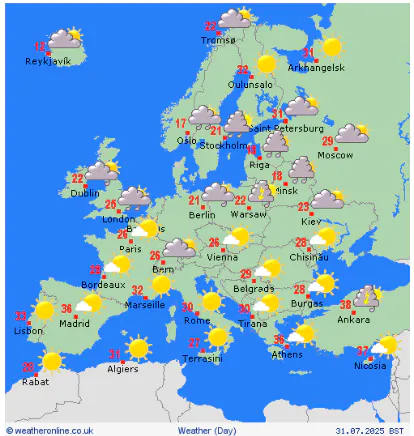
Northern Europe and the UK are expected to maintain cooler and wetter conditions, with intermittent rainfall and moderate temperatures. Across Central and Eastern Europe, the end of July was marked by a temperature anomaly of -4 to -7°C below the norm, indicating unseasonably cold conditions for this time of year.
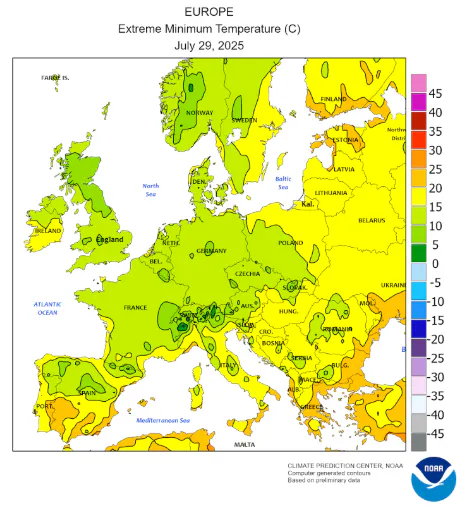
Source: https://www.cpc.ncep.noaa.gov/products/JAWF_Monitoring/Europe/temperature.shtml
U.S. Production and LNG Exports
The United States – now the world’s top LNG exporter – is shipping near record volumes of gas overseas. Feed gas to U.S. LNG export terminals is around 14.5–15 Bcf/day in late July, effectively running close to full export capacity. This strong export pull has been a constant driver of U.S. demand: even when domestic consumption ebbs (e.g. on cooler days), LNG terminals continue to draw gas, providing a floor under Henry Hub.
Europe’s energy policy is explicitly pivoting away from Russian gas. Brussels aims to phase out all Russian gas by 2027, which practically ensures continued high LNG imports (mostly from the U.S., Qatar and others) to fill the gap. The EU-U.S. trade deal even envisions $250 billion per year of U.S. energy purchases by the EU for the next few years – a figure including LNG that is likely unrealistic but indicative of Europe’s commitment to U.S. gas. This trend means Europe’s gas prices will remain sensitive to U.S. export capacity and U.S. price levels. Any increase in U.S. domestic gas prices (due to rising U.S. demand or constrained supply) could translate to higher delivered costs for Europe, or at least force Europe to seek additional suppliers. The medium-term gas demand picture is tempered by aggressive investment in renewable energy and efficiency, yet paradoxically Europe remains entwined in gas geopolitics. So, Europe is pouring money into clean energy – clean energy investment in 2025 is estimated at $494 billion, roughly double the level a decade ago. As a result, renewables like wind and solar supplied about 50% of Europe’s electricity in 2024, and their share keeps rising. This transition should gradually curb natural gas demand, especially in the power sector, over the long term.
Beyond weather and immediate supply/demand balances, structural trends and policies in North America and Europe are shaping the medium-term trajectory of natural gas prices. In the U.S., natural gas production is at record levels, which has been a critical factor keeping prices relatively low. Lower-48 dry gas output is running around 108–109 Bcf/day in late July (up ~3.4% year-on-year). Notably, drillers have been ramping up activity: the U.S. gas rig count reached 122 rigs in late July, a nearly 2-year high after climbing steadily from a low of 94 last fall. This investment in supply suggests producers are responding to higher demand (and anticipating future needs such as LNG contracts coming online). High production and infrastructure expansions (new pipelines, etc.) provide a cushion that helps limit price spikes. For instance, TC Energy – a major pipeline operator – reported that its systems now transport over 58,000 miles worth of natural gas pipelines, supplying ~30% of the gas consumed in North America. This indicates a massive throughput capability, and the company is bringing C$8.5 billion in new projects into service in 2025 to further enhance delivery. TC Energy raised its profit outlook on the back of strong natural gas and power demand across its U.S., Canadian, and Mexican pipeline network. In short, infrastructure and supply are responding to ensure gas can flow to where it’s needed.
On the demand side, the U.S. is undergoing a structural shift in its energy landscape that could boost medium-term gas consumption. One driver is the ongoing coal-to-gas switching in the power sector: as older coal-fired plants retire (due to economics or emissions rules), they are often replaced by natural gas-fired generation, which increases baseline gas demand. Additionally, new sources of demand are emerging. TC Energy specifically highlighted the growth of large data centers – particularly in regions like the U.S. Midwest and Virginia – as a factor driving up power needs (and thus gas demand for power). The rise of energy-intensive computing (from cloud services to artificial intelligence workloads) means electricity consumption is projected to climb, and a significant portion of that electricity in the U.S. still comes from natural gas. Indeed, the U.S. Energy Information Administration (EIA) forecasts that Henry Hub prices will almost double between 2024 and 2026, reaching around $4.40 per MMBtu by 2026. This bullish outlook is premised partly on rising domestic demand outpacing supply growth, including the industrial and power generation sectors. If that materializes, it implies a tighter U.S. market in the medium term, with higher prices potentially filtering through to LNG export contract prices. It’s worth noting, however, that such forecasts assume robust economic growth and demand – there is still uncertainty, and much will depend on whether producers continue their rapid output growth or hit constraints (e.g. pipeline bottlenecks or capital discipline).
European gas storage levels
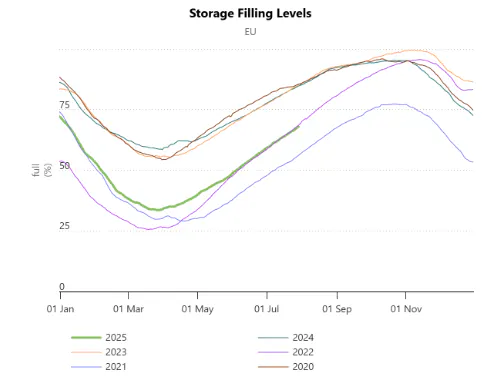
As of July 29, 2025, European Union gas storage facilities are 67.99% full, which is below the levels recorded on the same date in previous years—including 2024 (84.69%), 2023 (85.18%), 2022 (68.51%), and 2020 (85.43%). Only 2021 had significantly lower storage at this time (56.1%). This places 2025 at a mild deficit compared to the 5-year average, highlighting that the current refill pace is slower than desired, despite ongoing efforts. This lower fill level increases the risk sensitivity to late-summer heatwaves or early cold snaps, and adds a layer of volatility to European gas markets. To meet the EU's 90% storage target before winter, injection rates will need to accelerate in August and September. The gap compared to prior years also implies potential upward pressure on TTF gas prices, especially if weather or LNG supply issues emerge.
Source: https://agsi.gie.eu/data-visualisation/filling-levels/EU
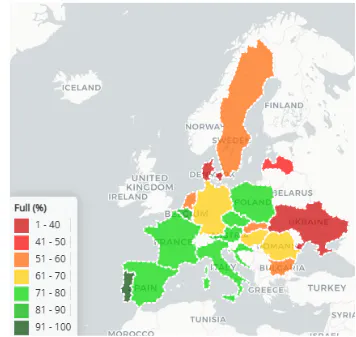
The current map of European gas storage levels reveals a diverse regional picture as of late July 2025. Western and Southern European countries—such as Spain, Portugal, Italy, and France—show robust storage levels, with many exceeding 81% fullness. Germany and Austria also maintain healthy reserves. In contrast, storage in Central and Eastern Europe is more uneven. More concerning are countries such as Ukraine, Belarus, Romania, and the Baltic states, which are below 50%, with some under 40%, signaling critical underfilling. This uneven distribution raises potential regional supply risks for the upcoming winter, especially in Eastern Europe, and could lead to cross-border gas coordination challenges if cold weather sets in early or LNG inflows decline.
Source: https://agsi.gie.eu/data-visualisation/filling-levels-country/map
Conclusion
As of July 31, 2025, natural gas prices reflect diverging regional dynamics. The Dutch TTF benchmark for European gas climbed steadily over the past week, reaching €35.37/MWh, which translates to approximately $11.50/MMBtu. This price increase reflects concerns over below-average EU storage levels, persistent heat in Southern Europe, and firm LNG demand, even as injection season progresses. European gas markets remain sensitive to both weather volatility and LNG availability, especially amid slower-than-usual storage replenishment in several countries like Sweden, Ukraine, and Slovakia. TTF prices are likely to stay above $11/MMBtu with potential to rise to $12.55/MMBtu if August heat persists, or if LNG supply tightens due to increased Asian demand or shipping bottlenecks. The medium-term outlook depends heavily on the pace of storage injections and weather in September. Without acceleration in storage filling, Europe may carry a mild risk premium into autumn, especially if early cold snaps arrive.
Meanwhile, the U.S. Henry Hub benchmark settled at $3.02/MMBtu, showing short-term pressure from milder forecasts and a recent dip in population-weighted CDDs. After peaking near $3.18/MMBtu earlier in the week. However, prices remain supported by strong LNG exports, high baseline cooling demand in southern states, and solid industrial usage. Looking ahead, U.S. natural gas prices are expected to remain in the $2.90–3.20/MMBtu range over the next two weeks. The short-term downside is limited by expected return of above-normal heat in mid-August. Further gains are possible if storage builds fall short of expectations or tropical storm activity disrupts Gulf Coast production.