


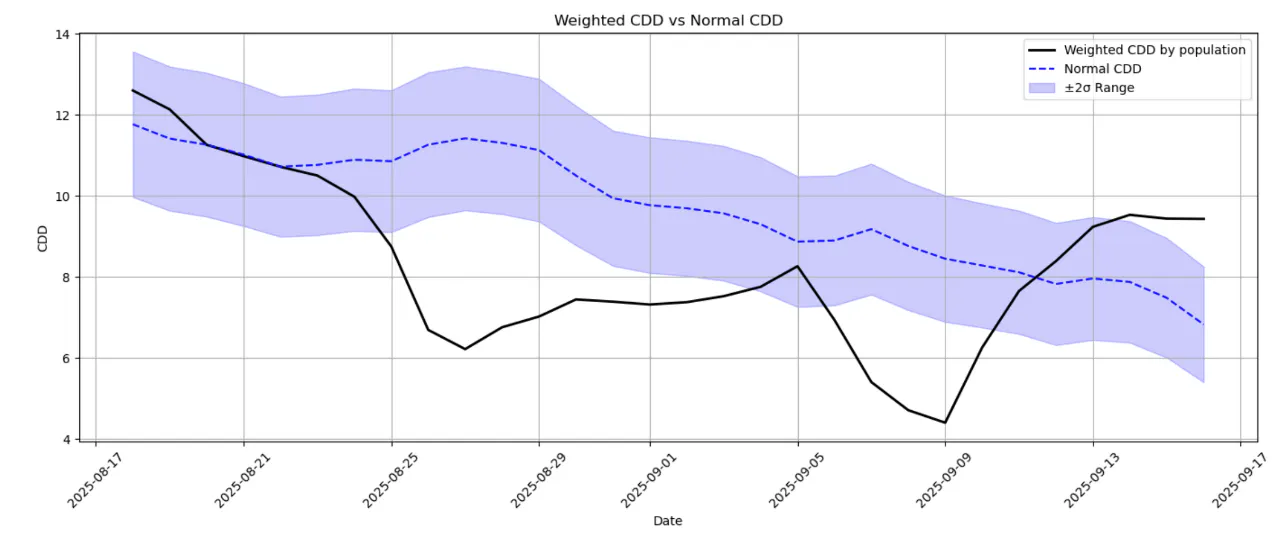
Gas prices are currently shaped by a confluence of seasonal, structural, and geopolitical factors. Milder weather conditions across the U.S. and Europe have reduced cooling demand, as reflected in the recent dip in the weighted Cooling Degree Days (CDD) index — New York registered just 6 CDD, underscoring the shift toward autumn. Similarly, northern and central Europe saw daytime highs of only 14–18 °C, reinforcing the seasonal transition. Importantly, U.S. LNG exports remain robust, driven by strong European demand, which has kept domestic facilities operating near capacity and helped absorb excess supply. However, the latest data suggests a slight softening in export momentum. Meanwhile, European gas storage levels have increased, but remained below the peaks seen in 2023–2024, adding another layer of complexity to price dynamics.
Storage Levels USA: Injections Control Market Balance
As of September 5, 2025, U.S. working gas in underground storage stood at 3,343 billion cubic feet (Bcf), according to the EIA. This marks a weekly net injection of 71 Bcf, bringing inventories to a level that is 188 Bcf above the five-year average and comfortably within the five-year historical range. Compared with last year, storage is only 38 Bcf lower, showing that the U.S. has maintained healthy injection momentum despite strong LNG exports.
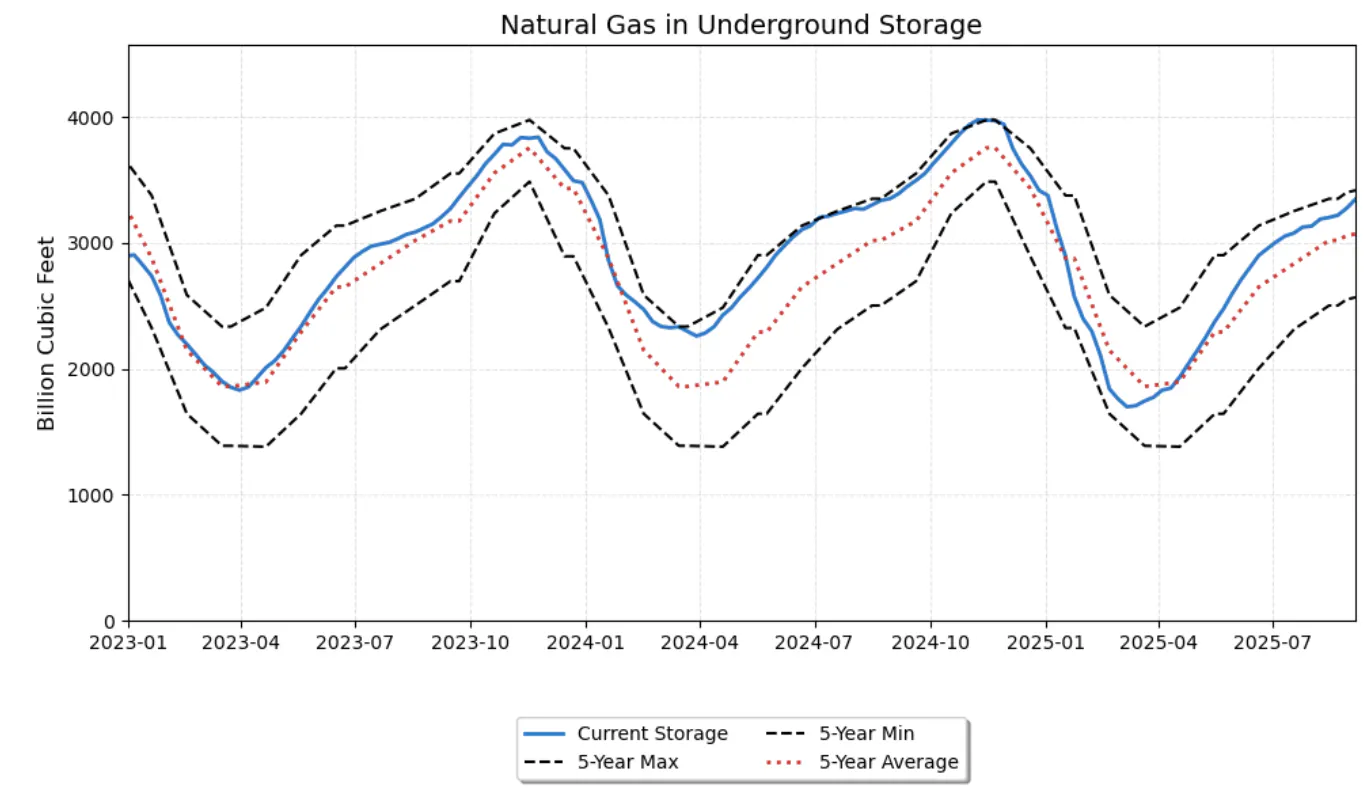
By region, the Midwest and East added significant volumes (30 and 22 Bcf, respectively), while the South Central saw a net build of 16 Bcf, split between salt and nonsalt facilities. The Mountain region posted smaller gains, while the Pacific showed a slight withdrawal due to local demand. Overall, stocks remain broadly balanced across the country.
U.S. Weather Conditions: Cooldown Sharply Cut AC Demand
The past week brought unseasonably cool weather to much of the U.S. East and Midwest, with temperatures ~1–3°C below normal in central and eastern states. This early autumn cool-down sharply reduced air-conditioning demand in northern markets – for example, New York saw very low cooling degree indices, signaling virtually no need for AC. In contrast, parts of the South and West experienced late-season heat. Texas, in particular, faced a sudden heatwave, driving a spike in electricity use for air conditioning. This regional divergence means overall gas demand for power generation eased relative to peak summer, as cooler conditions in populous eastern areas offset higher AC usage in the South.
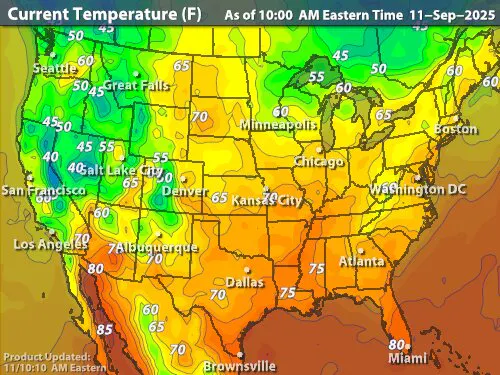
Source: https://www.wunderground.com/maps/temperature/us-current
Looking ahead, warmer-than-normal conditions are expected to linger into mid/late September across much of the country. A stable high-pressure system over the Western U.S. is keeping Arctic air at bay and supporting above-average warmth in the central states. This extended warmth is delaying the typical seasonal rise in heating demand. Homes and businesses usually begin burning more gas for space heating around this time, but with mild weather projected, the start of the heating season is effectively pushed back. In practical terms, the U.S. gas market is in a shoulder period with neither heavy cooling nor heating needs nationwide – a factor that has tempered domestic gas consumption and limited upward pressure on prices.
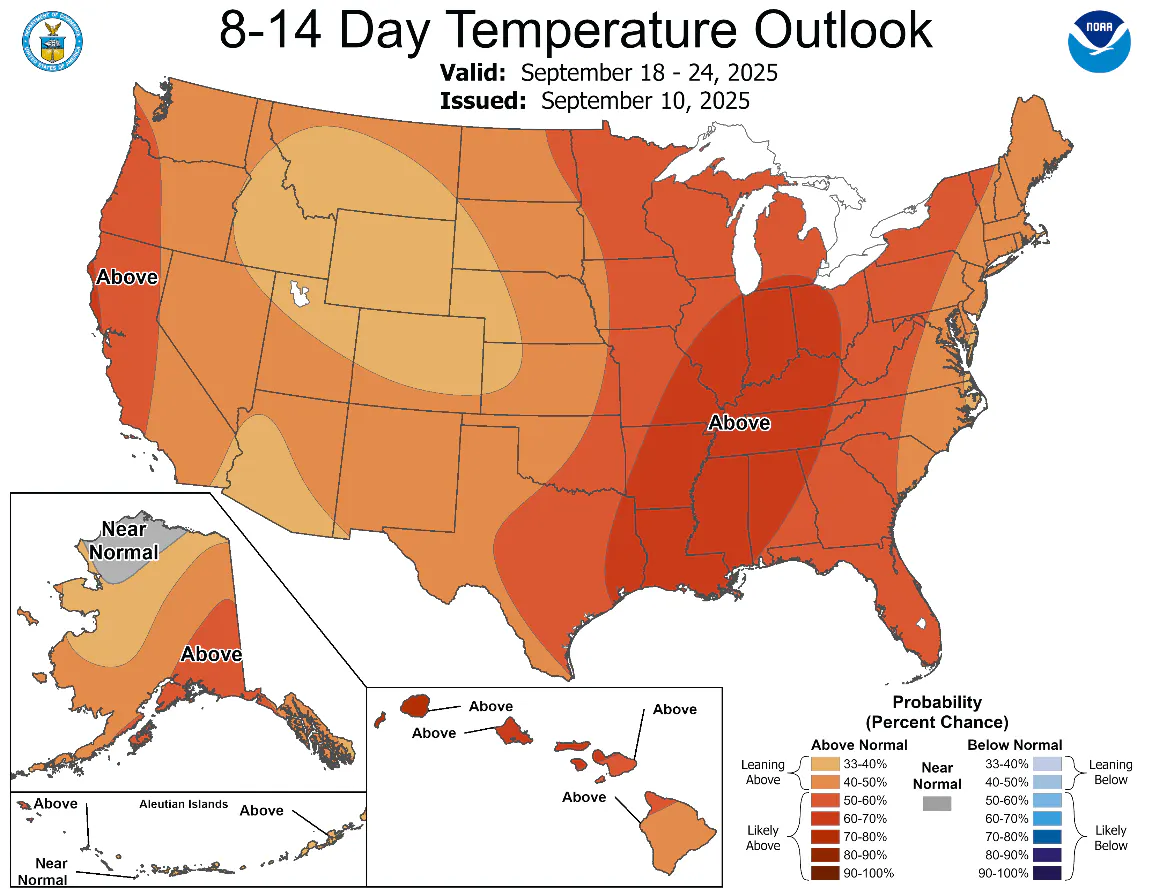
https://www.cpc.ncep.noaa.gov/
During the week of September 3–10, Cooling Degree Days (CDD) across the United States showed a mixed but generally declining pattern. The weighted CDD index dipped compared with the July–August peaks, signaling the seasonal transition toward autumn. New York had only 6 CDD, highlighting cool and comfortable weather with almost no need for air conditioning. California recorded 15 CDD, reflecting mild coastal conditions. Florida and Louisiana remained hot with 105 and 116 CDD, respectively, maintaining strong cooling demand, while Texas surged with 113 CDD, driven by a late-season heatwave. Overall, the South continues to support power-sector gas consumption, but the Northeast and West are already in a low-demand regime.
Looking ahead to September 11–16, forecasts point to a continuation of this split pattern. The Plains and Mississippi Valley will likely stay warmer than normal, sustaining elevated CDD in Texas and Louisiana. Florida should also remain consistently hot, keeping cooling demand high. By contrast, the Northeast (New York) will stay cool, with minimal CDD, while California trends moderate with only slight residual cooling needs. This divergence means that U.S. natural gas demand for power generation will remain regionally concentrated in the South and Southeast, while overall national gas burn for cooling will gradually ease as autumn conditions deepen in the northern states. This shift toward lower weighted CDD marks the shoulder season transition, where storage injections dominate the market balance and weather-driven demand becomes less intense.
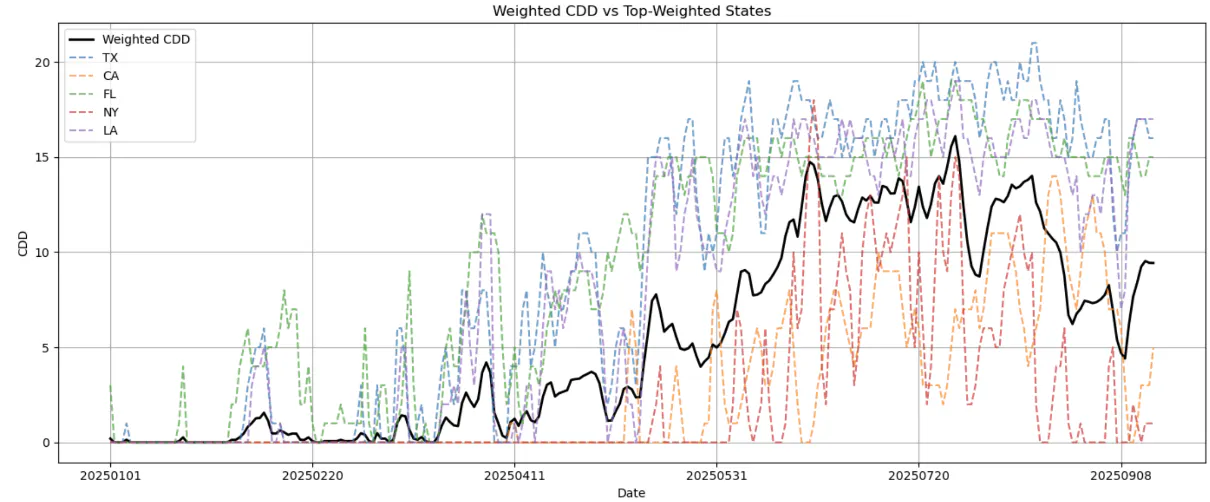
The weighted CDD index is forecast to rebound toward 9–10 CDD, bringing it back closer to but still slightly below the long-term average. This suggests a short-lived warm-up across key demand regions, particularly across the Central and Southern U.S., which will temporarily boost electricity demand for cooling. However, the overall trend remains downward, with normal CDD also declining as autumn progresses.
Europe’s Weather Conditions: Gradual Transition to Autumn
Europe’s weather has also turned seasonally milder. Over the past week, much of northern and central Europe experienced a transition to autumn conditions, with daytime highs only around 14–18 °C in northern regions (U.K., Scandinavia). This cool, rainy pattern in the north – driven by a shift from summer high-pressure to more variable Atlantic cyclones – has cut down residual cooling demand. Meanwhile, southern Europe remained relatively warm (daytime ~24–30 °C), particularly in the Mediterranean and southeast, but even there extreme summer heat has started to abate. Overall, average temperatures in southern/southeastern Europe stayed about 0.5–1.5 °C above normal, whereas central and northern areas were at or slightly below normal. The upshot is that continent-wide gas usage for air conditioning is declining as the summer ends, and widespread heating demand has not yet begun in earnest.
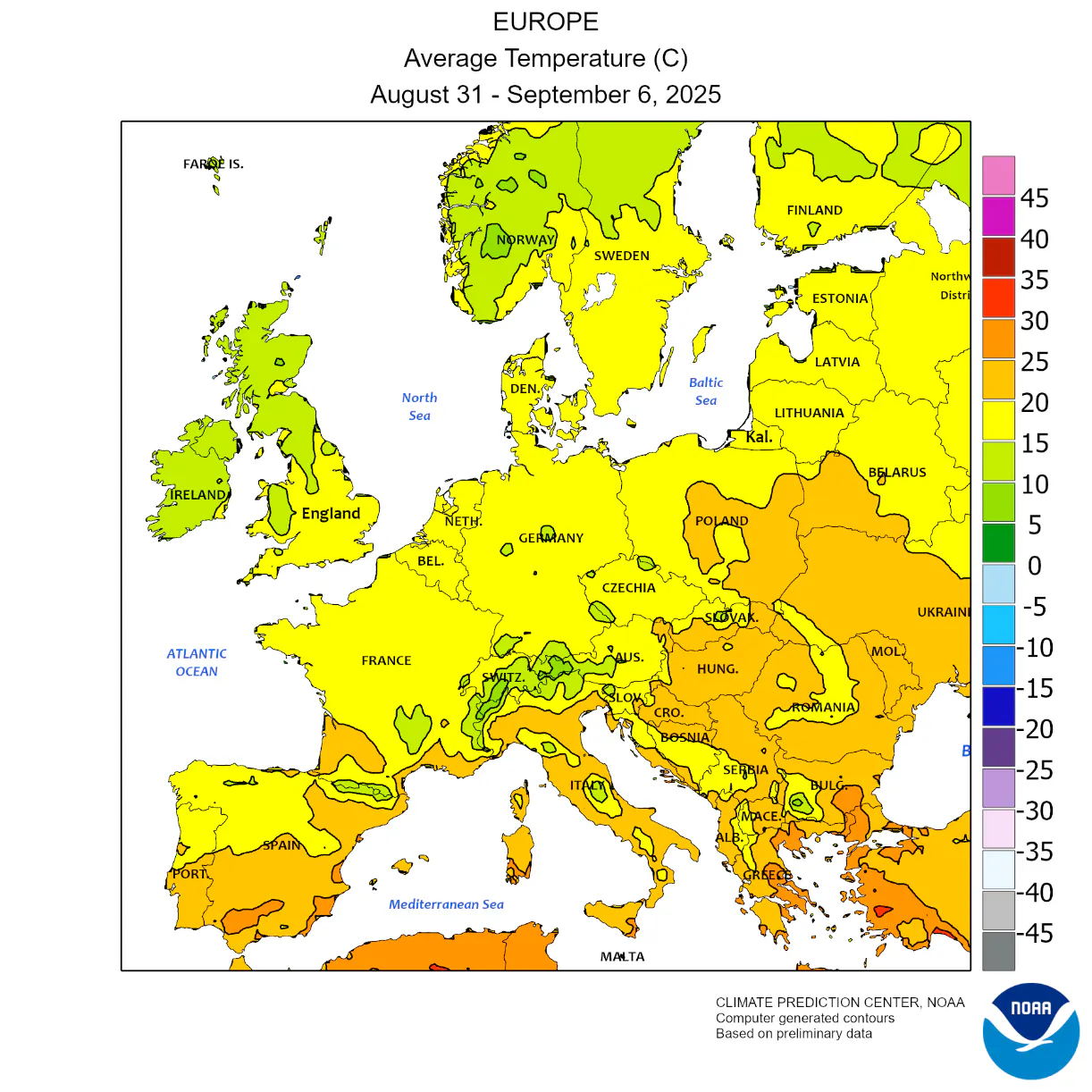
Source: https://www.cpc.ncep.noaa.gov/products/JAWF_Monitoring/Europe/temperature.shtml
Europe will see continued mild and variable weather in the coming week. Periodic rain and cool spells in the north and center will keep temperatures in a comfortable range (roughly 16–22 °C by day in northern/central Europe, with nights around 8–12 °C). Southern Europe may still reach late-summer highs of 26–30 °C during the day, maintaining some ongoing cooling needs in those areas. However, with temperature anomalies expected to be near the seasonal norm, no extreme weather-driven demand surge is on the horizon. In summary, Europe’s moderate early-September weather is exerting a calming influence on gas demand – air-conditioning loads are tapering off, and significant heating consumption has yet to ramp up – which in turn is helping keep natural gas prices in check this week.
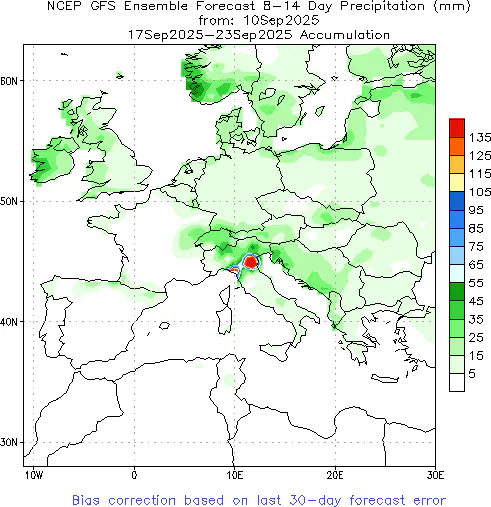
Source: https://www.cpc.ncep.noaa.gov/products/JAWF_Monitoring/Europe/GFS_forecasts.shtml
U.S. Production and LNG Exports: Record-Breaking Levels Preserved
The United States is exporting LNG at record-breaking levels, which has become a key driver of domestic gas demand and prices. Robust overseas demand – especially from Europe – has kept U.S. LNG facilities running near full tilt. These strong exports provide an outlet for U.S. production, supporting domestic gas prices by absorbing excess supply. However, in the latest week, there were signs of a slight pullback in export activity. Feed gas flows to LNG plants eased to an average ~15.6 billion cubic feet per day in early September, down from about 15.8 bcfd in August. In fact, daily LNG feed dropped to a three-week low (~14.9 bcfd) at one point due to minor outages and maintenance at several Gulf Coast terminals (including Corpus Christi, Sabine Pass, and others). The pullback occurred immediately after prices had hit a six-week high on expectations of strong demand, illustrating how sensitive U.S. gas prices are to fluctuations in LNG export volumes. Going forward, the U.S. will enter a period of scheduled maintenance at at least one major LNG facility (Cove Point is set for a month-long shutdown from Sept 15), which may further curtail export feed in the short term.
Meanwhile, Europe has fundamentally reshaped its gas supply by pivoting to imported LNG, and this shift is directly influencing price dynamics. The steady inflow of American LNG has amply supplied Europe’s market and helped push European gas prices down. However, Europe’s growing reliance on U.S. LNG also introduces new vulnerabilities to price volatility. If a disruption were to occur in the U.S. – for instance, a severe Gulf Coast hurricane or heatwave that suddenly curtails LNG exports – European supply could tighten rapidly, driving prices higher. U.S. Gulf weather events have, in the past, knocked LNG terminals offline, and Europe’s import balance would be affected immediately by any such outage. In terms of magnitude, Europe’s dependence on U.S. LNG is reaching unprecedented levels – by some estimates, the U.S. could soon account for 70–80% of Europe’s LNG imports once remaining Russian volumes are fully replaced. This would equate to nearly a quarter of Europe’s total gas supply when including piped gas from elsewhere. Such extreme reliance means European gas prices now hinge on smooth LNG trade flows. For the moment, those flows are ample, and have successfully stabilized the European market heading into autumn.
European Gas Storage Levels: Healthy, but Not Robust
As of September 9, 2025, European gas storage levels stand at about 79.7% full, which is somewhat lower than the exceptional highs of 2023–2024 (over 90% at the same date) but still comfortably above the 2021 level of ~69%. This indicates that Europe has managed steady injections throughout the summer, building a strong buffer ahead of the winter heating season. The current level suggests that storage is in a healthy but not record-breaking range, providing a cushion against early cold spells. While slightly below the highs of the past two years, the present fill rate still reflects stable supply conditions, supported by consistent LNG inflows and lower-than-expected demand. This positions Europe well for autumn, easing immediate concerns over supply security, though it leaves less excess margin compared to last year’s unusually high stockpiles.
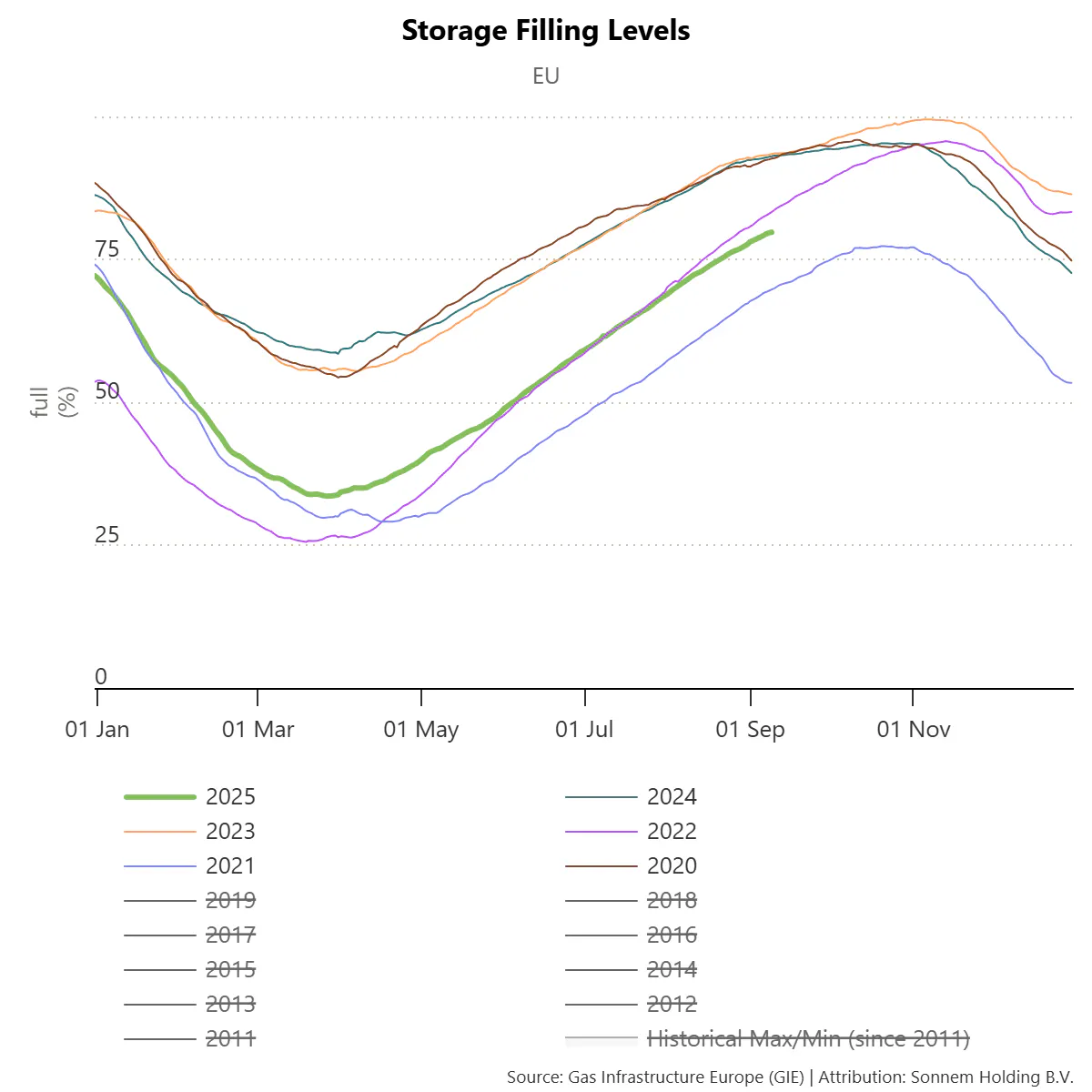
Source: https://agsi.gie.eu/data-visualisation/filling-levels/EU
At present, European gas storage levels show a mixed regional picture. Western and Southern Europe – including Spain, France, Italy, and Germany – are at high to very high levels, with reserves broadly secure ahead of winter. Central European countries such as Poland and Austria are also in the upper range, reflecting strong injection progress and stable supply. In contrast, parts of Northern Europe, including Sweden and Denmark, remain at low to moderate levels, highlighting slower storage accumulation there. The situation is more concerning in Eastern Europe: Ukraine and Belarus are at low levels, which could create vulnerabilities if winter demand turns out higher than expected. Overall, the continent as a whole sits at a comfortable average level, but regional disparities mean that while Western and Central Europe are well-prepared, Northern and Eastern regions still face risks if the heating season proves severe.
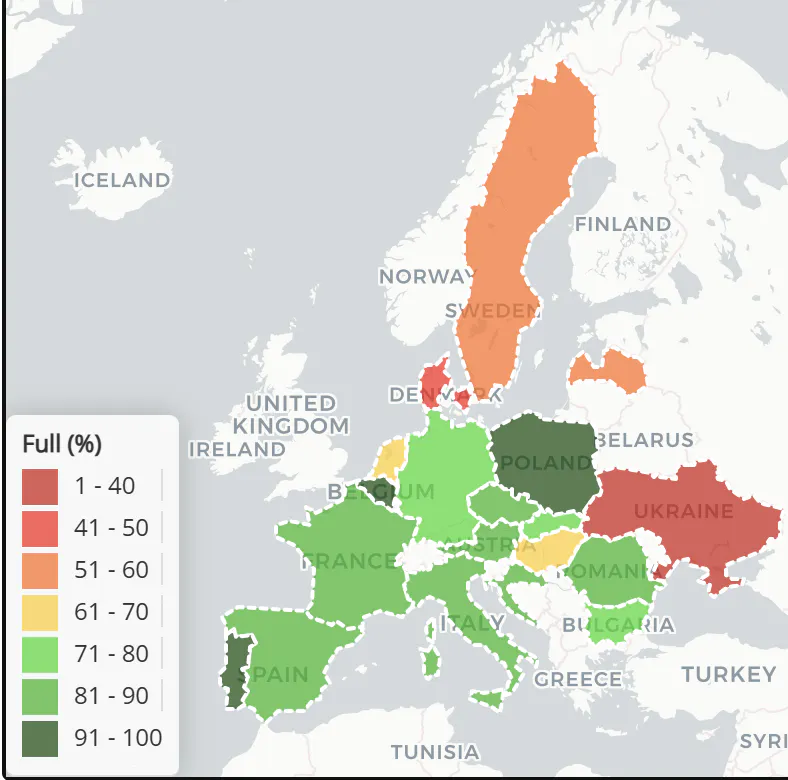
Source: https://agsi.gie.eu/data-visualisation/filling-levels-country/map
Conclusion
Natural gas markets in both the U.S. and Europe are currently shaped by a mix of supportive supply conditions and moderating weather-driven demand. In Europe, TTF benchmark prices have been trading around €32.4/MWh, which converts to roughly $9.8–10.0 per MMBtu. In the U.S., Henry Hub futures are near $3.02 per MMBtu. Both benchmarks have experienced intraday volatility this week, but prices have broadly remained rangebound.
As a result, natural gas prices are expected to remain relatively stable in the near term with slight downside risk. In the U.S., Henry Hub is likely to trade in the $2.90–3.20 per MMBtu range over the coming weeks. Ample storage and mild weather are bearish factors, but strong LNG demand will prevent deeper price declines. In Europe, TTF prices are projected to stay around $9.5–10.5 per MMBtu in September. High storage levels and moderate weather conditions keep the market calm, but Europe’s heavy reliance on U.S. LNG means any U.S. supply disruption (hurricanes, maintenance, policy shifts) could quickly lift prices.