


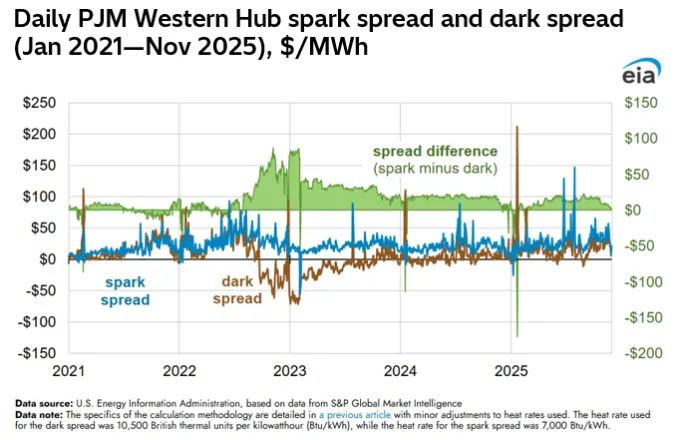
For most of the past two years, the ‘dark’ spread for coal has increased faster than the ‘spark’ spread for natural gas. The two spreads display the difference between the fuel cost of each fuel and the wholesale price of electricity. The narrowing of the two spreads indicates that the economics of coal plants have improved relative to that of natural gas plants since 2023. For a case in point, consider the daily PJM Interconnection-western hub spreads – between January and November 2025, the dark spread averaged $21/MWh, and the spark spread averaged $28/MWh – both indicative of profitability. This is according to U.S. Energy Information Administration's Augustine Kwon in his most recent ‘Today in Energy’ story.
According to data from Hitachi Energy’s Velocity Suite research team, in the first nine months of 2025, electricity production from coal in the United States grew by 12.9% from the same period in 2024. Electricity production by natural gas shrunk by 3.8% during the same period. Comparing the two time periods, the price of delivered coal to power plants declined slightly from $2.49 $/MMBtu in 2024, to $2.43/MMBtu in 2025. On the other hand, natural gas increased significantly from an average of $2.67/MMBtu in 2024, to $3.82/MMBtu in 2025 – up 43.1%. During the first nine months of 2025, coal accounted for 16.7% of the country’s total electricity production, while natural gas supplied 41.1%.
EIA Today in Energy story: Spark and dark spreads indicate improved profitability of natural gas, coal power plants: https://lnkd.in/eCsUtgTM
Chart courtesy of EIA’s Today in Energy – December 8, 2025.