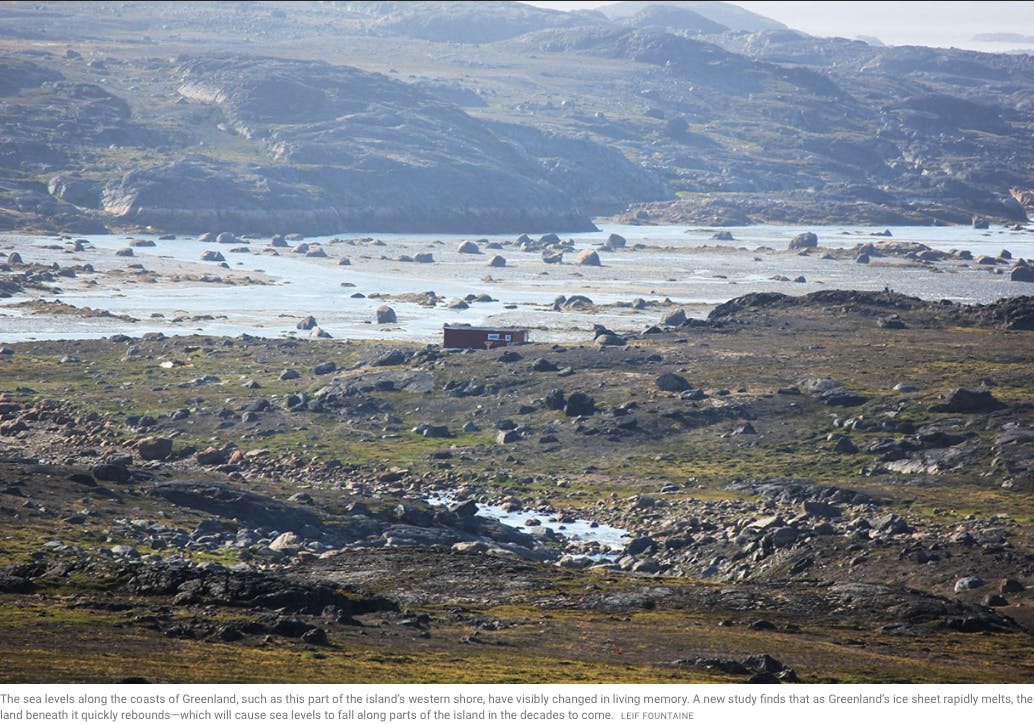
AAAS: "As Greenland loses ice, global sea levels will rise—and its own will fall." My wife + I returned last nite from a week's vacation on our own coast, in northern Oregon + southern Washington. But it is Greenland that is experiencing "glacial isotactic adjustment," which means its continental crust is rising up after centuries of compression by mammoth ice. Picture the Greenland Ice Sheet [GIS]—roughly three times the size of Texas and in some places more than 3 kilometers thick—"In the very places where glaciers are melting and shrinking, the land beneath will rebound as the burden eases, meaning [relative] seas may fall even as the meltwater causes them to rise elsewhere." The rapid melting of the GIS now constitutes about one-fifth of the global sea level rise, + when it melts it is free to travel far away, resulting in 'expanding coastlines, dried-up fjords, and future complications.' Another more subtle point: "the effect is intensified by gravity itself: The sheer mass of the GIS gravitationally attracts ocean water, but this attraction weakens as Greenland loses ice, sending seawater sloshing away."
Published today in Nature Communications, "the research shows portions of Greenland’s coast will rebound far more sharply than expected, causing seas to fall by anywhere from 1 to nearly 4 meters by 2100." Andra Garner, a Rowan University climatologist, said “we think about sea level rising and the challenges that will create...but in places like Greenland, sea levels are falling—and that also creates challenges.” The parts of Greenland moving up the most are "western and southern Greenland, including the island’s economic and cultural hub, [which] will likely bear the brunt of the retreat, posing major problems for shipping and food security." Roger Creel, a geophysicist at Texas A&M University, commented, "It’s the difference between getting from your port to the ocean or having to build a new port."
Hats off to the fossil fuel industries for their manifold contributions.