


Europe’s emerging‑fuels landscape is undergoing a defining shift. After a decade of strategy development, pilot projects, and regulatory groundwork, the region is now entering a new phase: one where transformative infrastructure is finally moving from concept to real‑world operation. In 2025-2026 alone, Europe saw the launch of the first open‑access CO₂ storage network and the commercial start‑up of one of the world’s largest e‑fuel facilities, marking visible progress toward a low‑carbon fuels economy. This transition, and the lessons emerging from it, will be central to the conversation in European Workshop Week’s Emerging Fuels Workshop in Prague later this month.
Understanding Europe’s position today requires looking through the lens of the sustainability maturity curve: moving from innovation trigger, then to the peak of inflated expectations, trough of disillusionment, slope of enlightenment, and finally the plateau of productivity. Europe has progressed rapidly along this curve and is now straddling the boundary between the last two phases, where deployment challenges become more systemic than technological.
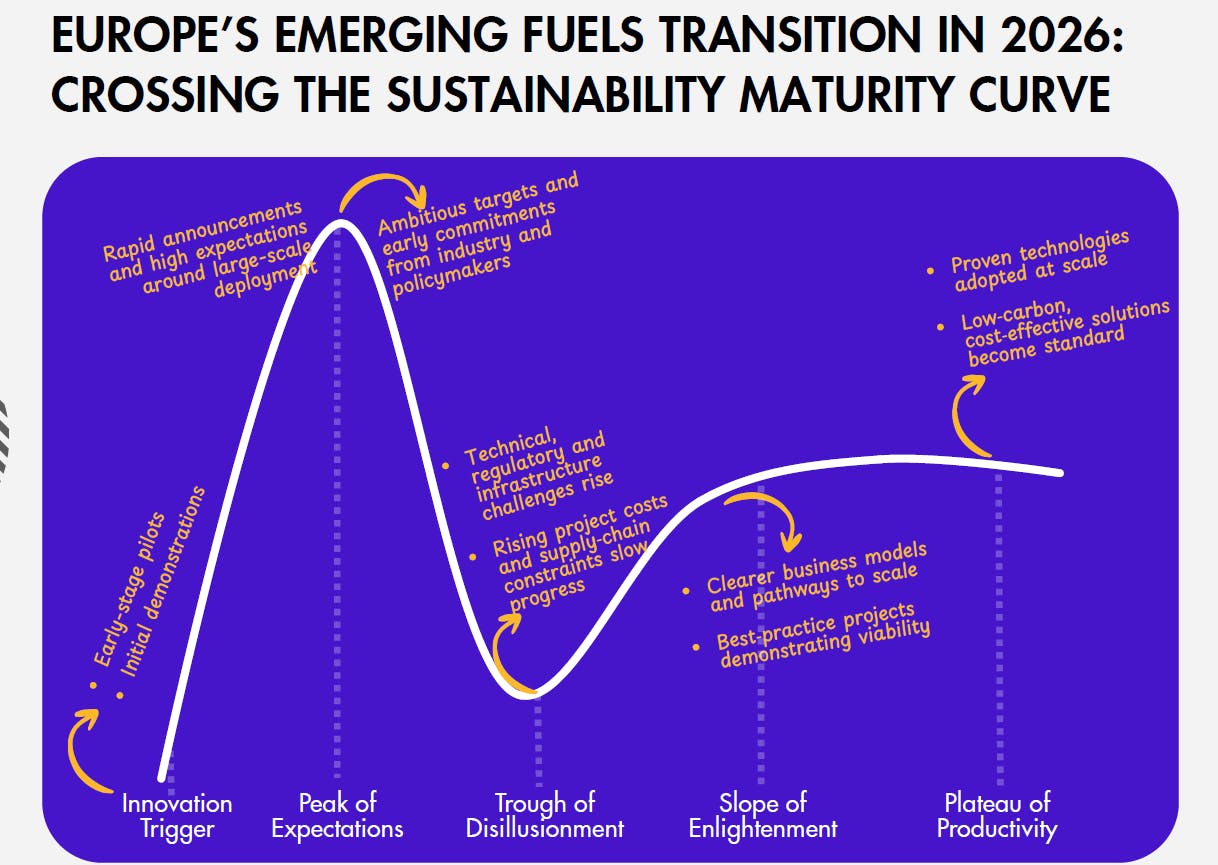
From Policy Compliance to System Signals
The last decade represented the compliance and efficiency stages for Europe. Countries focused on understanding RED II, ETS adjustments, and biofuel blending rules, and companies ran early pilots in hydrogen, SAF, and carbon capture. But in 2025, Europe delivered three landmark assets that signal a move into strategic integration.
The first was Northern Lights, which began operating as the world’s first open‑access CO₂ transport and storage network in August 2025, providing industries with a shared decarbonisation pathway. The second was Denmark’s Kassø e‑methanol plant, inaugurated in May 2025 as the largest commercial e‑methanol facility globally, with confirmed off-takers including Maersk. The third was Stegra, now progressing the construction of what is set to be the world’s first large‑scale green steel facility, scheduled to start commercial operations in the second half of 2026.
These assets demonstrate that Europe is moving beyond ambition and into the deployment phase, where technology is real, offtake agreements are active, and infrastructure is operational.
Hydrogen and E‑Fuels
Hydrogen remains central to Europe’s long‑term decarbonisation pathway, but the conversation has shifted from aspirational announcements to real‑world constraints such as electrolyser durability, grid congestion, and fuel‑switching economics. The 2025 European Hydrogen Bank auction, which awarded nearly €1 billion to hydrogen projects, illustrated the varying premiums required for different end uses - higher for maritime pathways and lower for general hydrogen demand.
E‑methanol is gaining momentum as the early maritime decarbonisation fuel. With the Kassø plant online and a growing global order book of methanol‑capable vessels, the market is no longer speculative. Port infrastructure is responding too, with Europe preparing new bunkering corridors and Rotterdam conducting the world’s first ship‑to‑ship ammonia bunkering pilot in 2025.
These developments show Europe firmly in the strategic integration stage of the sustainability maturity curve, scaling options that can operate in real supply chains.
Biofuels and Biomethane
While e‑fuels and hydrogen attract attention, biofuels and biomethane remain the workhorses of Europe’s 2020s decarbonisation pathway. With more than 1,600 biomethane plants across the continent, 86% grid‑connected by 2025, biomethane is already making measurable emissions reductions.
Yet sustainable feedstock limits capped under RED III are pushing Europe toward a long‑term reliance on synthetic fuels. This dynamic mirrors the sustainability maturity curve’s efficiency‑to‑integration handover: biofuels provide immediate abatement while PtX fuels build the foundation for 2030–2050.
Infrastructure: The Barrier of the Transformation Stage
As Europe enters the transformation phase, infrastructure emerges as the biggest limiting factor. Around 40% of European electricity distribution grids are more than 40 years old, constraining electrification, hydrogen production, and industrial growth.
The hydrogen backbone vision (over 53,000 km of dedicated hydrogen pipelines by 2040, with 60–69% repurposed natural gas lines) will help address this, but requires significant coordination.
Similarly, early CO₂ networks like Northern Lights and emerging ammonia/methanol bunkering pilots illustrate how essential cross‑sector infrastructure will be for large‑scale transformation.
Costs and Market Reality
Despite momentum, green hydrogen, ammonia, and synthetic fuels remain costlier than fossil alternatives. As mandates tighten, analysts expect some early‑stage project attrition as developers face permitting challenges, financing hurdles, and uncertain offtake agreements.
This is a normal part of the maturity curve: markets consolidate, frontrunners gain traction, and commercially viable pathways rise to the surface.
Looking Ahead
Europe’s next ten years will be decisive:
2026–2030: biomethane, HVO, and e‑methanol dominate; early hydrogen corridors form; CCS scales through networks like Northern Lights.
2030–2035: e‑kerosene gains traction under ReFuelEU; maritime RFNBO uptake accelerates; hydrogen backbone expands.
2040–2050: full system transformation—hydrogen networks, CCS, PtX fuels, and electrification converge into a mature, integrated decarbonised system.
EPRI will continue monitoring the evolution of emerging and low‑carbon fuels, providing technology‑neutral expertise through its Emerging Fuels and Technologies Integrated Portfolio to support safe, reliable, and effective energy‑system transitions.