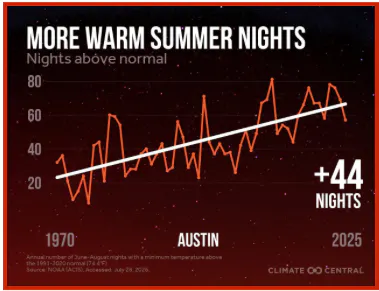
ClimateCentral: "Warming U.S. Cities Face Higher Cooling Demand and Energy Bills."
"This Climate Matters analysis is based on open-access data from the National Oceanic and Atmospheric Administration (NOAA) and the U.S. Energy Information Administration (U.S. EIA)."
Demand for cooling is rising across the U.S., contributing to higher energy bills as households rely more on air conditioning in our warming climate—instead of the superior option of heat pumps for combination heating + cooling throughout the yr. "Cooling degree days—a temperature-based metric used to estimate the demand for energy to cool buildings—have increased since 1970 in 97% of the 241 major U.S. cities analyzed," with Austin, Texas just chosen as the poster child.
"Based on long-term trends in cooling degree days, these cities have seen a 37% increase in cooling demand, on average, since the early 1970s," essentially the last half century. Logically, "households tend to spend more on cooling in warmer U.S. states that have higher annual cooling degree days." In the 10 states with the highest average cooling costs, households spent between $378 (in Hawaii) and $712 (in Arizona) on cooling in 2020, a metric which shows that finding updated figures—even, or perhaps especially, from governments—can be more difficult than pulling teeth.
As you can imagine, those most at risk are the poor, more equaterward located + extremes of age.
For those of you in the fossil fuel industries, are you at all concerned with your contributions to making this last July the hottest month in recorded history?