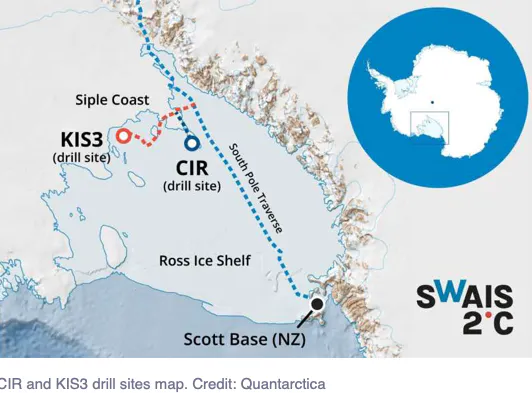
Phys.org: “Record-breaking Antarctic drill reveals 23 million years of climate history.” They were not collecting ice cores this time, rather sub-ice sediment cores. A team of 29 scientists, drillers, engineers and polar specialists living in tents on the snow at Crary Ice Rise had to first use a hot-water drill to melt a hole through 523 m of ice, then lowered more than 1300 m of “riser” and “drill string” pipe down the hole. “To our knowledge, the longest sediment cores previously drilled under an ice sheet are less than 10 m,” said Molly Patterson, co-chief scientist and associate professor of earth sciences at Binghamton University. “We exceeded our target of 200 m, and undertook this 700 km from the nearest base—this is Antarctic frontier science.”
The first 2 seasons failed to strike pay dirt, but this time they pulled up “228 m of ancient mud and rock,” an archive of past environmental conditions at the site from warmer periods in Earth’s history, vital information for climate scientists to determine how much and how fast the ice sheet will melt in the future under our warming climate. “The vast West Antarctic Ice Sheet holds enough ice to raise global sea levels by 4–5 m if it were to melt completely…but there is uncertainty around the temperature increase that could trigger rapid loss of ice.” Preliminary dating of the sediment carried out in the field was ‘based on identification of tiny fossils of marine organisms found in some of the layers.’ Next, “a wider team of scientists from the 10 countries collaborating in the SWAIS2C project will apply a range of techniques to refine and confirm the age of the records.” Some levels show the ‘presence of shell fragments and the remains of marine organisms that require light to survive, implying the lack of ice above.’
But the beauty of this project is that we will now be able to nail down the dates + temperatures from a key, key period in geologic history. Which will allow us to forecast our future more plainly. None of this would be happening except for gargantuan + unremitting overuse of fossil fuels.