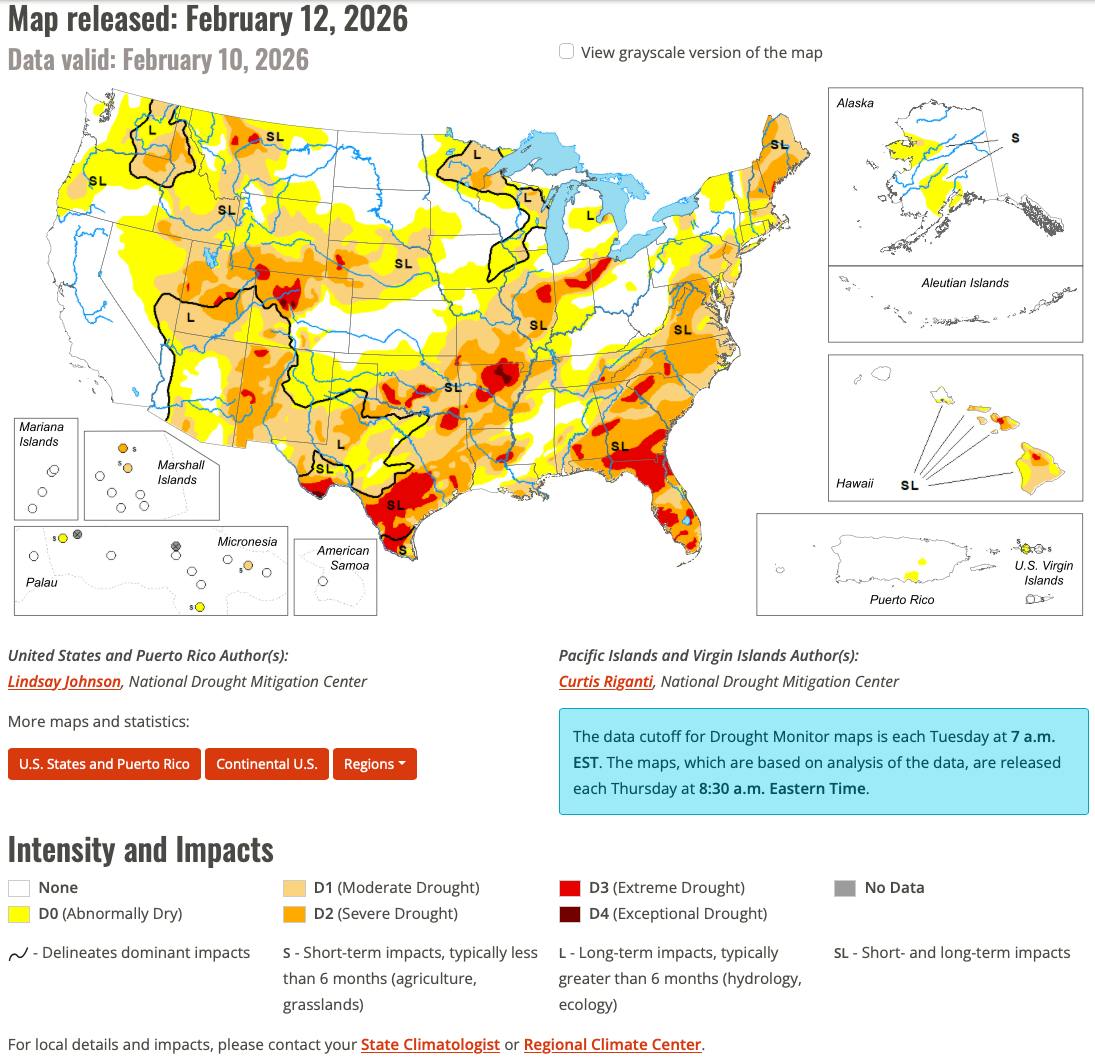
U.S. Drought Monitor: “Map released: February 12, 2026.” May seem odd to be concerned about drought almost smack dab in the middle of our northern hemispheric winter. The color key developed by the National Drought Mitigation Center lies near the bottom. Note that D3 or Extreme Drought is affecting many of the contiguous 48 states as of several days ago, but if you look carefully there is also D4 or Exceptional Drought in 2 small areas in southern Texas + another 2 in NE Arkansas. “There was a strong east-to-west temperature gradient again this week, with below-normal temperatures across much of the East and above-normal temperatures across the West.” Another week of localized precipitation that missed large portions of the country led to expanding precipitation deficits.
“Although some mountain snow fell, critically low snowpack with snow-water equivalent levels below the 15th percentile continues to dominate much of the [western U.S.] and support ongoing drought expansion.” Many areas have drying soil, thus vegetation, also lower streamflows, contributing to the problem.
One of my brothers-in-law lives on the Big Island of Hawaii, where “strong trade winds brought heavy precipitation and wind to the windward slopes of Molokai, Maui and the Big Island, where 4 to 10 inches of rain fell at lower elevations and snow at higher elevations, supporting ‘one-class’ improvements in those areas.”
Lot more granular detail on the site, + I invite you to check this out + perhaps refer to the website from time to time. Any guesses as to how this map will look come summer? Or would you prefer to keep your head stuck in—the sand? Which is getting hot + dry.
As always, there is a direct line connection between fossil fuels and the crucible of climate change.