


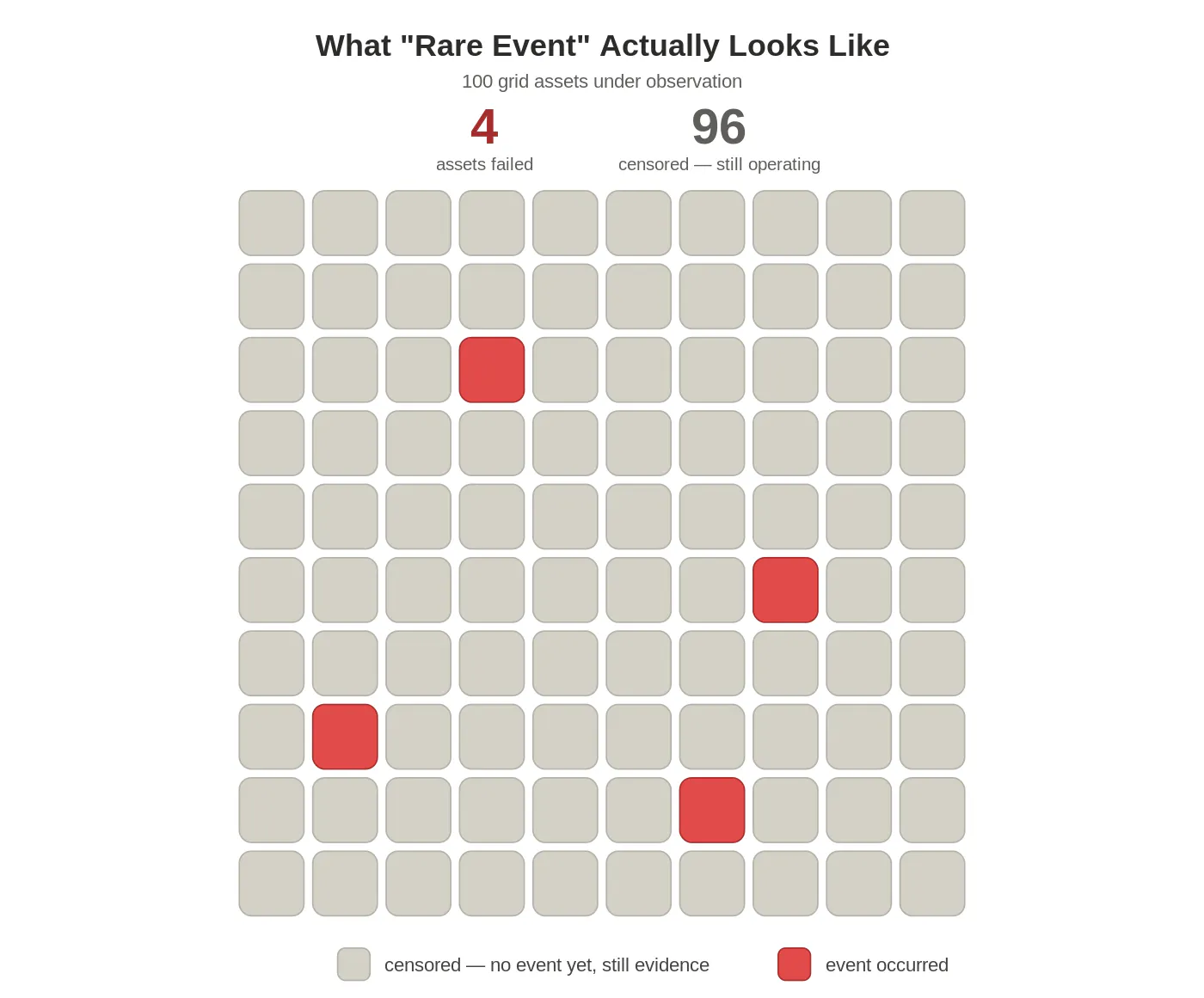
Most asset-failure prediction work in this industry still gets framed as a binary question: will this unit fail in the next N months, yes or no? That framing throws away information. Every asset that hasn't failed yet — still in service, still reporting clean readings — isn't a blank. It's a right-censored observation: it bounds when failure is likely to occur even without an event attached to it yet. Time-to-event (survival) modeling treats it that way. Binary classification doesn't.
EPRI's own Transmission Asset Database is a good illustration of why this distinction matters at scale. As of EPRI's own reporting, the database tracks 11 categories of transmission assets — insulators, transformers, circuit breakers, conductors, and more — pooling records from 80 utilities across the US, Canada, the UK, Malaysia, Taiwan, and Australia: 43,213 in-service assets, 4,746 recorded failures, and 1,832 retired or taken out of service. That's effectively a massive censored dataset. The 43,213 in-service assets aren't "non-events" to discard — they're censored observations that still carry information about failure timing, the same way a still-enrolled student or a cancer patient without recurrence does in the other two domains I work in. (EPRI Journal, "Predicting Failures with EPRI's Transmission Asset Database": https://eprijournal.com/predicting-failures-with-epris-transmission-asset-database/)
A Dutch transmission operator's own asset-management research group has already applied this formally. Khuntia et al. (2022) ran Kaplan-Meier and Weibull survival analysis directly on 1989-2021 failure and inspection data for high-voltage instrument transformers on the Dutch grid, then used the fitted models to simulate maintenance/replacement CAPEX and downtime-risk scenarios years out — not just "will this fail" but "when does this fleet's failure risk cross a threshold that changes the budget conversation."
I wrote up the fuller case for this reframe — including why interpretable models like Cox proportional hazards and Kaplan-Meier still tend to beat neural time-to-event formulations (like WTTE-RNN) in practice, and where the same reframe shows up independently in EdTech dropout prediction and cancer survival modeling — in a longer piece here: https://jamesaksanders.com/2026/08/06/censored-data-as-evidence-time-to-event-modeling-across-grid-edtech-and-healthcare-prediction-problems
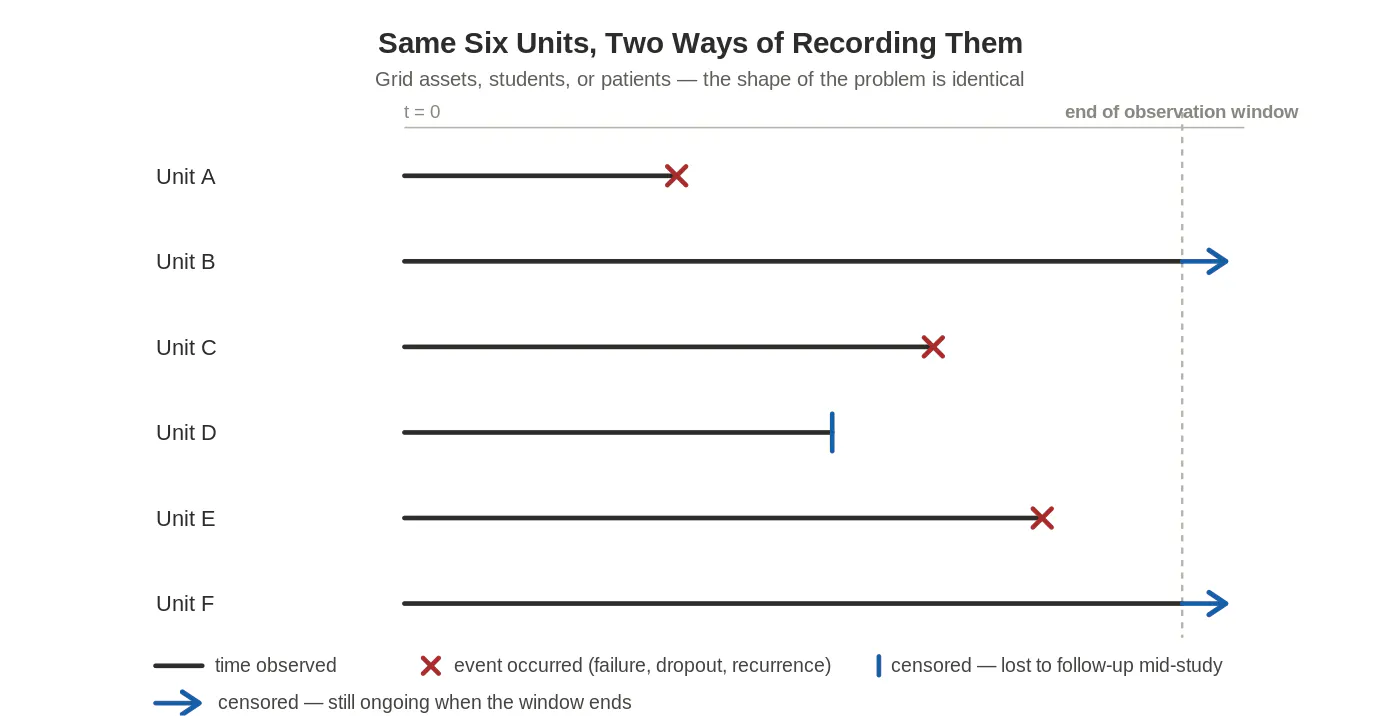
Genuinely curious whether others managing transmission or distribution asset fleets have run into teams defaulting to binary failure classification even when the underlying data — like EPRI's own database — is really asking for a survival framing instead.