


As electrification, telecom attachments, and climate resilience programs accelerate, utilities increasingly need engineering-grade visibility into the structural capacity of the poles that support the distribution grid.
When policymakers and regulators discuss grid modernization, the conversation often centers on high‑visibility initiatives: undergrounding programs, wildfire mitigation sensors, advanced grid hardening, and the rapid deployment of distributed energy resources.
Yet the success of many of these efforts ultimately depends on a far more fundamental component of the distribution system — the utility pole.
North America’s distribution grid includes hundreds of millions of poles, many of which are decades old and supporting a growing mix of electrical and telecommunications infrastructure. As utilities accelerate electrification initiatives, expand EV charging networks, and accommodate new telecommunications attachments, these structures increasingly determine how quickly — and safely — the grid can evolve.
Much of the industry’s modernization effort has focused on digitizing where assets are located. But location alone does not determine whether infrastructure can safely support new equipment or additional electrical load. Structural capacity — the ability of poles and attachments to withstand mechanical forces from conductors, equipment, wind, and environmental conditions — ultimately determines what can be built on the distribution network.
Despite their importance, many utilities still lack structural visibility into the poles that support their distribution networks. Without reliable data on pole condition, geometry, and load capacity, planners are often forced to make infrastructure decisions based on incomplete or outdated records.
As electrification accelerates and climate‑related risks intensify, the lack of structural visibility into pole infrastructure is becoming a practical constraint on how quickly the grid can evolve.
When Mapping Isn’t Enough
Over the past decade, utilities have invested heavily in geospatial technologies such as LiDAR, photogrammetry, and advanced imaging to document their networks. These tools have significantly improved asset inventories and mapping accuracy.
However, much of this data remains descriptive rather than structural.
Knowing where an asset is located does not necessarily reveal how it behaves under mechanical load, environmental stress, or evolving attachment configurations. For engineers responsible for pole load analysis and reliability planning, structural attributes such as conductor tension, attachment height, pole lean, and span geometry are critical inputs.
Traditional GIS systems excel at organizing spatial information, but they are not designed to automatically reconcile evolving structural conditions in the field. As a result, utilities often rely on records that were collected years or even decades earlier — records that may no longer reflect current infrastructure realities.
The gap between mapped infrastructure and structurally understood infrastructure is emerging as a key modernization bottleneck.
Operational Pressures Are Increasing
The distribution grid is facing a convergence of pressures.
Electrification is increasing demand on local circuits. Distributed energy resources are introducing bidirectional power flows. Telecommunications providers continue to expand fiber and wireless deployments through joint‑use attachments.
At the same time, utilities are operating under increasing regulatory scrutiny related to wildfire mitigation, resilience investments, and reliability performance.
When utilities cannot quickly determine whether a pole can support additional equipment or conductors, projects ranging from fiber deployment to DER interconnections can slow or require additional field verification.
Each of these developments places additional mechanical and operational stress on distribution infrastructure. Yet many utilities still operate with inspection cycles that occur every five to ten years, leaving significant gaps between observed conditions and the current state of the grid.
The Emergence of Structural Intelligence
In response to these pressures, the industry is beginning to explore new approaches to infrastructure modeling that move beyond simple asset identification.
Advances in computer vision, reality capture, and AI‑assisted analysis are enabling systems that can reconstruct distribution infrastructure directly from field imagery and interpret the geometric and material characteristics that influence structural performance.
Rather than simply identifying a pole in an image, these systems analyze the relationships between conductors, attachments, crossarms, and other components to produce structured models that can support engineering workflows such as pole load analysis and clearance verification.
This shift represents a move from geospatial awareness to structural intelligence — the ability to understand not only where assets are located, but how they behave under real operating conditions.
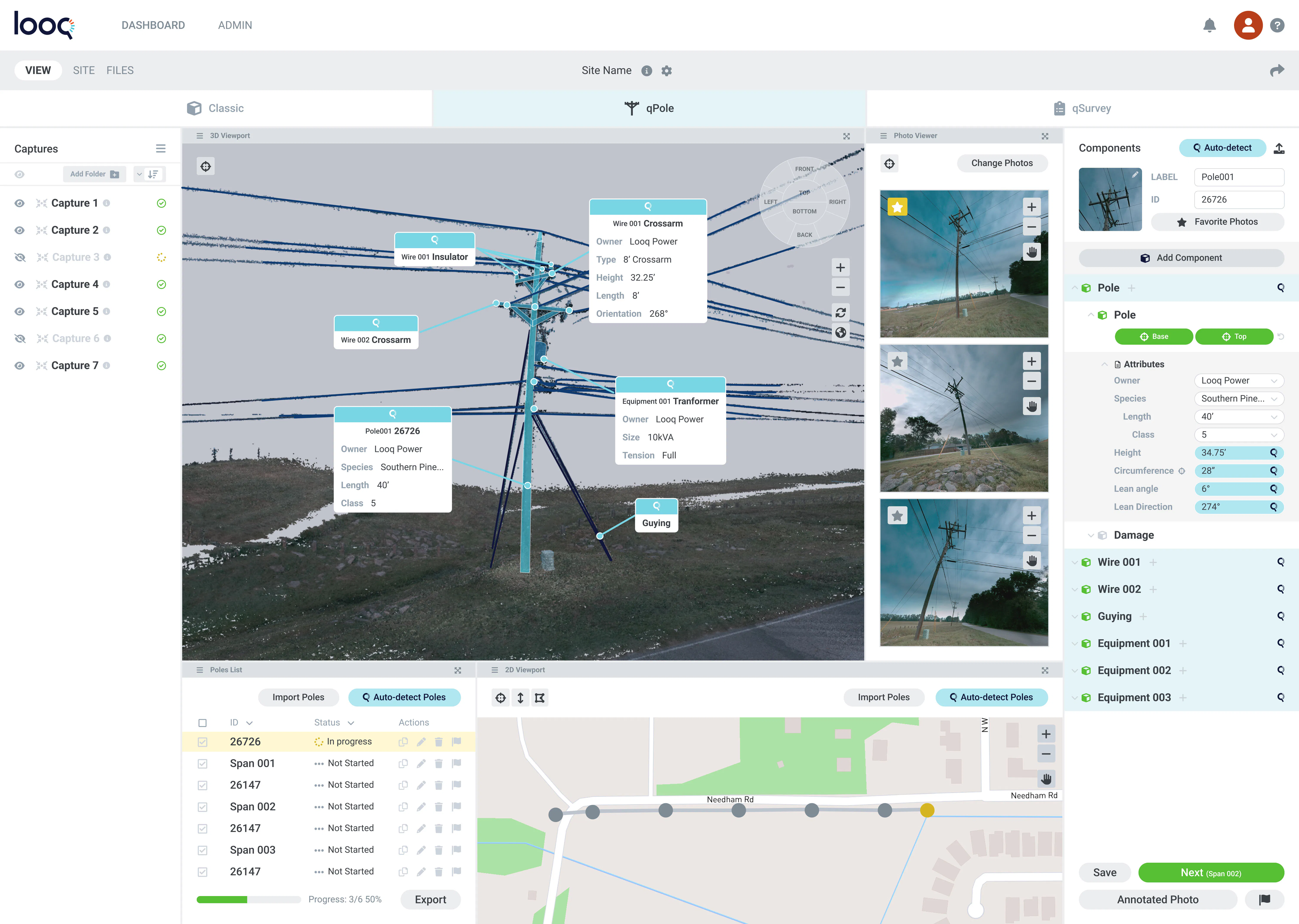
Image Caption: Example of a reconstructed utility pole model generated from field imagery, illustrating how structural components such as conductors, crossarms, and equipment can be identified and converted into engineering-ready data. Image courtesy of Looq AI.
Making Field Data Operational
Collecting accurate field data is only part of the challenge. For utilities to realize the full value of improved infrastructure visibility, this information must integrate seamlessly with the engineering tools already used for system design and analysis.
Pole load analysis platforms require structured inputs describing attachment heights, conductor spans, equipment weight, and structural geometry. When field data can be converted into these formats automatically, engineers can move more quickly from inspection to analysis.
Emerging workflows are beginning to demonstrate that structured pole modeling can dramatically reduce the time required to move from field capture to engineering‑ready models, helping utilities accelerate planning cycles while improving data consistency.
Implications for Regulation and Investment
As regulators evaluate grid modernization investments, the ability to support decisions with high‑fidelity infrastructure data is becoming increasingly important.
Outage mitigation strategies, wildfire risk reduction programs, and capital expenditure proposals all rely on credible evidence about system conditions. Structural models that accurately represent real‑world infrastructure can help utilities demonstrate where upgrades are most urgently needed and how proposed investments will improve reliability and resilience.
In that context, modernizing how utilities model and understand pole infrastructure may prove just as consequential as many of the grid technologies receiving far more public attention.
The energy transition ultimately depends on the strength and accuracy of the infrastructure that supports it. As utilities work to modernize the grid for electrification and climate resilience, improving structural visibility into distribution assets may be one of the most consequential — and least discussed — steps forward.