


Introduction
Utilities around the world are investing billions in AMI 2.0 with a clear expectation of measurable return on investment (ROI). Near real‑time meter reads, advanced grid analytics, improved outage response, and data‑driven customer engagement all promise to transform how utilities operate and compete. Yet as many organizations move from pilot to scale, an uncomfortable reality is emerging. i.e. the value of AMI 2.0 is only as strong as the completeness and trustworthiness of its data. Meter data gaps (missing, delayed, or incomplete intervals) are quietly eroding ROI long before they appear on financial dashboards.
In traditional AMI programs, gaps were tolerated as an exception to billing. If invoices closed on time, the system was deemed successful. AMI 2.0 changes that equation. High‑frequency data and event‑driven architectures mean that even short discontinuities can ripple across multiple value streams: inaccurate load forecasts, impaired DER analytics, delayed outage insights, manual data corrections, and increased customer disputes. Each intervention adds operational cost, increases risk, and stretches the payback period of the AMI investment. What initially looks like a technical data issue ultimately becomes a business efficiency and value‑realization challenge.
The irony is that many utilities already possess the technical capabilities needed to address this problem. Modern AMI 2.0 platforms can ingest late‑arriving data, replay event streams, and apply dynamic validation rules at scale. However, gap management is still frequently handled in a reactive, siloed manner. They are detected late, resolved inconsistently, or silently estimated. In these cases, utilities may meet surface‑level KPIs while steadily losing confidence in their analytics, their forecasts, and the downstream decisions that depend on them. The result is an AMI program that generates data volume but not necessarily data value.
Closing meter data gaps is therefore not about perfection; it is about maximizing return. Reliable, timely, and well‑annotated data reduces manual effort, shortens billing cycles, improves regulatory posture, and strengthens analytics outcomes. When utilities actively monitor data health and apply intelligent gap‑filling strategies, they protect the economic promise of AMI 2.0 and accelerate the realization of benefits across operations, planning, and customer engagement. In a data‑driven utility, gap management is no longer a back‑office correction—it is a frontline investment protection strategy.
How do the meter data gaps get introduced?
Meter data gaps in AMI 2.0 are introduced through a combination of device‑level events, communication network behavior, and multi‑layer system interactions across the metering data pipeline.
At the edge, smart meters may
temporarily suspend data recording or
transmission due to power outages, or
firmware upgrades, or
clock synchronization issues, or
internal buffering limits, or
hardware faults, etc.
These disruptions are often brief but can result in missing or delayed interval data, especially in high‑frequency read configurations.
At the network level,
RF mesh instability, or
cellular congestion, or
interference, or
backhaul outages
can interrupt upstream data delivery, causing partial or fragmented read sequences. In many cases, data is not permanently lost but arrives outside expected time windows, creating apparent gaps from a system perspective.
Downstream, head‑end systems (HES), message brokers, and stream‑processing platforms introduce additional gap vectors through
ingestion backlogs, or
throttling, retry limits, or
serialization errors, or
processing failures
As AMI 2.0 architectures increasingly rely on near real‑time, event‑driven data flows, even small latency spikes or short system unavailability can result in missed intervals if buffering, replay, or recovery mechanisms are misaligned.
Finally, organizational and operational factors compound the issues like
differing validation rules across HES, MDM, and analytics platforms or
delayed gap detection or
unclear ownership for remediation
can allow gaps to persist unnoticed until they affect billing, reporting, or analytics.
Taken together, these factors make data gaps an expected side effect of scale and complexity in AMI 2.0, introduced not by a single point of failure, but by the interaction of devices, networks, systems, and processes operating at near real‑time cadence.
Impact on the business revenue
Meter data gaps directly affect utility revenue by disrupting accurate energy measurement, delaying billing cycles, and increasing reliance on manual estimation. The immediate impact is often unbilled or under‑billed energy, but the secondary effects—operational cost, dispute resolution, and regulatory exposure—can be equally significant.
Meter data gaps can materially impact utility revenue even when billing is unaffected, because AMI 2.0 interval and event data increasingly drives outage detection, restoration verification (last gasp / first breath), and operational decisioning in OMS/ADMS. When AMI power loss or power restoration signals are delayed, missing, or inconsistent across a neighborhood, utilities lose the ability to confirm outage boundaries quickly and to validate restoration in near real time. The practical outcome is longer outage durations, more “truck rolls” to verify power status, slower isolation and switching decisions, and increased reliance on customer calls and field confirmation. These operational delays translate to direct costs (overtime crews, additional dispatches, fuel, contractor charges) and indirect financial exposure (reliability performance penalties, incentive reductions, or disallowed cost recovery in some regulatory models).
Let’s see it as a scenario “A storm causes localized outages. AMI events are used to detect outages and confirm restoration automatically”
Assumptions are
Customers impacted: 150,000 and Average load per customer at the time: 1.5 kW
AMI event gaps delay accurate outage boundary detection and restoration verification by: 20 minutes
Additional field verification required due to uncertain restorations: 120 extra truck rolls
Cost per truck roll (labor + vehicle + overhead): $450
Overtime/contractor uplift during storm operations: $60,000
Reliability performance exposure (incentive/penalty/risk-adjusted value): $0.04 per customer‑minute (representing avoided incentive loss or penalty risk, used here as a planning proxy)
Direct Operational Cost (Truck Rolls + Overtime)
Truck roll cost = 120 × $450 = $54,000
Overtime/contractor uplift = $60,000
Direct incremental cost = $114,000
Reliability Exposure (Customer‑Minute Impact)
Customer‑minutes added = 150,000 × 20 = 3,000,000 customer‑minutes
Risk‑adjusted reliability exposure = 3,000,000 × $0.04 = $120,000
Total Financial Impact (Non‑Billing)
Total impact = $114,000 + $120,000 = $234,000 attributable to delayed/missing AMI events and the operational uncertainty they create.
Interpretation: A 20‑minute loss of AMI visibility during a single large event can add hundreds of thousands of dollars in operational cost and reliability exposure—without changing a single billed kWh.
What’s Changing: New Approaches to Gap Management
What is fundamentally changing in AMI 2.0 gap management is a shift from reactive correction to proactive confidence management. Traditionally, data gaps were discovered late like often during billing and addressed through static estimation rules or manual reprocessing. Modern AMI 2.0 platforms, however, are enabling gap management to move upstream and closer to real time. Utilities should increasingly be detecting gaps as they form, rather than after downstream impact, by monitoring data flow across meters, networks, head‑end systems, and streaming pipelines. Instead of treating missing data as an exception to be fixed, leading organizations treat it as a measurable condition to be observed, classified, and acted upon based on business impact.
Another important change is the move away from binary “valid or invalid” data judgments toward confidence‑based data usage, where late, reconstructed, or estimated reads are retained but assigned explicit confidence scores. This allows billing, operations, and analytics teams to make informed trade‑offs between timeliness, accuracy, and risk. Architecturally, re-playable event streams, late‑data acceptance windows, and idempotent reprocessing are replacing rigid batch correction cycles, making recovery more automated and less disruptive. Operationally, gap resolution is no longer handled solely within meter data management systems but is coordinated across HES, streaming platforms, OMS, ADMS, and analytics environments, with clear lineage and traceability. Most significantly, gap remediation is becoming business‑prioritized rather than uniform—critical use cases such as outage restoration, regulatory reporting, or revenue assurance receive faster and stronger recovery guarantees than lower‑impact analytics. Together, these changes reflect a maturing understanding that gaps are unavoidable in large‑scale digital infrastructures, but unmanaged gaps are not. The new approach recognizes gap management as a continuous capability that protects the reliability, economic value, and decision confidence of AMI 2.0 programs.
What Good Monitoring Looks Like
Effective gap management in AMI 2.0 depends on how well utilities can see, understand, and act on data gaps in near real time. Monitoring is no longer just a technical dashboard—it is a business control system that ensures data reliability, protects revenue, and supports operational decisions. Leading utilities are evolving monitoring capabilities across three key dimensions:
Simple, Intuitive Dashboards
Good monitoring starts with clarity and usability. Dashboards must present complex data flow conditions in a way that both technical and business users can quickly interpret and act upon.
Key characteristics include:
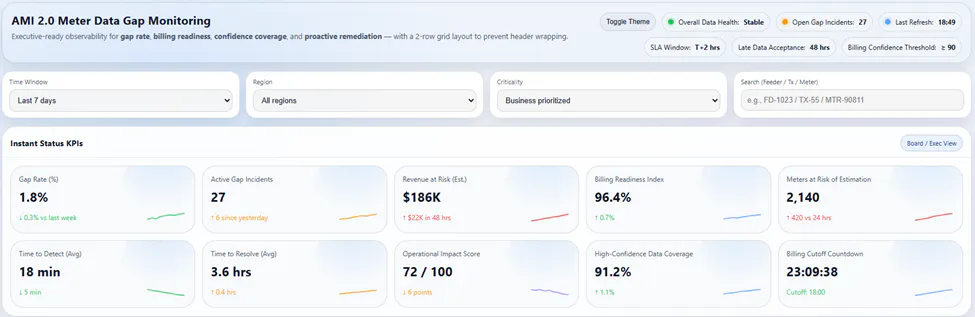
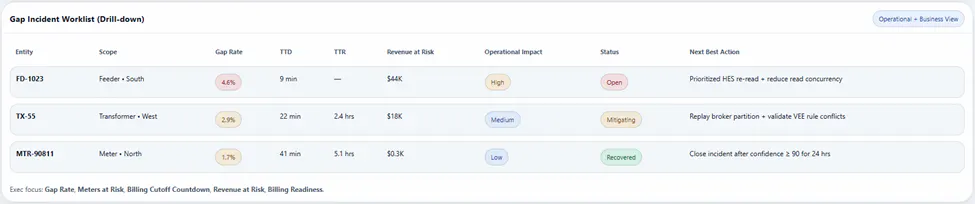
At‑a‑glance summaries: Total active meters, % of meters with gaps, and number of active gap incidents
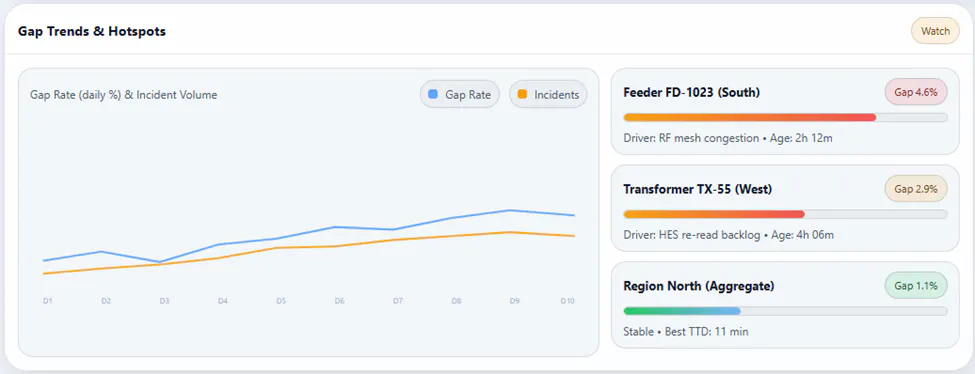
Visual prioritization: Use of color coding (e.g., red/amber/green) to highlight severity and urgency
Hierarchical drill‑down: From system‑wide view → region → feeder → transformer → meter
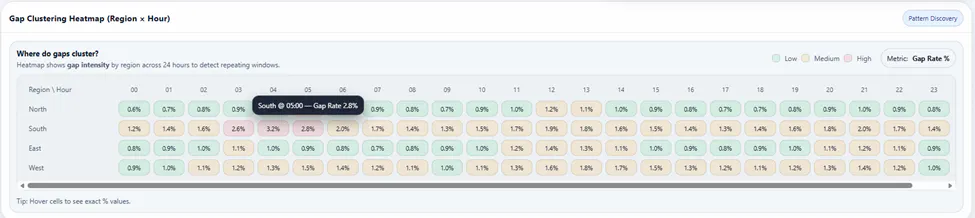
Time‑based trends: Hourly/daily gap patterns to identify recurring or systemic issues
Correlation overlays: Ability to map gaps against outage events, network issues, or system incidents
The goal is to eliminate the need for manual analysis and enable instant situational awareness. A well‑designed dashboard ensures that teams can move from detection to decision within minutes.
Business‑Centric Metrics
Traditional monitoring focused on technical indicators (packet loss, retries, system logs). In AMI 2.0, effective monitoring translates these into business‑relevant metrics that stakeholders can understand and act on.
Examples of business‑aligned metrics include:
Gap Rate (%): Percentage of expected reads missing over a defined interval
Revenue at Risk: Estimated financial exposure due to missing or unverified data
Time to Detect (TTD): How quickly gaps are identified after occurrence
Time to Resolve (TTR): How long it takes to recover or fill gaps
Billing Readiness Index: Percentage of meters meeting billing confidence thresholds
Operational Impact Score: Effect of gaps on outage detection, load forecasting, or DER visibility
By linking data gaps to financial, operational, and regulatory outcomes, these metrics elevate gap management from an IT issue to a business performance indicator.
Proactive Alerts and Intelligent Triggers
Monitoring is only effective if it enables timely action. Modern AMI 2.0 environments are moving toward proactive alerting systems that identify issues before they escalate into business impacts.
Key capabilities include:
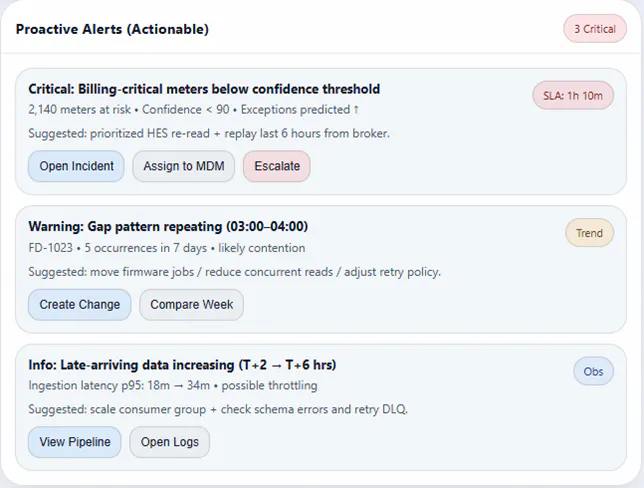
Threshold‑based alerts: Trigger alerts when gap rates exceed predefined limits (e.g., >2% missing reads in a feeder)
Pattern‑based detection: Identify recurring gaps (same meter, same time window, same network segment)
Event‑driven alerts: Correlate gaps with outages, firmware updates, or communication failures
Priority‑based escalation: Automatically route high‑impact gaps (e.g., billing‑critical meters) to the right teams
Predictive alerts (emerging): Use historical patterns to anticipate potential gaps before they occur
Proactive alerting ensures that gaps are addressed at source, reducing downstream effects such as estimation, manual corrections, or delayed decision‑making.
How AMI 2.0 Enables Smarter Gap Filling
AMI 2.0 fundamentally changes gap‑filling capabilities by moving from rigid, batch‑driven correction to flexible, event‑driven recovery mechanisms embedded across the data pipeline. Unlike earlier architectures where missing data was handled retrospectively within Meter Data Management (MDM) systems, AMI 2.0 introduces distributed intelligence across head‑end systems, streaming platforms, and analytics layers. This shift enables utilities to recover data more accurately, quickly, and transparently, reducing reliance on estimation and improving overall data confidence. Three key capabilities underpin this transformation: event replay, late data acceptance, and cross‑system coordination.
Event Replay (Recovering Data from the Stream)
In AMI 2.0, meter data is typically transmitted through event streaming platforms (e.g., message brokers). These platforms maintain durable logs of meter events, allowing systems to replay data from a specific point in time.
When a downstream failure occurs (e.g., MDM outage or processing error), data is not lost instead it can be reprocessed by replaying the event stream. Utilities can selectively replay for Specific meters, Time windows (e.g., missing 02:00–04:00 interval) or the Entire partitions (e.g., feeder or region). Replay ensures consistency using idempotent processing, avoiding duplication.
The process eliminates permanent data loss in many scenarios, reduces need for estimation by recovering original meter reads and enables faster recovery aligned with SLAs (instead of batch re‑runs overnight). Event replay converts data gaps from irrecoverable failures into recoverable pipeline delays.
Late Data Acceptance (Beyond Rigid Cutoffs)
Traditional systems imposed strict cutoffs—if data did not arrive within a defined window, it was ignored or estimated. AMI 2.0 should introduce configurable late data acceptance windows, allowing systems to incorporate delayed but valid data.
Systems should accept data even if it arrives hours or days after expected intervals or after initial estimation or validation steps. Late data can replace previously estimated values, update downstream systems with corrected reads and trigger recalculation of aggregates or billing determinants.
The process improves accuracy without delaying operations unnecessarily, reduces permanent estimation and associated revenue/analytics risk and balances timeliness vs accuracy dynamically. Late data acceptance shifts utilities from time-bound data rejection to value-aware data incorporation.
Cross‑System Coordination (End‑to‑End Gap Resolution)
AMI 2.0 environments will involve multiple systems—HES, message broker, MDM, OMS/ADMS, analytics platforms, each with visibility into different aspects of data gaps. Smarter gap filling requires coordinated action across these layers.
Gap detection may occur in HES (missing reads from meter) or Streaming layer (message delays) or MDM (validation failures). Recovery actions are orchestrated across systems where HES initiates re‑read requests, Streaming layer replays missed events and MDM applies validation and reconciliation. Shared metadata ensures Data lineage tracking (actual vs estimated vs reconstructed) and Single version of truth across platforms.
The operations are enhancements with centralized monitoring dashboards integrating signals from all systems, automated workflow route gap incidents to responsible teams and SLA‑driven prioritization ensuring critical gaps are resolved first.
The process eliminates siloed handling of gaps, improves resolution speed and accountability and ensures consistency across billing, operations, and analytics. Cross‑system coordination transforms gap filling from a system‑specific task into an enterprise data reliability process.
Final Section: What Utility Leaders Should Do Next
As utilities continue to scale AMI 2.0, managing meter data gaps must move beyond a reactive, system‑level activity and become an enterprise‑wide capability tied directly to value realization and risk management. Three strategic actions are critical to achieving this shift.
First, utilities must treat data gaps as a platform concern, not an isolated application issue.
Meter data flows span multiple layers—from field devices and communication networks to head‑end systems, streaming platforms, MDM, and downstream analytics. Gaps introduced at any point propagate across the entire value chain, affecting billing accuracy, operational decisions, and regulatory reporting. Addressing them effectively requires a holistic, platform-level approach, with clear ownership, shared data definitions, and coordinated remediation workflows across IT, OT, and business teams.
Second, investing in observability is essential to enable proactive gap management.
Traditional monitoring approaches focused on system uptime and technical metrics are insufficient in AMI 2.0 environments. Utilities must adopt business-aware observability frameworks that track gap rate, data timeliness, confidence levels, and downstream impact in near real time. This includes intuitive dashboards, intelligent alerting, and end‑to‑end data lineage visibility. With strong observability, utilities can detect gaps early, prioritize them based on impact, and act before they translate into revenue loss, operational inefficiencies, or customer dissatisfaction.
Finally, gap management policies must be aligned with business risk, not applied uniformly.
Not all data gaps carry the same consequence. Billing‑critical intervals, outage‑related events, and regulatory reporting data demand higher accuracy and stricter SLAs, while lower‑impact analytical use cases can tolerate controlled levels of uncertainty. Leading utilities are adopting risk‑based gap policies, supported by confidence scoring and differentiated recovery strategies, ensuring that effort and investment are focused where they deliver the highest return.
In combination, these actions reposition gap management as a core discipline within AMI 2.0 operations—one that safeguards revenue, strengthens decision confidence, and ensures the long‑term success of digital utility transformation initiatives.