


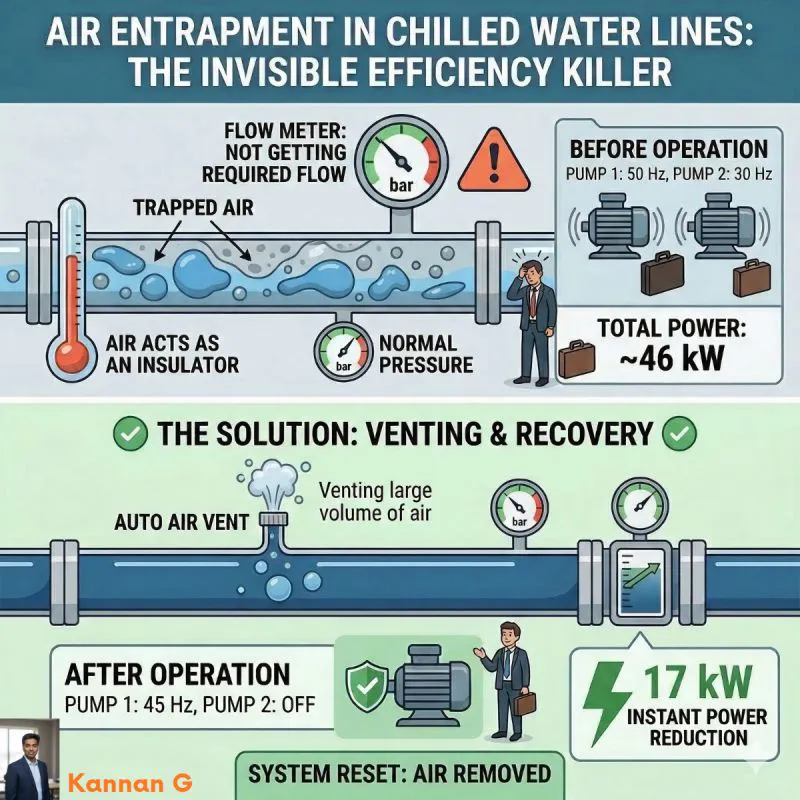
HVAC and industrial cooling, we often focus on descaling tubes, checking refrigerant levels, or optimizing VFD settings. However, one of the most common and overlooked efficiency killers is simple atmospheric air trapped within the chilled water circuit.
I was faced with many audits of this problem, but recently in the food industry in Trichy, I encountered a system where air entrapment wasn't just a minor nuisance. it was forcing the plant to run double the required pumping power.
1. Why Air is a Problem
Air in a closed-loop chilled water system creates three major issues:
The Insulator Effect: Air has significantly lower thermal conductivity than water. When air bubbles coat the internal surfaces of heat exchanger tubes (evaporator/condenser), they act as an insulating barrier, drastically reducing the heat transfer coefficient.
Flow Resistance (Air Locks): Air pockets tend to settle at the high points of piping. These pockets reduce the effective cross-sectional area of the pipe, acting like a partially closed valve.
Pump Cavitation & Wear: Air entering the pump impeller causes noise, vibration, and pitting, leading to premature mechanical seal failure.
Normal Pressure, Low Flow:
We observed a peculiar situation:
The pressure drop across the evaporator and condenser lines appeared normal.
Despite this, the flow meter showed almost low water flow.
Even starting a second pump only marginally increased the flow.
Air as an Insulator and Obstruction:
Next steps,When I manually opened the Auto Air Vent (AAV) lines, we didn't get water-we got a massive, sustained release of trapped air. This "air lock" was creating artificial resistance that the pumps simply couldn't overcome efficiently.
We coordinated a one-hour total plant room shutdown on a Sunday. By allowing the system to settle and systematically bleeding the air from the high points:
The air traps were cleared.
Water flow was restored to design specifications.
We were able to switch back to a single pump.
The Results (The ROI)
Before: Two pumps running at 50Hz and 30Hz.
After: A single pump running at 40Hz.
Net Savings: 17 kW of instant power reduction.
Key Takeaway:
Don't always trust the pressure gauges alone. If your flow is low but your pumps are working overtime, you might be pumping air instead of water. Regular maintenance of Auto Air Vents and manual bleeding at high points isn't just "housekeeping"-it’s an energy-saving strategy.
Have you ever faced a stubborn air lock in your HVAC systems? Let's discuss in the comments.