


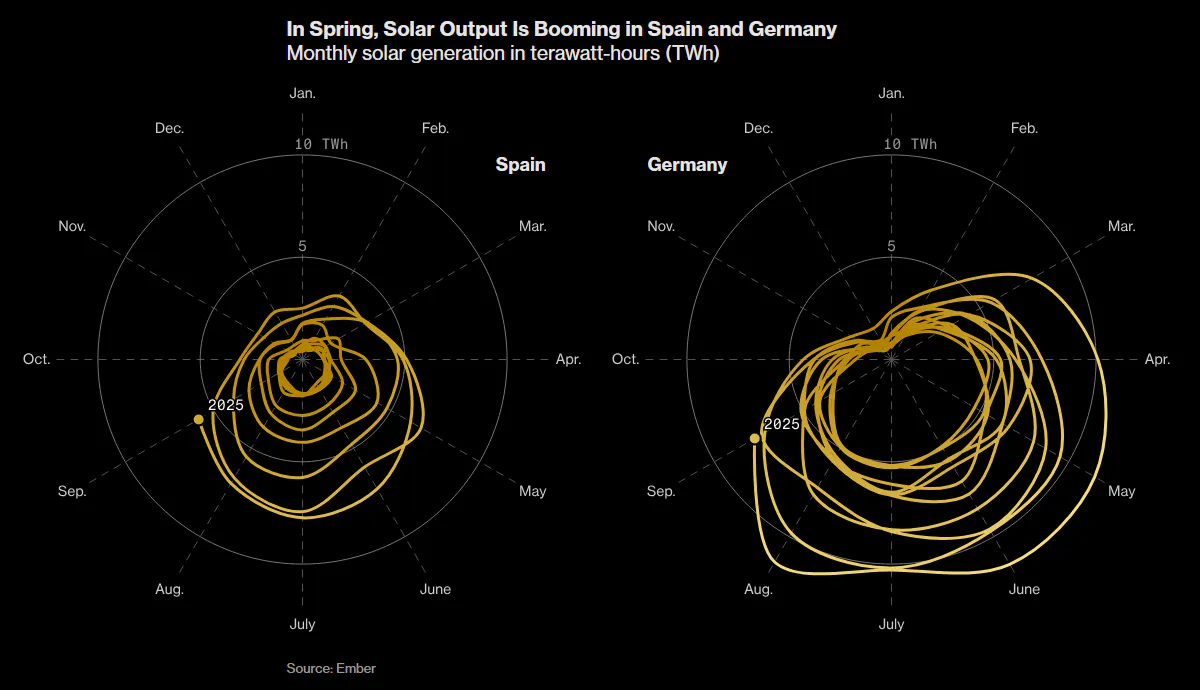
In summer, we waste energy. In winter, we freeze. Bloomberg just showed the truth — Europe’s “Green Deal” forgot the seasons.
Europe’s “Green Deal” has quietly collapsed.
The world’s largest financial players saw it coming first.
BlackRock and Vanguard both pulled out in December 2024, followed by several institutional investors who realized that the European energy transition had become structurally unprofitable.
Since then, a wave of reports — from Euronews, Reuters, Bloomberg, and now even Bill Gates — has confirmed what markets already knew:
Europe’s electricity networks are outdated, prices are rising, and volatility is no longer a temporary symptom but a systemic condition.
The April 2025 blackout on the Iberian Peninsula exposed how fragile the grid has become.
Power generation from wind and solar can no longer be synchronized with demand; inverter-dominated systems lack inertia and overload existing transmission lines.
The so-called “green revolution” has produced the same outcome as every over-optimized system: instability through complexity.
To make matters worse, a cyber-security alert from the Czech National Agency (NÚKIB) revealed that 95–99 % of installed solar inverters come from China.
If Beijing ever decided to disrupt Europe’s power grids, it could do so without a missile — just a software command.
This is no longer a debate about climate policy.
It’s about sovereignty.
And sovereignty requires storage — not ideology.
TSTM (Tubular Storage Tank Modules) provide that missing layer of resilience.
They store renewable energy mechanically as compressed gas, without electronics, firmware, or external control.
They turn volatility into stability — and dependence into autonomy.
🔗 Read the full paper:
TSTM as a Solution to the Structural Contradictions of the Energy Transition