


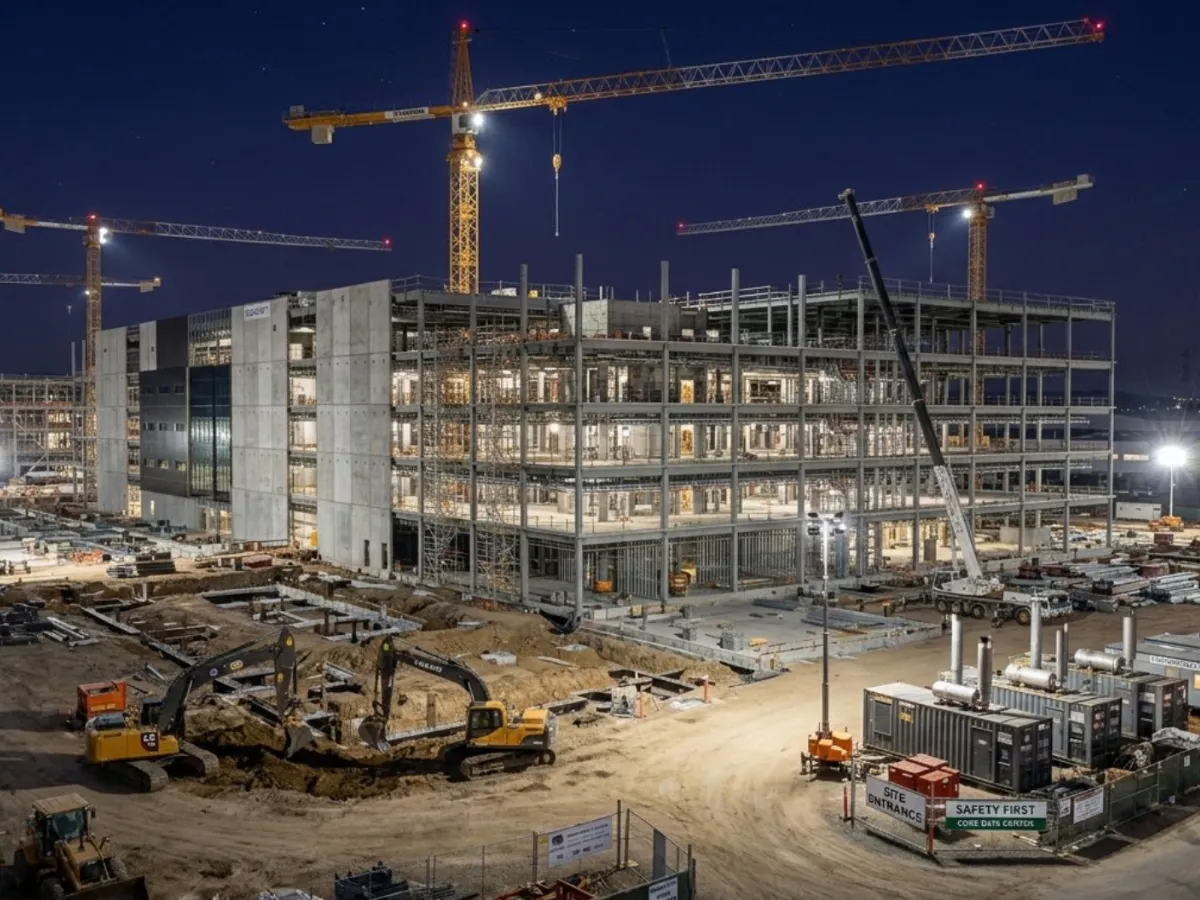
The global data center construction boom creates intense infrastructure demands. Developers currently manage 23.1 gigawatts (GW) of data center capacity under construction globally, split across 831 sites. Builders place 73.5% of this development within the Americas.
This surge fuels heavy financial investments, totaling 77.7 billion dollars in U.S. construction starts. Managing these projects requires staffing, pushing the construction workforce to between 0.7 and two workers per megawatt (MW) capacity, and some facilities can reach 100 MW or more.
However, local electrical infrastructure limits progress. Projects face severe grid interconnection delays lasting three to four years across energy markets, such as PJM and ERCOT. This figure accounts for active projects only, as new projects often take longer to start.
Extended grid delays reshape power procurement strategies during data center construction. Rental economics increasingly favor flexible generator solutions over traditional purchased backup systems. Data center operators now face tough choices about temporary power during construction, which directly alter project timelines, budgets and operational readiness.
The Grid Interconnection Bottleneck
Transmission infrastructure lags heavily behind surging data center power demands. The following delays are causing bottlenecks and forcing construction managers to rethink how they evaluate generator value.
PJM Fails to Gather Enough Power
PJM’s December 2025 capacity auction failed to procure enough power, falling 6,625 megawatts short of reliability targets. This shortfall represents the entire electricity demand of Philadelphia. This is significant, as PJM is the nation's largest grid operator and serves over 65 million people across 13 states and the District of Columbia.
Meanwhile, average connection timelines expand. Facilities that achieved operational status spent an average of over eight years getting interconnected, a fourfold increase from the sub-2-year timelines in 2008. This bottleneck strands infrastructure in lengthy queues, including facilities in Northern Virginia, which route 70% of global internet traffic.
Federal Regulations Stall Progress
The Federal Energy Regulatory Commission (FERC) Order No. 2023 transitions operators to a first-come, first-served cluster study model. However, regional grid operators are working through transition periods that require developers to post new milestone payments and prove site control.
The FERC acknowledges that Order No. 2023 primarily targets generation facilities rather than the massive, localized power draws of artificial intelligence data centers. To address these load-specific constraints, federal authorities are proceeding with a separate Advance Notice of Proposed Rulemaking on large-load integration.
Stalling Market Requirements
The regulatory lag collides with accelerating market requirements. Artificial intelligence and machine learning workloads fuel capacity needs, contributing to a projected 160% increase in power demand by 2030. This power crunch introduces intense capital pressure as developers face steep construction costs between $488 and over $1,000 per square foot.
As a result, grid congestion forces operators to re-evaluate their primary infrastructure strategies to prevent long-term project stagnation. Many construction sites have had to consider how they will receive power to facilities, and the solution can be from traditional or rental generators.
The Construction Phase Power Challenge
Power challenges begin the moment construction starts. There are certain challenges that construction professionals should be aware of before considering a generator.
Power Demands Evolve Across Construction Phases
Data center infrastructure requires distinct power configurations at different building phases. In the early stages, construction workers may use generators to power machinery, industrial cranes and diagnostic systems. These power requirements expand during the precommissioning phase, where testing teams run load banks to simulate full mechanical and electrical stress.
However, the most severe operational friction occurs during the early operational stages. Many large data centers require hundreds of megawatts to operate, and these buildings cannot get that power even when connected to the grid. Electricity demand is expected to rise by 15% to 20% through 2030, further exacerbating the problem.
The Traditional Purchase Approach and Why It Is Breaking Down
Historically, data center developers purchased permanent backup generator units up front, assuming that utility hookups would take less than three years. Under that old model, the equipment powered all construction phases before transitioning to backup or emergency roles soon after. Multiyear connection backlogs disrupt this strategy through several compounding factors:
Asset deterioration: Generators depreciate and lose value when sitting unused or when serving as the primary power source on a construction site for half a decade.
Regulatory Upgrades: Environmental mandates and emission caps advance during this time, risking technological obsolescence that makes equipment unsellable.
Capacity Incompatibilities: Early equipment decisions lock developers into generators that fail to support evolving demands for artificial intelligence hardware.
Capital Freezes: Financial teams tie up millions of dollars in depreciating hardware instead of preserving capital for site expenses or scaling.
Overhead Expenses: Long-term ownership requires continuous preventive maintenance and specialized field technicians to monitor generators.
This reality forces construction supervisors to re-evaluate purchasing practices and look beyond traditional approaches. What constitutes the “best value” changes. More importantly, the features professionals should look for in a value-oriented construction generator also change.
The Total Cost of Ownership Shift
Extended utility grid queues reshape the financial metrics governing data center development. When construction timelines exceed five years, teams look beyond up front equipment costs. Foley Power Systems Rentals, a heavy equipment and generator rental company in the United States, is seeing this change firsthand. "We are seeing a significant shift in how construction managers evaluate power solutions for long-duration projects,” says Foley Power Systems Rentals.
The company elaborates, “Five years ago, most data center developers planned for 24-36 month construction timelines and purchased generators accordingly. Today, the path to grid energization has changed completely. Between interconnection studies, transmission buildouts, substation upgrades and construction, projects in major markets are facing 7-8 year timelines from initial power planning to final energization.”
Foley Power Systems Rentals is also noticing that customers are asking different questions now, stating, “Customers are asking: ‘What's the total cost of ownership over 7-8 years, not just the up front price?’ ‘How do we maintain flexibility as construction phases evolve and grid timelines shift?’ ‘How do we ensure we are not locked into technology that will be obsolete by the time we reach full grid capacity?’” It is evident that customers are looking at generator rentals as a cost-effective, long-term partnership.
The Rental vs. Purchase Decision Framework
Determining the optimal approach to securing on-site power requires a financial framework. Developers balance immediate costs with long-term utility to maximize asset value.
When Purchase May Still Make Sense
Despite broad industry shifts toward temporary power systems, purchasing equipment up front is still a practical solution for many companies. Purchasing a power solution is generally ideal for short grid delays of up to three years. After connectivity occurs, the hardware can transition to a standby role.
Organizations can take advantage of tax benefits under Section 179 that allow for equipment deductions. Ownership also suits companies with established, internal technical teams that perform complex machinery service. Projects with static power requirements across all building phases benefit from the long-term control that equipment ownership delivers.
When Rental Economics Makes Sense
Temporary rental programs offer strategic and financial advantages when:
Extended grid delays last five or more years.
Timeline uncertainty arises from regulatory approvals.
Capital preservation is important in a volatile construction market.
Scalability requirements are important during certain construction phases.
Fuel cost changes disrupt cash flows.
Employment freezes, or companies are unable to hire local maintenance workers.
Technology depreciation is inevitable due to long time frames.
With an 8-year grid delay, many projects benefit from a high-value construction generator rental.
When to Take a Hybrid Approach
Some developers blend both strategies to manage risk across different development stages. Teams may secure flexible rental units during early construction phases. They may consider using a generator in the first three years while they assess connectivity times. As companies become aware of the delay, they can re-evaluate their options.
This method allows companies to purchase permanent backup assets roughly 12 to 18 months before energization. Companies can leverage rental experience to inform permanent equipment sizing decisions. This approach offers flexibility with the potential for ownership.
The Broad Industry Implications
The interconnectivity backlog is changing the broader commercial energy market. Power procurement choices are altering how the industry is handling the backlog.
Market Response to Extended Timelines
Extended grid delays are changing the industrial generator rental sector. Between 2018 and 2024, diesel generator capacity at U.S. data centers nearly tripled from 20 GW to 55 GW. As the need for backup power booms, data center construction projects are becoming a growing share of equipment rental volume, forcing equipment suppliers to expand their fleet inventories.
The mid-Atlantic region, particularly Virginia, requires more power as projects expand. The mobile power generation equipment rental market is an indication of this need. In 2024, the market size was estimated at $6,095.8 million. By 2030, it may exceed $8,906.3 million.
Backup Generation as Grid Resource
Grid resilience and extended construction timelines are central to the power generation issue. However, the U.S. Department of Energy issued emergency orders in January and May 2026 that highlight the importance of backup generators as a grid resource during extreme weather.
The DOE estimates that more than 35 GW of surplus backup generation remains available. U.S. Energy Secretary Wright states that the administration “will continue taking action to ensure that the 35 GW of untapped backup generation that exists across the country can be deployed as needed during Winter Storm Fern and in the future.”
This backup power is equivalent to 35 large power plants, indicating a significant amount of power is available but underutilized. Long-term temporary generator deployments at data center sites expand this decentralized resource pool. This could provide additional power reserves to bolster local grids during peak demand and other high-stress periods.
Eliminating the Data Center Construction Queue is Important
Extended grid backlogs alter the baseline economics of data center development across the construction pipeline. When connection timelines stretch to eight years, purchasing a generator up front may no longer be financially advantageous.
Multiyear infrastructure delays cause heavy capital investments to lose value and become technologically obsolete before ever handling live computing workloads. For this reason, the best value industrial generator is often a rental.
Transitioning to flexible rental models allows developers to preserve capital, adapt electrical capacity to active construction phases and ensure compliance with shifting environmental mandates. Modern data center builders should consider implementing adaptable temporary power strategies to successfully withstand multiyear grid connection delays.