


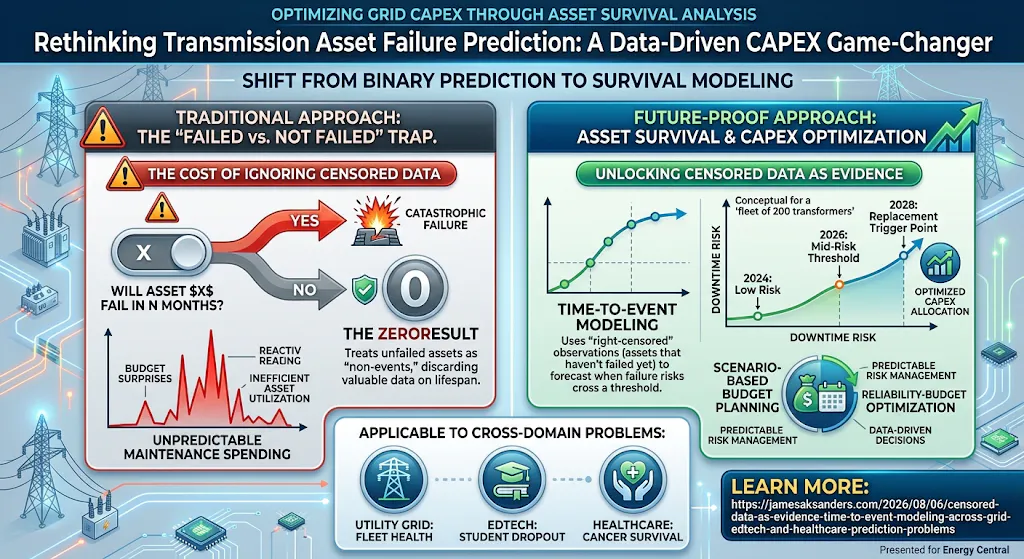
If you are managing transmission or distribution assets, your capital allocation team is likely making a costly assumption every time they run failure risk models: treating thousands of operational assets as "non-events."
When asset management teams rely on standard binary classification ("Will asset X fail in the next 12 months—yes or no?"), they throw away critical survival data. An in-service transformer or circuit breaker that hasn't failed yet isn't a blank datapoint—it is a right-censored observation. It carries crucial statistical bounds on when future fleet failure risks will cross acceptable operational thresholds.
EPRI’s Transmission Asset Database illustrates the sheer scale of this missed opportunity. Tracking 11 asset categories across 80 international utilities, the database monitors:
43,213 in-service assets
4,746 recorded failures
1,832 retired assets
If your analytical tools discard those 43,000+ healthy assets as mere background noise, your multi-year CAPEX and downtime-risk forecasts are missing key failure-timing parameters.
Leading operators are already shifting away from binary predictions toward survival modeling. For instance, research on high-voltage instrument transformers on the Dutch grid (Khuntia et al., 2022) applied Kaplan-Meier and Weibull survival analysis to decades of inspection data. Instead of asking a binary "if" question, they modeled when fleet failure risks would spike, allowing them to optimize multi-year maintenance budgets and replacement CAPEX long before catastrophic events occurred.
In my deeper dive on this topic, Censored Data as Evidence: Time-to-Event Modeling Across Grid, EdTech, and Healthcare Prediction Problems, I break down:
Why interpretable time-to-event frameworks (like Cox Proportional Hazards and Kaplan-Meier) often outperform complex neural formulations in real-world grid environments.
How the exact same survival framework solves hidden prediction traps across utility asset health, higher-ed student dropout risk, and clinical oncology.
Question for the Energy Central Community:
Are your asset planning teams currently incorporating right-censored survival data into long-term CAPEX planning, or are predictive models at your utility still defaulting to binary 12-month classification windows? I’d love to hear how others are bridging the gap between reliability modeling and budget planning.