The integration of distributed energy resources (DERs) in residential microgrids necessitates sophisticated energy management systems capable of real-time decision-making. This article examines the architecture and operational principles of real-time energy storage dispatch systems, highlighting their role in optimizing energy flow, reducing costs and enhancing supply resilience.
Introduction: Residential microgrids represent a paradigm shift in distributed energy management, combining photovoltaic (PV) systems, battery energy storage systems (BESS) and conventional grid connectivity. The energy storage dispatch system serves as the intelligent controller that orchestrates power flow between these components, responding dynamically to generation patterns, consumption and economic signals.
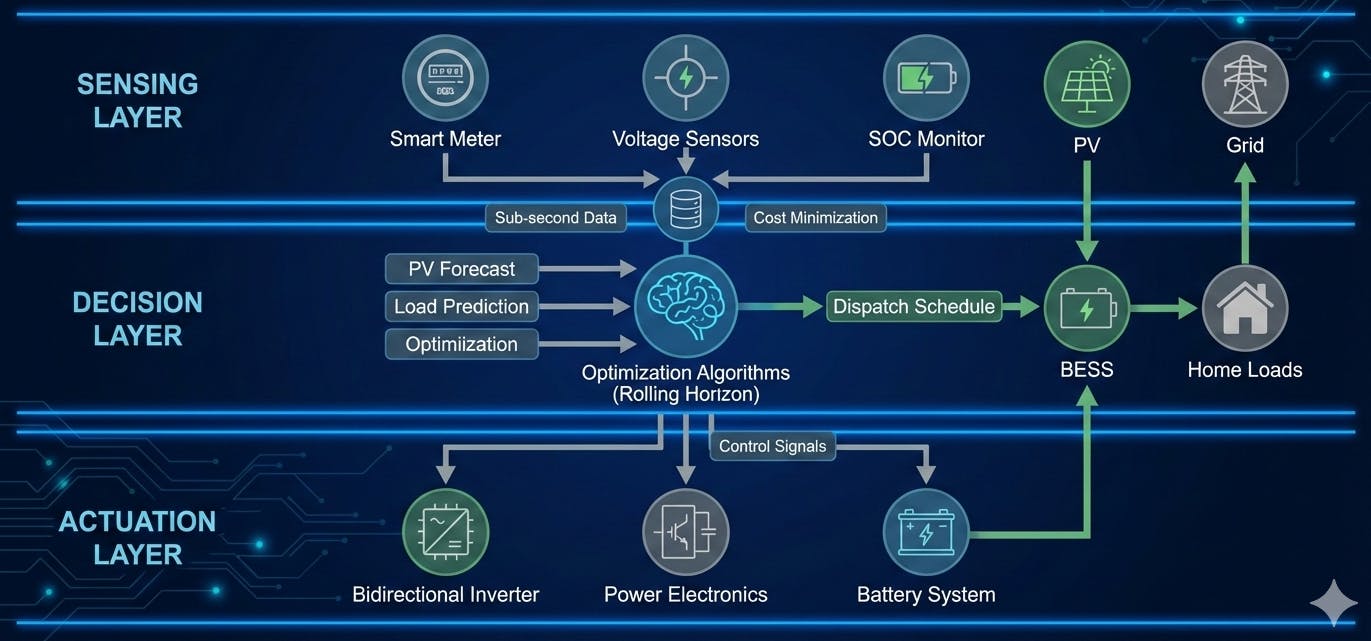
System Architecture: The dispatch system comprises three primary layers: the sensing layer, the decision layer and the actuation layer. The sensing layer incorporates smart meters, voltage sensors and state-of-charge (SOC) monitors that provide real-time data at sub-second intervals. The decision layer employs optimization algorithms that process incoming data streams to determine optimal dispatch schedules. The actuation layer translates these decisions into control signals for bidirectional inverters and power electronic interfaces.
Operational Methodology: Real-time dispatch operates on rolling optimization horizons, typically ranging from 15 minutes to several hours. The system continuously solves a constrained optimization problem that minimizes operational costs while satisfying technical constraints including battery capacity limits, ramp rate restrictions and power quality requirements. The objective function incorporates time-of-use electricity cost, battery degradation costs and potential revenue from grid services such as demand response or frequency regulation. Advanced systems incorporate forecasting modules that predict solar generation and load demand using machine learning algorithms trained on historical patterns and weather data. These predictions enable proactive dispatch decisions that preemptively charge batteries during low-cost periods or reserve capacity for anticipated peak demand intervals.
Technical Challenges: Several technical challenges complicate real-time dispatch implementation. Forecast uncertainty requires robust optimization techniques that account for prediction errors through stochastic programming. Battery degradation modelling must accurately represent capacity fade and resistance growth as functions of cycling depth, temperature and SOC levels. Communication latency and cybersecurity concerns necessitate fail-safe operating modes and encrypted data transmission protocols.
Performance Metrics and Benefits: Properly implemented dispatch systems demonstrate significant performance improvements. Field deployments report 20-35% reductions in electricity costs through peak shaving and energy arbitrage. Self-consumption rates, the fraction of PV generation consumed on-site, increase from typical values of 30-40% to 60-80% with coordinated storage dispatch. These systems enhance power quality by mitigating voltage fluctuations and providing backup power during supply failure.
Conclusion: Real-time energy storage dispatch systems represent a critical enabling technology for residential microgrids, transforming passive energy consumers into active participants in grid management. As battery costs decline and regulatory frameworks evolve to compensate distributed resources for grid services, these systems will become increasingly sophisticated, incorporating vehicle-to-grid integration, peer-to-peer energy trading and coordinated multi-microgrid operations. Continued research in optimization algorithms, degradation modelling and communication protocols will further enhance their performance and reliability.