"Still No Miracles Needed" is a 2026 book by Mark Z. Jacobson, with subtitle How Today's Technology Can Save Our Climate and Clean Our Air. I'm reading it now, + enjoying its textural detail. Leaving out all the footnotes in the back, only 392 pages. What I want to discuss is material from pages 38-39. In the context of controlling the multiple generators on the electrical grid, having units that can quickly come up to speed is essential.
Batteries + capacitors are well-nigh instantaneous. Hydropower, from reservoirs behind dams, can come up to full power in 15-30 seconds, the time required for water to fall thru an opened sluice gate + down a penstock, rapidly getting the turbine-generator rotating at full speed. In comparison, a fossil methane peaking gas turbine takes 300 seconds = 5 minutes. A combined-cycle gas turbine needs 600-1200 seconds = 10-20 minutes.
Already operating coal + nuclear power plants may be able to ramp up to full power in 20-100 minutes, though a cold start from zero output takes several days. I have seen nuclear power fallaciously claimed to be dispatchable power, implying immediately able to alter its output. Classic misinformation meant to confuse. Or I suppose you could call it propaganda instead.
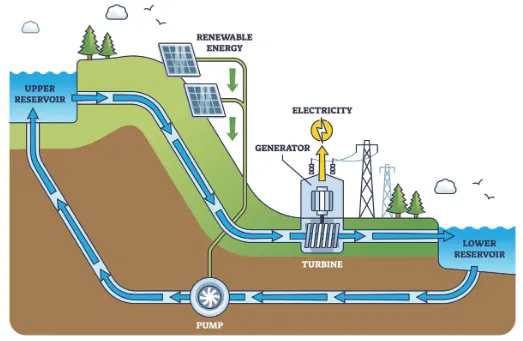
The other main issue I want to get into is pumped hydro, where at times of cheaper, excess electricity availability, pumps can lift water to lakes or reservoirs at greater height, storing power which in time of need can gravitationally fall + turn the pump motor in reverse—operating as a generator. May come as a surprise to some that globally this represents 95% of energy storage. Most of the stories in mainstream media focus on the proliferating types of electrochemical batteries + heat storage modalities.
"Worldwide, about 616,000 potential pumped hydro sites exist...[which could] store an estimated 23 million gigawatt-hours of electricity." Drumroll please. This represents over 100 times the power needed to back up a 100% renewable grid. Which implies development of only 1% or 2% would be sufficient. Cool, right?