


AI’s surge is no longer a future scenario—it’s already beginning to reshape the U.S. power system. EPRI’s 2026 Powering Intelligence study, an update from its 2024 study on the same topic, shows just how consequential that shift could be: data centers, particularly AI‑focused facilities, are emerging as the largest driver of electricity demand growth this decade. By 2030, they could account for 9% to 17% of total U.S. electricity demand, more than double today’s share, with eight states facing far higher concentrations.
Why AI Is Reshaping the Energy Landscape
Today, data centers consume roughly 4–5% of all U.S. electricity. The projected range of 9% to 17% by 2030 is 60% higher than the range estimated in EPRI’s 2024 report, driven by a surge of newly announced and under construction facilities. Even at the low end of the projection, the trend represents substantial upward pressure on power systems nationwide.
AI is already responsible for 15–25% of data center power use today, and its share is rising fast. Going forward, a single modern data center may require 100 to 1,000 megawatts of capacity, equivalent to the electricity needs of hundreds of thousands of homes or a small city. While efficiencies in hardware and algorithms continue, they are increasingly outpaced by the rapid expansion of AI workloads, ranging from image and video analysis to emerging agent‑based systems. In short, the growth curve is steep, with significant uncertainty through 2030 and even broader uncertainty over longer time frames.
State-by-State Implications: A Closer Look
Beyond national trends, the study highlights critical state‑level insights, underscoring a resurgence in regional U.S. electric load growth that is shaping how utilities, policymakers, businesses, and communities prepare for the next wave of digital infrastructure buildout.
Developers are looking for a combination of factors when choosing project location: quick access to large amounts of power is often paramount, in addition to available land and water, proximity to digital infrastructure and labor markets, fast permitting, attractive incentive structures, and clean energy resources
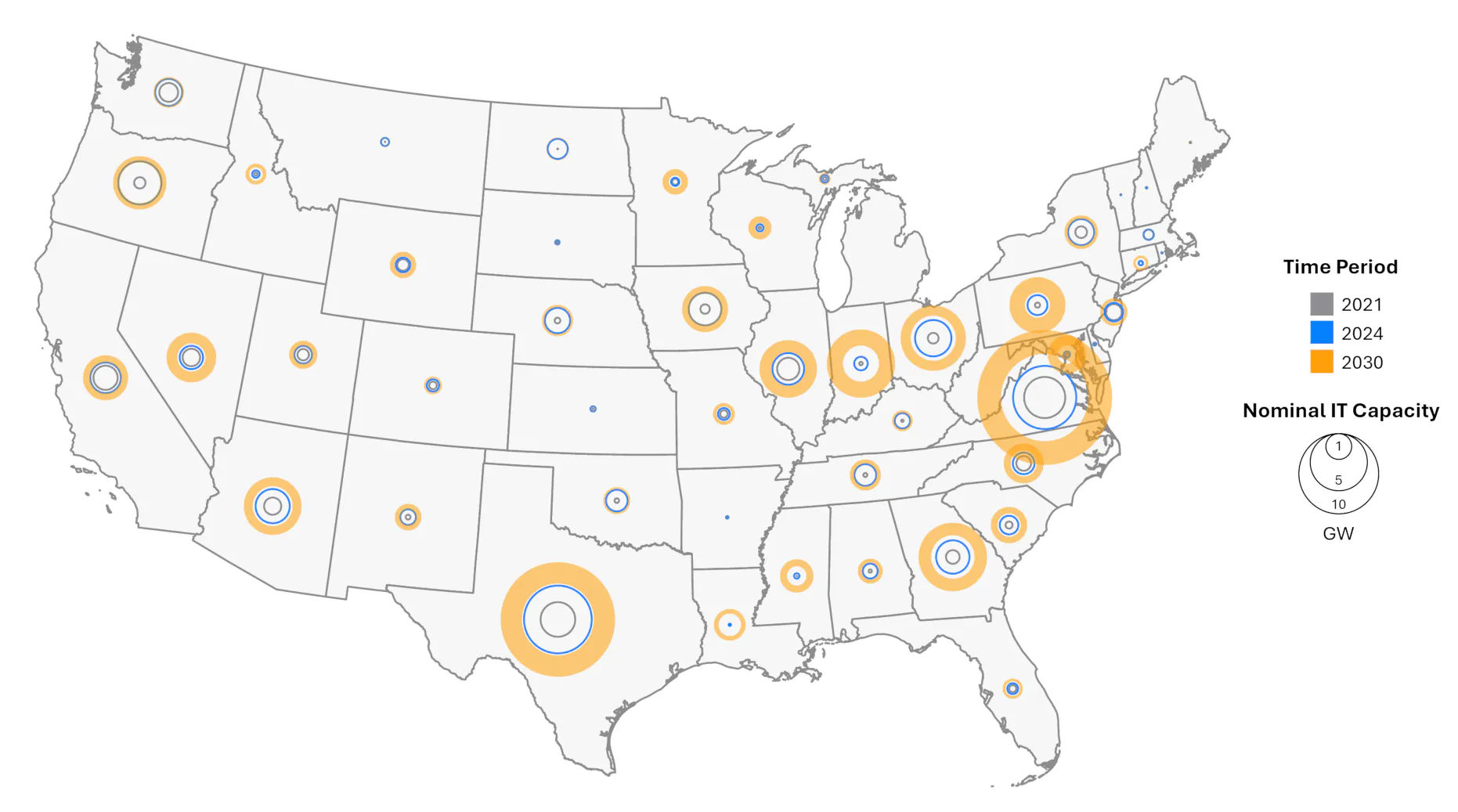
Virginia is the largest and most concentrated U.S. data center market. Data centers already consume over 20% of the state’s electricity, the highest share in the nation. By 2030, that share is projected to increase to 39%–57%, driven by many projects already under construction or in advanced planning. Virginia’s scale makes data centers a dominant driver of grid planning, peak load growth, and infrastructure investment.
At the same time, the geographic diversity of data center activity is increasing. Under the medium growth scenario, seven additional states could see data centers exceed 20% of total electricity demand by 2030: Arizona, Indiana, Iowa, Nebraska, Nevada, Oregon, and Wyoming.
Texas is projected to remain one of the largest data center markets in absolute terms. Its total data center demand is comparable to Virginia when cryptocurrency mining is included. Georgia and North Carolina also show strong growth, reflecting continued concentration in major regional markets.
Developers of large AI training centers are prioritizing power availability and large tracts of land. Louisiana, Mississippi, New Mexico, Ohio, and Pennsylvania are favorable for new areas of concentrated development, where data center shares are projected to exceed 10% of total electricity demand by 2030. These dynamics underscore why state specific forecasting, flexible load strategies, and coordinated planning are critical as data centers scale.
A Defining Moment for the U.S. Power System
The study emphasizes that the grid can support this level of growth, but it may require accelerated deployment. An increase in transmission and generation capacity typically requires up to 10 years, whereas new data centers can be developed in a fraction of that time. This timing mismatch emphasizes the need for coordinated planning among utilities, developers, and regulators.
Through its DCFlex initiative, EPRI is collaborating with the power and digital industries to explore data center flexibility and alleviate grid bottlenecks. Its field testing on operating data centers is demonstrating a range of flexibility options – from varying computational demands to cleaner drop-in replacements for diesel generations - that can accelerate the integration of large loads into power systems, while sustaining both grid reliability and data center operations.
Big Picture
Total U.S. electric load is projected to grow at a rate of 2% to 3.6% per year through 2030, a significant increase from 0.8% annually from 2019 to 2024. And data centers aren’t the only source of growth. Electrification of vehicles and other sectors, industrial re-shoring, and specialized manufacturing growth are all poised to contribute to an expanding role for electricity in the modern economy.
This study underscores the importance of enhanced forecasting, better use of existing energy assets, and deeper collaboration to ensure a reliable and affordable power supply to support these critical trends.