


This summer, federal regulators told the operators of America's largest power grids that their rules for connecting big new customers, what the industry calls large load interconnection, appear inadequate, and gave them a deadline to fix those rules or justify them. It's the most serious attempt in years to change how anything gets connected to the grid. But it leaves one assumption untouched: that getting power means waiting your turn in a line. Hospitals, water authorities, and industrial parks, the institutions with the least ability to wait, are about to find out they don't have to.
Last winter, the largest electric utility in the United States came close to rationing electricity to roughly 400,000 customers, something Americans consider unthinkable. Its chief executive has since warned of actual blackouts as early as 2027, against a projected national shortfall of more than 100 gigawatts before the decade is out. This tends to get framed as an energy problem, but it isn't one; we have plenty of ways to generate electricity. The real problem is institutional, and the institution has a name almost nobody uses: the interconnection queue, the waiting list for permission to plug into the grid. Almost nothing gets built without clearing it.
Every request to connect to the grid (a gigawatt computing campus, a new apartment complex, a hospital wing, a factory line) enters the same line, sorted by arrival and readiness rather than by purpose. When London's government warned housing developers in 2022 that finished projects might wait years for an electricity connection, it noted that utilities aren't permitted to prioritize homes over other projects. A children's hospital and a server farm queue side by side.
The average U.S. interconnection wait has roughly doubled in fifteen years; in the mid-Atlantic region, it now stretches toward eight years. One technology company has reported being quoted connection timelines of up to twelve years. When customers at that scale join the same line as everyone else, the queue stops working like a process and starts working like a lottery: deciding whether a town gets its new housing, its electrified bus fleet, its hospital expansion, or the factory that would anchor its next twenty years.
Politicians have noticed: roughly thirty states have taken up legislation to try to fix the queue, but every one of these fixes shares a flaw: they try to re-sort the line. You cannot fix a queue by reordering it while its largest members remain inside.
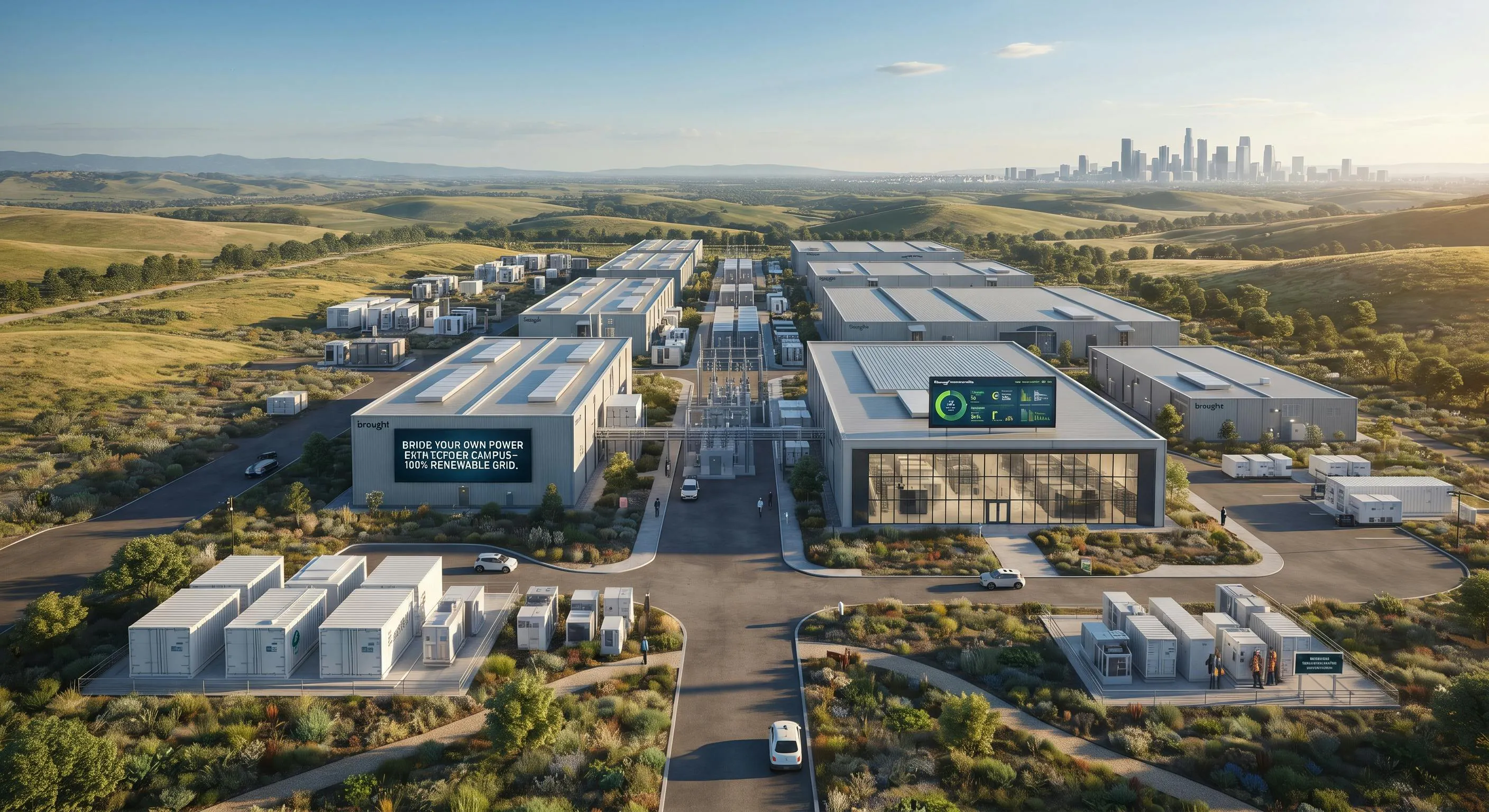
The more interesting response has come from the technology companies themselves. Quietly, the largest of them have begun building, buying, or contracting for their own power: dedicated plants, on-site generation, private supply. The industry now has a name for this: BYOP, or "Bring Your Own Power." They looked at a decade-long line and decided that waiting in it was optional, and they were right. Rather than resent the move, we should recognize what it proves: there's a door out of the queue, and it was the customers who could afford to reach it who found it first.
Generating your own power at your own site used to require being a technology giant: the scale to fund a dedicated plant, the balance sheet to sign a decade of supply.
That threshold is now collapsing, along with the assumption that self-supply is a privilege of scale. A new generation of compact power sources, including small and micro modular nuclear reactors and compact fusion machines, is shrinking the minimum buy-in from "hyperscale campus" to "any critical facility."
That distinction is regulatory as much as technical, and it favors fusion. In 2023, the NRC decided to license fusion machines under the same lighter "byproduct material" framework used for medical and industrial radioactive materials, rather than the framework built for fission power plants, a decision Congress reinforced in the 2024 ADVANCE Act. Fusion also carries none of fission's public-fear legacy: no chain reaction that can run away, no core to melt down, and no high-level waste that has to be buried for thousands of years. A hospital or water authority weighing whether to host a power plant of its own is not just comparing megawatts and footprints. It is comparing which technology a community, and a regulator, will approve fastest, and on that count fusion already starts several steps ahead.
Bringing your own power plant used to require the resources of a company like Microsoft. Within a decade, it may require little more than a parking lot.
That matters for everyone who isn't Microsoft: the exit is no longer reserved for the grid's biggest buyer. A water authority, a regional hospital, a university campus, a mining facility, a single industrial park: each is now large enough to carry its own power plant and walk out of the queue.
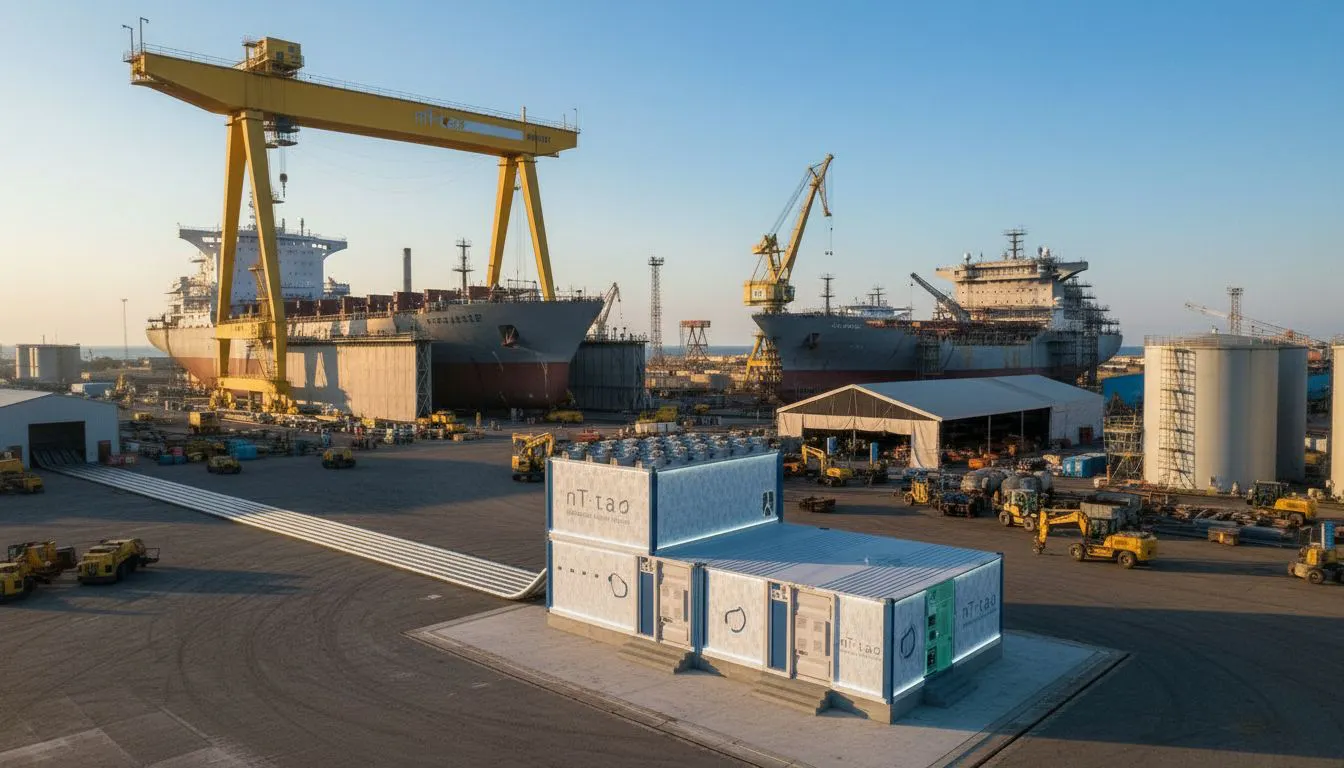
The field didn't get leveled by policy; it got leveled because the machines got small. The scale now being engineered is roughly twenty megawatts from a footprint of about 2,700 square feet: a power plant that fits where a hospital already parks its cars. Machines at that scale are expected just before 2035, which is an argument for deciding now rather than waiting, since a decade in the queue and a decade spent building your own exit take the same amount of time.
That reframes the fight over data centers. Every load that supplies itself, hyperscale or mid-size, is a customer that leaves the line, and everyone behind it moves up a spot, through physics rather than litigation or a new tariff. Each hospital, water utility, desalination plant, or district that generates its own reliable, round-the-clock power on-site stops competing with everything else the community needs and stops waiting on anyone else's schedule.
Optimists might object that the problem solves itself: once the giants exit the line, it clears for everyone else. It won't. The line was already five years long before artificial intelligence arrived. The grid's missing equipment, such as transformers, has multi-year lead times, and the engineers it lacks can't be produced by regulatory reform. The next wave of demand (electrified transport, heat, industry, telecommunications) is already forming behind this one. Still, the optimists' own argument concedes the real point: exiting the line works. The only question left is who gets a door, and that has a different answer now than it did three years ago.
The power-abundant city of 2035 won't be the one that fought its data centers, or the one that surrendered to them. It will be the one that noticed what the giants already proved (that waiting in line for power is optional) and made that true for everyone else. The giants can keep their campuses; they were simply first through a door that's now open to the facilities behind them: power generated where life actually happens, on the schedule of the people who need it.