


Topic: Multi-Agent System Testing through Digital Twin
by Kamadhenu Thenatchi , Shruti Jain & Rubini PE.
Even today, a significant portion of testing is performed either manually or using legacy automation approaches that are time-consuming, effort-intensive, and costly—especially when executed on real products and environments.
In the current product development landscape, particularly for business-critical applications, testing with true real-time business scenarios is not feasible. Most validations rely on modified or synthetic data, which limits our ability to accurately replicate production-grade workflows. As a result, the actual sequence of events, data dependencies, and cross-application interactions that occur in production remain largely untested.
This constraint makes it increasingly difficult to validate end-to-end scenarios at scale and exposes the organization to risks that only surface once the solution is live.
We propose the use of Agentic AI–enabled Digital Twins to modernize and fundamentally transform testing environments and test data strategies across energy and utility systems.
Recent studies on Digital Twin (DT) implementations demonstrate a growing shift toward integrating intelligent agents to enhance decision-making, operational efficiency, and simulation accuracy. Multiple review articles emphasize the critical role of agents in enabling autonomous, collaborative, and adaptive decision-making within DT ecosystems. This marks a significant transition from static digital replicas toward self-managing, continuously optimizing systems capable of responding dynamically to real-world conditions.
Across the literature, the most common objective of embedding agents within Digital Twins is to improve decision quality and optimize system performance. Agentic capabilities allow Digital Twins to autonomously adapt, optimize operations, and make context-aware decisions using real-time data and simulations. By integrating AI and machine learning, Agentic Digital Twins expand beyond monitoring and visualization, evolving into intelligent systems that actively manage complexity across interconnected environments. This trend reflects a broader industry movement toward autonomous, resilient, and highly adaptive systems capable of addressing real-world operational challenges at scale.
In this proposed model, testing is conducted entirely within a Digital Twin–based test environment, using data sourced from a Digital Twin of real-time production sensors and applications. The result is a near-exact replica of the real testing process, mirroring production behavior without introducing risk to live systems.
This approach dramatically accelerates testing cycles by enabling rapid simulation of faults, anomalies, and edge cases in a virtual environment—significantly reducing the cost and operational risk associated with fault injection in physical products or live operational systems.
Types of Digital Twins in Testing
Digital Twins generally fall into two primary categories:
Process Twin
A process digital twin is a real-time digital representation of an end-to-end business or operational process. Continuously updated with live operational data, it enables organizations to observe, analyze, simulate, and optimize workflows as they occur across systems and applications.Product Twin
A product digital twin represents a physical or digital product across its lifecycle, reflecting its state, behavior, and performance using continuous data feeds. It enables optimization from design and development through operations and end-of-life.
For testing purposes, Process Twins deliver the greatest value, as they allow entire test workflows—including environments, data, and system interactions—to be mirrored digitally.
In an Agentic Process Twin–based testing framework, the testing lifecycle follows four key steps:
Capture production activities in real time
Live operational events are captured by integrating physical events, application telemetry, and real-time data synchronization from production systems.Identify and sequence events
Captured data streams are sequenced using timestamps and event identifiers to reconstruct the exact order of operations that occurred in production.Recreate production conditions
The Digital Twin reproduces the precise conditions under which the events occurred, ensuring accurate alignment between the test and live environments.Trigger testing through the Digital Twin
Testing is executed using real production data, triggers, and workflows within the virtual twin environment.
Through continuous synchronization, the Digital Process Twin remains tightly coupled with live systems, enabling near real-time replay and validation of production scenarios.
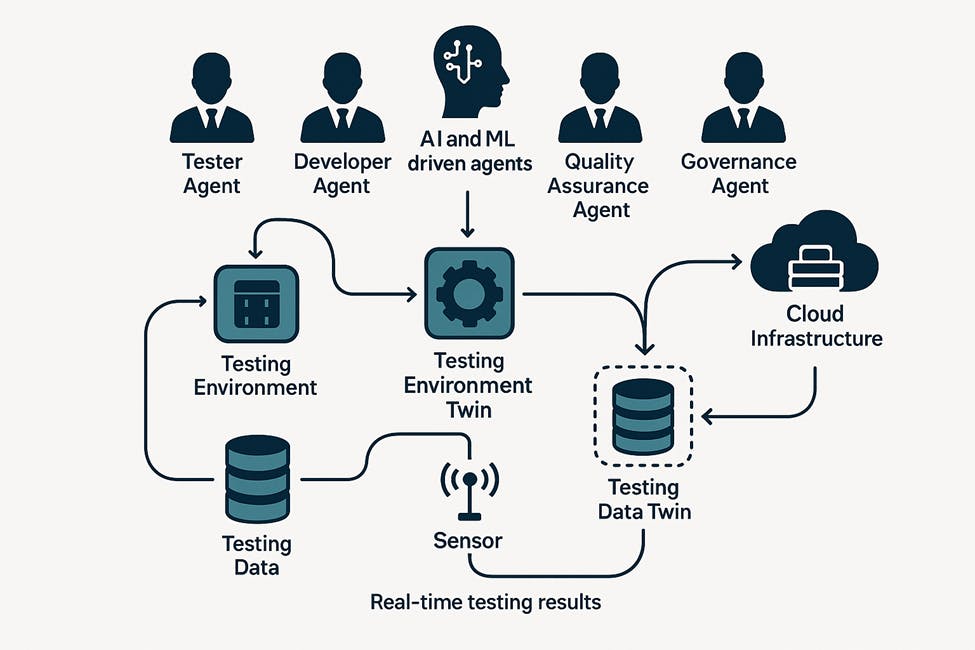
By replaying real production events in a controlled digital environment, failures observed in live operations can be reproduced precisely and repeatedly, significantly improving test accuracy and confidence. This approach eliminates guesswork, reduces dependency on synthetic data, and enables true end-to-end validation of complex system interactions.
Ultimately, Agentic AI–powered Digital Twin testing represents a paradigm shift—from reactive, sample-based testing to intelligent, continuous, production-grade validation. This model has the potential to fundamentally change how testing is performed across energy and utility ecosystems, improving resilience, reducing costs, and accelerating innovation.