


More Power, Less Space:
Compact Substations for Los Angeles’ Growing Electricity Demand
By Ebazer Khairetdinov
Los Angeles is electrifying—transportation, buildings, industry, and data centers are driving electricity demand higher every year. At the same time, many transmission substations inside the city were built decades ago, when loads were smaller and land was more available. Today, utilities face a difficult equation: more power is needed, but there is almost no room to expand.
Compact substation design, often implemented through DIAS, GIS, and other high-density substation architectures, is emerging as a practical solution—delivering more electrical capacity within the existing fence line.
1. Los Angeles Needs More Power—But Where Do We Put It?
Southern California’s electricity demand is growing due to electric vehicles, heat pumps, building electrification, transit expansion, and the increasing share of distributed renewable energy. The California Energy Commission forecasts that statewide electricity demand could increase by 30–50% by 2045 compared to today’s levels [1].
Many older substations in Los Angeles were not designed for this future. Upgrading them is essential to maintain reliability, but conventional expansion typically requires additional land, new permitting, and lengthy construction.
The challenge is no longer simply how to build a larger substation. It is how to deliver more electrical capacity within essentially the same physical footprint.
2. The Traditional Expansion Problem
Traditional air-insulated (AIS) substations require significant space for bus structures, clearances, and equipment access. Adding new feeders, transformer banks, or bus positions usually means extending the yard and acquiring adjacent property.
In a dense urban environment like Los Angeles, available land is extremely limited and expensive—industrial land can exceed $1–2 million per acre in many areas [2]. This makes land acquisition one of the most significant drivers of substation expansion cost and schedule.
3. Compact Substations Change the Equation
Compact substations use integrated, high-density equipment—such as GIS, compact switchgear, modular E-House solutions, and compact transformers—to dramatically reduce the footprint required for substation equipment.
A useful way to think about value is power density:
Power Density (MW per acre) = Substation Capacity (MW) / Site Area (acres)
Increasing power density allows utilities to deliver the required electrical capacity while using less land. In dense urban environments, this can become an important design criterion because the physical footprint of a substation may be as significant a constraint as its electrical capacity.
4. Rebuilding Within the Fence
Consider a typical existing 66/12 kV urban substation with 56 MVA of installed transformer capacity, supplied by two 28 MVA transformer banks.
In a conventional open-air configuration, much of the site is occupied by 66 kV bus structures and switching equipment, 12 kV switchracks, capacitor banks, overhead line terminations, and required electrical clearances. In a dense urban environment such as Los Angeles, expansion may therefore require additional property that is unavailable or prohibitively expensive.
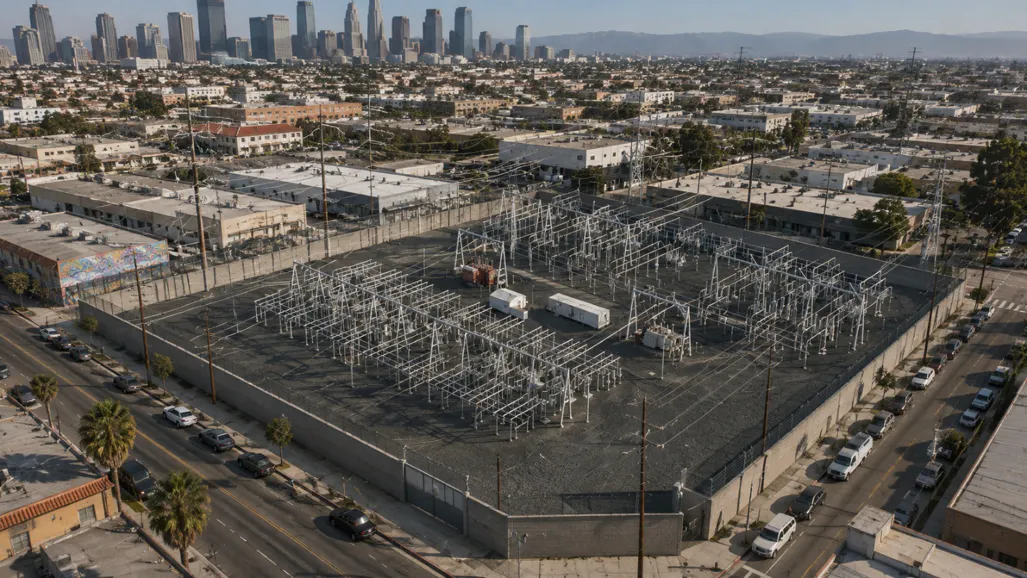
A compact modernization approach offers an alternative: use the existing property more efficiently to increase capacity within the same fence line. By relocating the 66 kV and 12 kV switching equipment into a compact E-House and converting overhead circuits to underground cable connections, outdoor space can potentially be recovered for additional transformer banks.
In this illustrative example, the existing two-transformer arrangement could be expanded to four 28 MVA, 66/12 kV transformer banks, increasing installed capacity from:
2 × 28 MVA = 56 MVA
to:
4 × 28 MVA = 112 MVA
The transformers and required 12 kV capacitor banks would remain outdoors, while switchgear, protection, control, metering, and auxiliary systems would be consolidated within the E-House.
The result is potentially a 100% increase in installed transformer capacity—from 56 MVA to 112 MVA—without acquiring additional land, subject to site layout, electrical clearances, cable routing, fire protection, environmental requirements, and other engineering constraints.
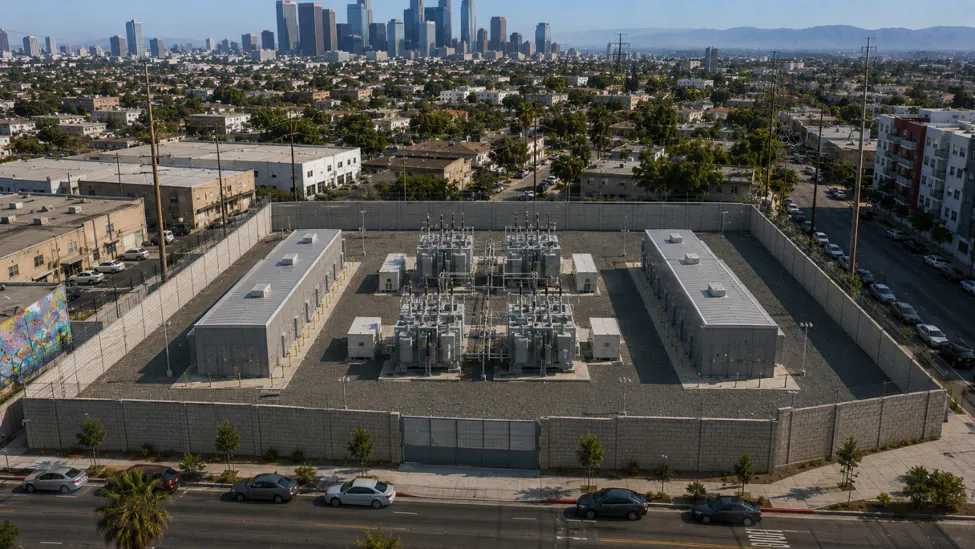
This illustrates the key advantage of compact substation architecture in land-constrained urban areas: not simply reducing the substation footprint, but using the existing land to accommodate substantially more electrical capacity.
5. The Economics of Land Avoidance
Compact equipment may have a higher unit cost, but total project cost must be evaluated across all major components:
Equipment
Civil and structural work
Land acquisition
Permitting and environmental requirements
Construction and outage costs
Underground cable installation
Integration and engineering
Future expansion value
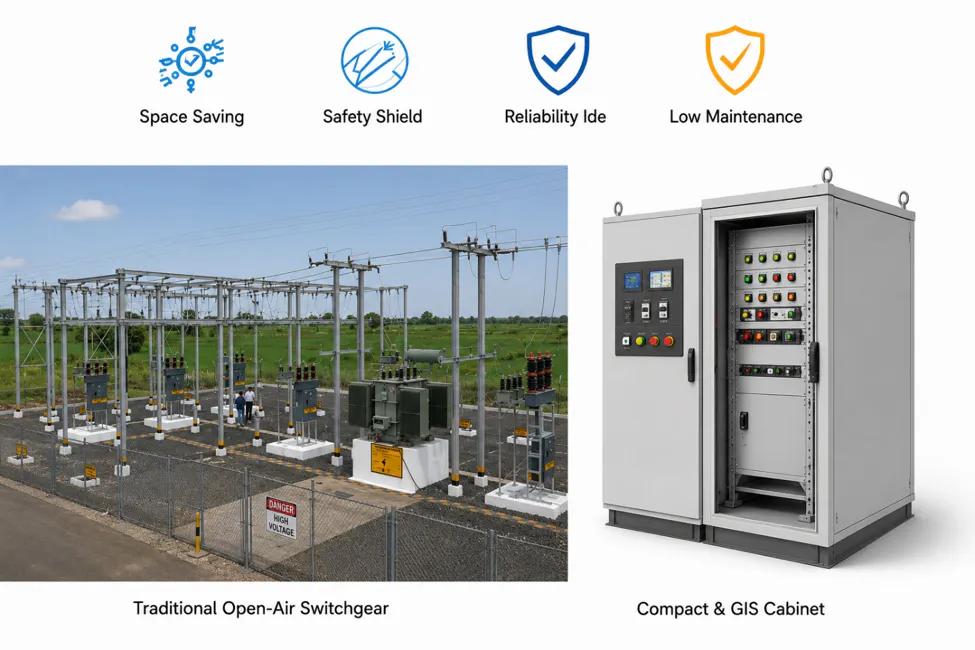
For an urban project, the lowest equipment price does not necessarily produce the lowest overall project cost. A conventional AIS solution may use familiar and relatively economical equipment but require substantially more land, structures, clearances, and field construction.
A compact solution can shift part of the investment toward factory-integrated equipment, E-House systems, underground cables, and engineering while reducing the amount of land required.
The best decision is therefore not always the solution with the lowest equipment cost—it is the solution that delivers the required capacity, reliability, and maintainability at the lowest overall lifecycle and project cost within the constraints of the site.
6. More Than Just a Smaller Substation
The benefits of compact design extend beyond land savings.
Moving major switching equipment into an E-House can reduce the amount of equipment exposed to the outdoor environment and allows significant portions of the electrical, protection, control, and auxiliary systems to be assembled and tested before arriving at the site.
Underground 66 kV and 12 kV connections also eliminate many of the overhead structures and conductor clearances associated with a conventional open-air arrangement.
At the same time, compact design introduces its own engineering considerations. Underground cable ampacity, thermal performance, cable routing, terminations, ventilation, fire protection, equipment access, grounding, maintainability, and future replacement strategies must all be considered during design.
The objective is therefore not simply to make the substation smaller.
The objective is to achieve the required capacity and reliability while using the limited urban site as efficiently as possible.
------------------------------------------------
References
[1] California Energy Commission (CEC). 2023 Integrated Energy Policy Report (IEPR). CEC-200-2023-004.
[2] CoStar Group. Industrial Land Market Report – Los Angeles County. 2024.
[3] NREL. Best Practices for Operation and Maintenance of Photovoltaic and Energy Storage Systems: 3rd Edition. NREL/TP-7A40-73822, 2019.
[4] U.S. Department of Energy. Grid Modernization Multi-Year Program Plan, 2024 Update.