


Executive Summary
This paper highlights the importance of scenario planning and stress testing to support ERM practices in the Indian Power Sector to meet the demands of energy transition, amidst challenges of renewable energy growth and risks associated with climate change, geopolitics, regulations and cybersecurity. The authors propose a structured framework for scenario planning and stress testing to identify priorities and analyze governance models, aligned with electricity policy, regulations, supply volatility, energy markets and grid realities.
Introduction
Traditional Enterprise Risk Management framework assumes that risks behave independently, correlations remain stable and disruptions can be managed through incremental controls. However, in today’s business environment, ERM tools need to adapt to the changing nature of risks confronting the power sector. Recent global events have proven how risks once considered unrelated can suddenly exacerbate each other resulting in cascading failures which overwhelm the traditional ERM controls.
In India, the power sector is expected to catalyze economic growth, with large-scale renewable energy integration, electrification of heat and transport, and grid modernization, amidst financial stress, fuel shocks, supply constraints, market volatility and climate change. Scenario planning and Stress testing are the tools that provide a resilient approach to strategic decision-making in such a scenario.
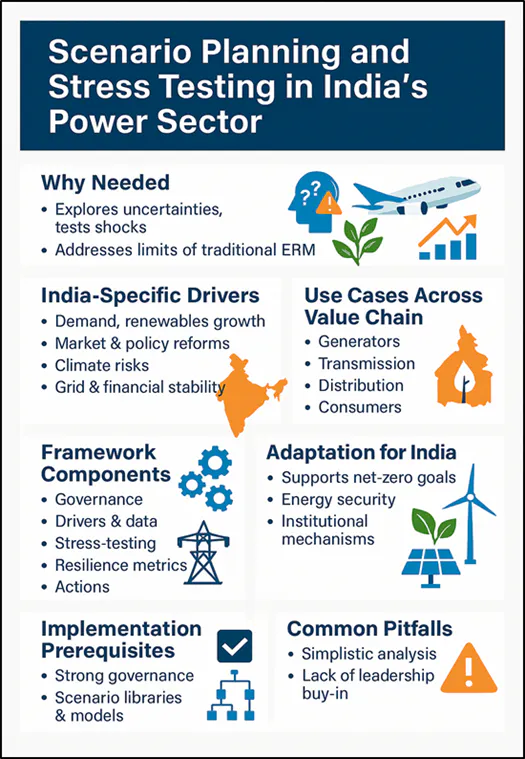
Conceptual Foundations
Institutional mechanisms need to be strengthened to develop a modern, integrated ERM framework, based on the following concepts:
Scenario Planning: Helps evaluate multiple plausible futures by examining key drivers of uncertainty and their implications on strategy formulations and organizational controls.
Stress Testing: Examines the impact of low-probability, high-impact events, quantifying the outcomes, e.g. financial losses, liquidity depletion, service interruptions and time-to-recover.
Defining Characteristics: Scenario planning and stress testing should incorporate the following to distinguish them from traditional ERM:
Interdependence: Model the interdependence and influence of risks upon each other.
Impact Analysis: Measure impact on cash reserves, debt servicing, outages and compliances.
Focus on Tails: Systematic exploration of extreme scenarios and interdependent risks.
Decision Orientation: On capacity expansion, reserve margins, capital allocation, hedging and contingency planning.
Contextualizing Scenario Planning and Stress Testing in India
The following factors make the Indian power sector a compelling case for institutionalizing scenario planning and stress testing:
Structural Transformation: India’s power sector is characterized by rapid growth in electricity demand driven by urbanization, rising incomes, EV penetration, data center loads, RE integration, grid modernization, digitalization and market reforms.
Policy and Regulatory Drivers: The Central Electricity Authority (CEA) of India report on Long-Term National Resource Adequacy Plan (LT-NRAP) for 2026–27 emphasizes optimal planning, reserve margins and capacity planning at both national and state levels, accounting for demand forecasts, generation availability, energy variability and grid constraints. The plan addresses the need for creating optimal capacity mix of variable RE sources with flexible and dispatchable generation to maintain grid stability.
Market-led mechanisms: Security-constrained economic dispatch (SCED) and Market-based economic dispatch (MBED) are reshaping energy price rationalization, while Power Distribution reforms aim to improve financial viability. Indices like Loss of Load Probability (LOLP) and Expected Energy Not Served (EENS) are used to evaluate the risk factors in energy generation and dispatch.
Emerging Risk Dimensions:
Climate Variability: Impact of climate change on RE generation and supply chain
Fuel Supply and Logistics: Supply chain and foreign exchange risks due to fuel imports
Grid Stability: Weather changes, cyber risks and increasing penetration of variable renewable energy (VRE) reduce system inertia, affecting grid stability.
Financial Fragility: Demand volatility, delayed receivables, subsidy dependence and cash flow issues restrict the ability of utilities to absorb financial shocks, behind-the-meter economics and business continuity risks.
Scenario Planning and Stress Testing Framework
Foundational elements of this framework drive outcomes by integrating ERM into a process-driven approach, and taking the following actions:
Map key uncertainties and develop plausible and distinct narratives.
Identify early warnings, extract insights and develop response strategies
Use scenarios planning to assess operational, financial, regulatory and climate impacts
Develop resilience scorecard aligned with risk appetite and assess system robustness.
Ensure an adaptive framework that evolves with changing energy landscape.
Adaptation of the Framework in India
This framework needs to be adapted in today’s Indian power sector context, considering the following key objectives:
Long-Term Energy Security: Evaluate supply chain for critical materials, fuel price volatility or geopolitical conflicts impacting energy security.
RE Integration & Grid Stability: Simulate high penetration of RE sources like solar and wind to identify potential grid instability issues.
Achieving Net-Zero: Model various decarbonization pathways to assess economic viability and energy transition risks, in line with sustainability goals.
Prerequisites of Framework Implementation
The prerequisites for implementing this framework are elaborated below:
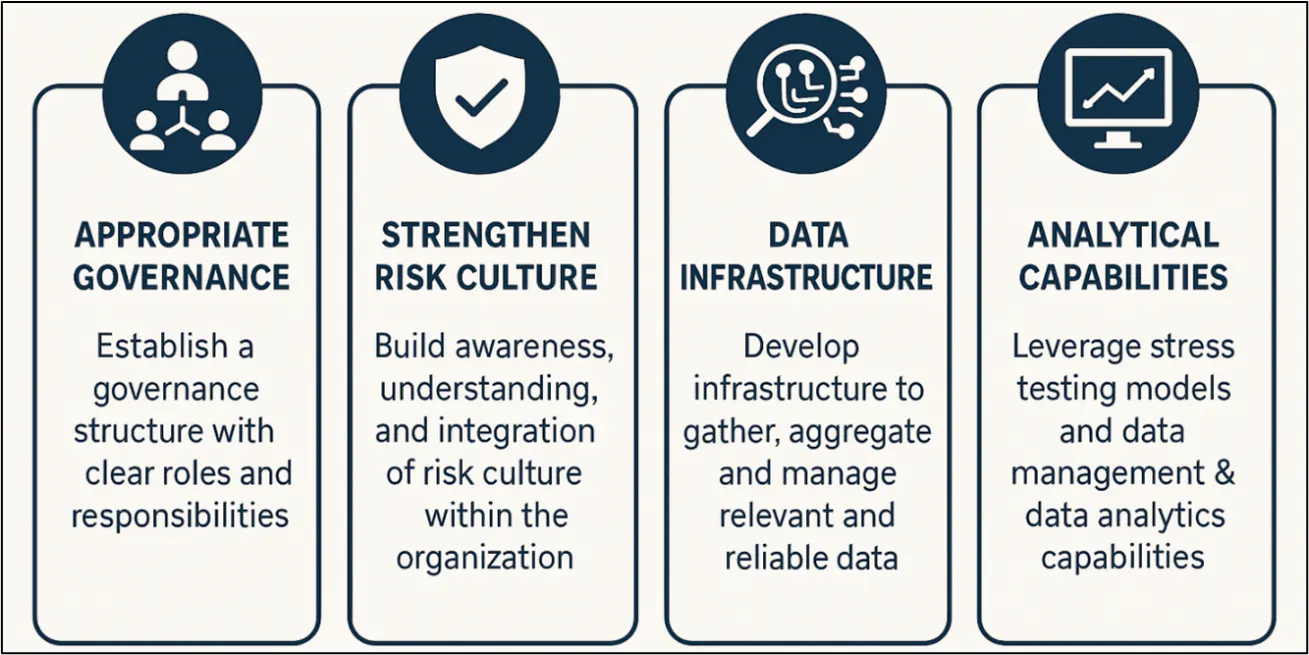
Risk Governance: Define objectives, ownership and risk appetite with resilience goals e.g. minimum reserve margins, liquidity buffers and recovery time objectives as benchmarks.
Material Drivers: Scenarios must be aligned with the material drivers of risk, covering energy demand vs supply, grid operations, energy markets and regulations.
Scenario Library Development: A balanced scenario library typically includes a baseline, several plausible alternative futures and a set of mandatory tail scenarios.
Quantitative Stress Testing: Assess the impact on reserve margins, loss-of-load probability, energy curtailment and grid stability. Financial models translate these into EBITDA, liquidity, equity and debt coverage, compliances and renewable purchase obligations.
Resilience Metrics: Benchmark performance against predefined KPIs, enabling clear communication with management decision makers.
Management Actions: Link stress outcomes to appropriate actions, such as demand response, switching fuel sources, allocating capital expenditure or engaging with energy stakeholders including regulators.
Planning and Budgeting: Embed scenario planning and stress testing into the resource adequacy plan, annual budgeting, capacity planning and power purchase agreements.
Capability Building: Perform due diligence in financing, capacity planning, skill development, infrastructure creation and governance set-up.
While scenario planning and stress testing offer substantial benefits, their effectiveness depends on disciplined design and calibrated execution. Companies must resist the temptation to oversimplify scenarios, given the high degree of coupling between weather, fuel supply, energy prices, markets and regulations.
Conclusion
The Indian power sector is entering a phase of unprecedented complexity, where traditional approaches to risk management are increasingly inadequate. Rapid demand growth driven by urbanization, electrification and digitalization, marked by high penetration of renewable energy, evolving market mechanisms and environmental obligations. Indian power utilities face mounting exposure to climate extremes, supply chain issues, financial fragility and cyber risks. In this context, conventional Enterprise Risk Management (ERM) tools fail to capture the dynamic, interconnected and nonlinear nature of emerging risks.
Scenario planning and stress testing represent a critical evolution in risk management for the Indian power sector. Unlike traditional methods, these approaches explicitly model how risks interact and amplify one another. Scenario planning enables utilities to explore multiple plausible futures, such as demand growth, accelerated RE adoption and market reforms, while stress testing focuses on extreme but plausible shocks, including climate change, fuel supply, grid constraints, cash flows and cyberattacks. Together, they provide a forward-looking, resilience-oriented framework that moves beyond probability-based thinking to preparedness for systemic disruptions with comprehensive data-driven strategies. Central to the framework is the development of a focused scenario library, which evaluates scenarios that impact operational performance (e.g. reliability indices, grid stability), financial resilience (e.g., liquidity, debt servicing) and regulatory compliances. Resilience scorecards, trigger thresholds and predefined management actions ensure that scenario insights directly inform capital allocation, fuel strategies, contingency planning, supply chain issues and regulatory engagement. Importantly, the framework must integrate with the core processes such as resource adequacy planning, budgeting and investments, thereby avoiding the common pitfall of treating scenario analysis as a standalone exercise.
The transition from static ERM to dynamic scenario planning and stress testing is not merely a methodological upgrade but a strategic necessity. For Indian power companies, adopting these tools will be critical to navigating uncertainty, strengthening resilience and ensuring reliable, affordable, and sustainable electricity supply in an increasingly volatile environment.
Authors

K Ramakrishnan is an alumnus of IIT, Madras, IIM, Ahmedabad and NUS, Singapore. He has served as ED, NTPC- India’s largest integrated power company, before taking on lead roles as Chief Executive, STI Power, followed by Rolls Royce and Siemens in Singapore, and can be reached at: [email protected].
Soubhagya Parija is an alumnus of Indiana University and Harvard University. He has served as Chief Risk Officer at FirstEnergy, USA and New York Power Authority. He has taught ERM at Columbia University and served on the Board of RIMS. He lives near San Francisco, and can be reached at: [email protected].
Jayant Sinha is an engineer from BITS Pilani, Accredited Management Teacher, Certified Sustainability Leader, Cambridge UK and Certified Clean Energy Professional. He has served in PSU and private multinationals offering engineering, consultancy and capacity building solutions in India, UK, EU, North America & ME, and can be reached at: [email protected].