


As power grids increasingly transition to inverter-dominated structures, the internal stability of BESS systems has become a core operational capability. Critical components such as power electronics, inverter power modules, IGBTs, battery management units (BMS), and transformers rely on stable thermal conditions and fast response under high-load operation to ensure grid-forming capability and fault-ride-through performance.
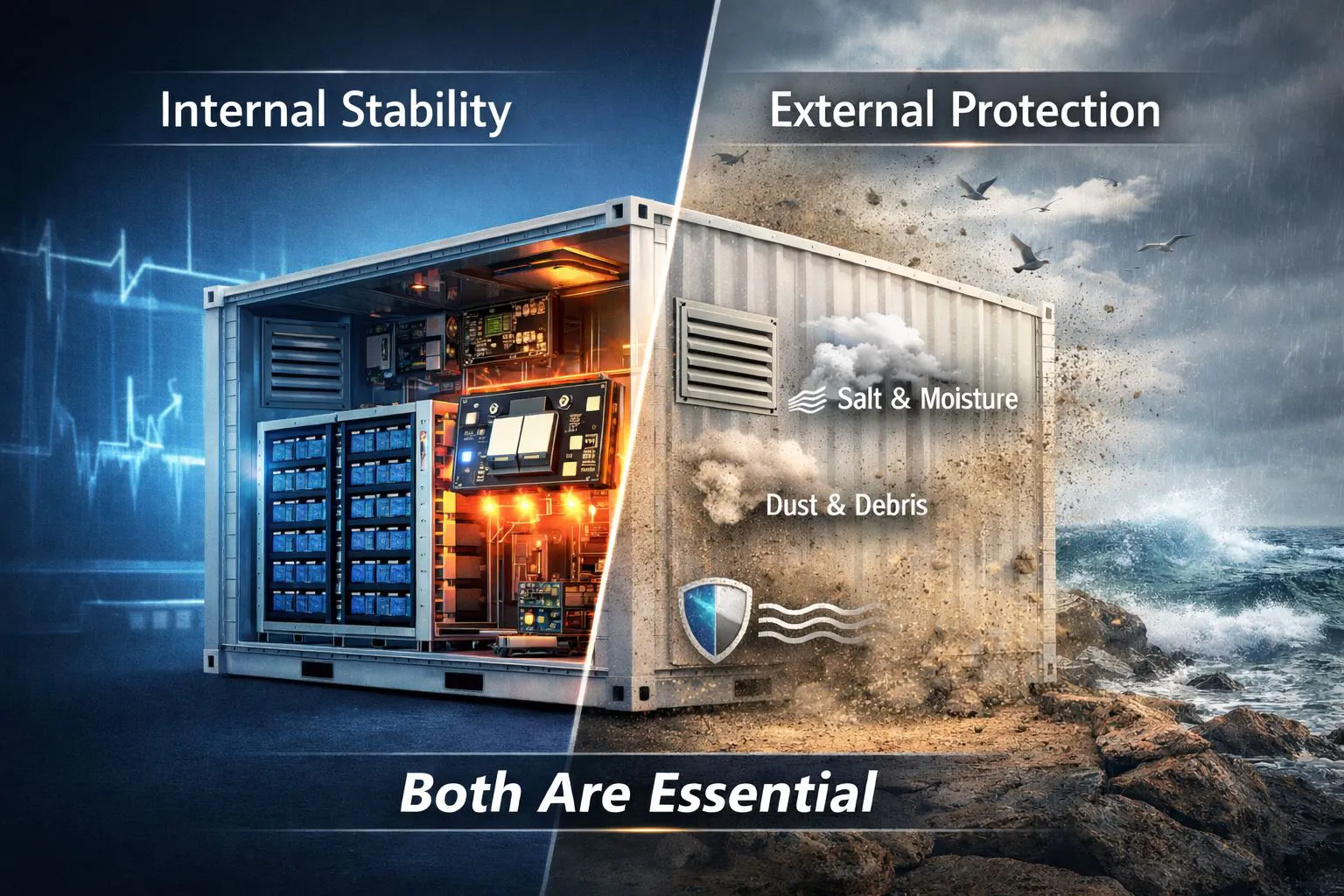
However, focusing solely on internal control and algorithms is not enough to guarantee long-term reliability. Protection against external environmental factors is equally crucial. Excessive heat, humidity, salt spray, or dust ingress can lead to thermal accumulation, reduced insulation performance, or signal interference, which directly impacts control accuracy, response speed, and even shortens the lifespan of key components.
The impact of harsh environments is especially significant in coastal, high-humidity, or high-dust regions, yet often underestimated. Grid stability depends not only on advanced control strategies but also on the equipment’s structural protection rating, airflow design, and long-term reliability under operational stress.
Therefore, the true value of a BESS system lies not only in its grid-forming capability and virtual inertia but also in the synergy between internal stability and external protection. Both are essential: only when key components operate reliably while effectively resisting environmental stress can the system deliver predictable and dependable performance in inverter-dominated grids.
⚡In high-load, high-risk scenarios, the combined assurance of internal stability and external protection should be the industry standard for BESS system design.