

For any energy storage technology, accurately modeling the state of charge (SoC)—the amount of energy stored at any given time—is essential to understanding its value. This is especially true for emerging long-duration energy storage (LDES) technologies, which can store and discharge energy over days, weeks, or even months. In Part 1 of this article, EPRI research examined how two key modeling dimensions—temporal and spatial representation—impact energy storage outcomes in planning models. Recent work by EPRI’s Resource Planning for Electric Power Systems Program explores the importance of understanding modeling choices and outcomes for advancing LDES modeling for resource planning.
From Hours to Weeks: Storage Modeling Decisions and the Value of Long-Duration Energy Storage
LDES can add flexibility to power systems by shifting energy across days, weeks, or even seasons. However, integrating LDES into resource planning tools also presents modeling challenges.
Key questions for planners modeling LDES may include:
What alternative modeling approaches can effectively capture energy shifting over extended periods?
What factors, including existing generation fleet, extreme events, and decarbonization targets, affect LDES investment decisions?
How do these considerations impact the operation of LDES in future resource portfolios?
Recent EPRI research addresses these questions using a unit-level capacity expansion planning model applied to a stylized test system, projecting a year into the future. See the research brief from "Advancing Long Duration Energy Storage (LDES) Modeling for Long-Term Resource Planning” for more details. This study addresses approaches to incorporate LDES in long-term planning. Highlights include:
The selection of LDES in capacity expansion models is highly sensitive to the representative periods used to capture time; this is due to the multi-day or multi-week nature of renewables production.
Short- and long-duration storage technologies may fill different roles in future power systems; both contributing to daily and seasonal system needs.
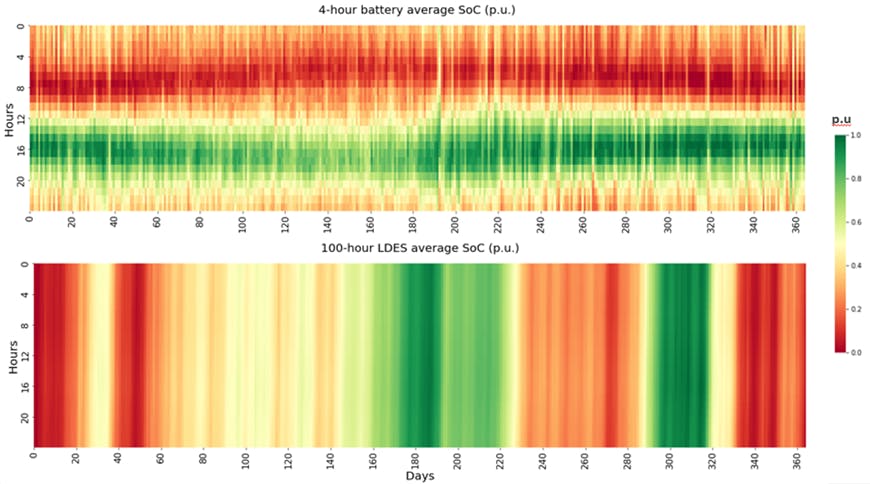
Figure 4. The heat maps illustrate the State of Charge (SoC) for 4-hour batteries and 100-hour LDES in a carbon-free future. The vertical axis represents every hour of the day, while the horizontal axis represents every day of the year. The charge levels fluctuate between high (green) and low (red), reflecting the charging and discharging cycles of the storage systems. Figure from “Advancing Long Duration Energy Storage (LDES) Modeling for Long-Term Resource Planning” and companion research brief.
LDES can help mitigate stressful grid events, such as extended periods of high net demand, particularly when other flexible resources are limited. However, its value depends on the timing, duration, and frequency of these events. The figure below illustrates LDES dispatch during challenging conditions, such as periods of reduced solar or wind generation.
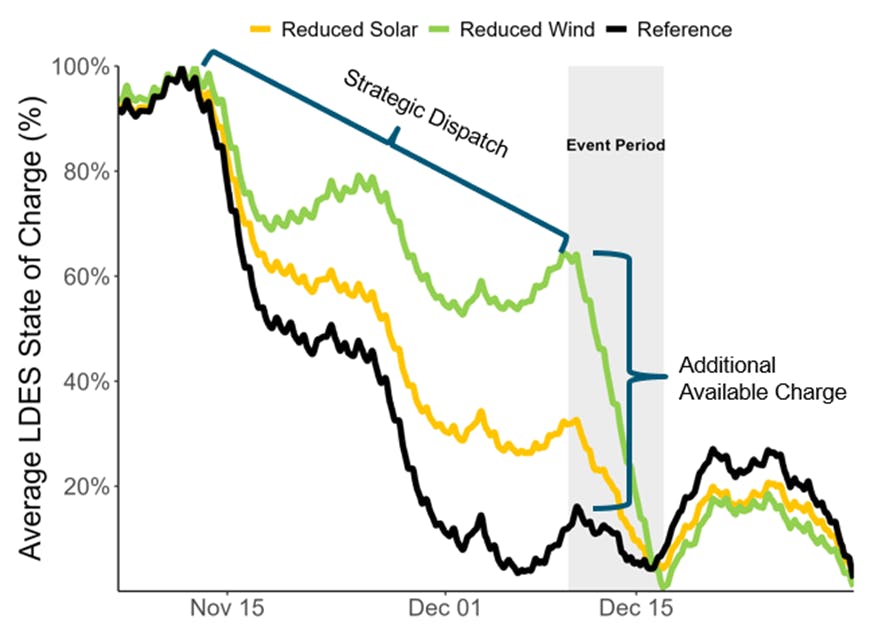
Figure 5. LDES State of Charge (SoC) for three different scenarios: a reference case without a synthetic weather event, a reduced-solar case simulating a 1-week event with lower solar generation, and a reduced-wind case simulating a 1-week event with lower wind generation. Simulating these types of events with perfect foresight illustrates how extended periods of low variable resource generation or high net demand can stress the grid, as well as the role LDES can play in mitigating such events. In this example, the average LDES SoC was strategically maintained at a higher level prior to the event to ensure additional charge was available to withstand periods of low renewable supply. For more information related to this figure, see: Advancing Long Duration Energy Storage (LDES) Modeling for Long-Term Resource Planning and research brief.
Further Resources and Detailed Technical Reports
EPRI research also supports resource planners seeking guidance on modeling the characteristics of storage technologies. This includes cost and performance estimates for selected mechanical and thermal long-duration energy storage (LDES) technologies, as well as evaluations of installed costs and performance attributes for both commercial and emerging battery technologies.
For more technical insights, full research publications referenced in this article can be found below:
Advancing Long Duration Energy Storage (LDES) Modeling for Long-Term Resource Planning (3002031338) and companion research brief.
Assessing Temporal and Spatial Modeling Choices for Energy Storage in Long-Term Resource Planning (3002028963) and companion research brief.
Energy Storage in Long-Term Resource Planning: A Review of Modeling Approaches and Utility Practices (3002028378).
EPRI’s Resource Planning for Electric Power Systems Program supports long-term planning with objective electric sector data, outlooks, methods, and state-of-the-art modeling. Research featured in this post is by Karen Tapia-Ahumada and Sean Ericson. Article written by Ryan Fulleman and Karen Tapia-Ahumada.

