


Electric utilities are under unprecedented pressure to modernize their grids. Aging infrastructure, rapid growth of distributed energy resources (DERs), increasing climate risk, and rising customer expectations are forcing utilities to rethink how they plan, operate, and maintain their networks.
While many modernization efforts focus on physical upgrades, a quieter — and arguably more transformative — shift is happening in how utilities understand their grid. Geographic Information Systems (GIS), particularly when combined with digital twin concepts, are becoming a cornerstone of modern grid intelligence.
From Static Maps to Living Grid Models
Historically, GIS in utilities was often viewed as a system of record — a static map of assets used primarily for documentation and regulatory reporting. Today, that role is rapidly evolving.
Modern GIS platforms, such as ESRI’s ArcGIS ecosystem, now serve as foundational infrastructure for real-time, operationally aware digital twins of the electric grid. These digital twins go beyond visualization. They represent a continuously updated, spatially accurate model of grid assets, operating conditions, and environmental context.
In practice, this means GIS is no longer just where assets are, but how they behave — and how they will behave under different conditions.
Why Digital Twins Matter for Grid Modernization
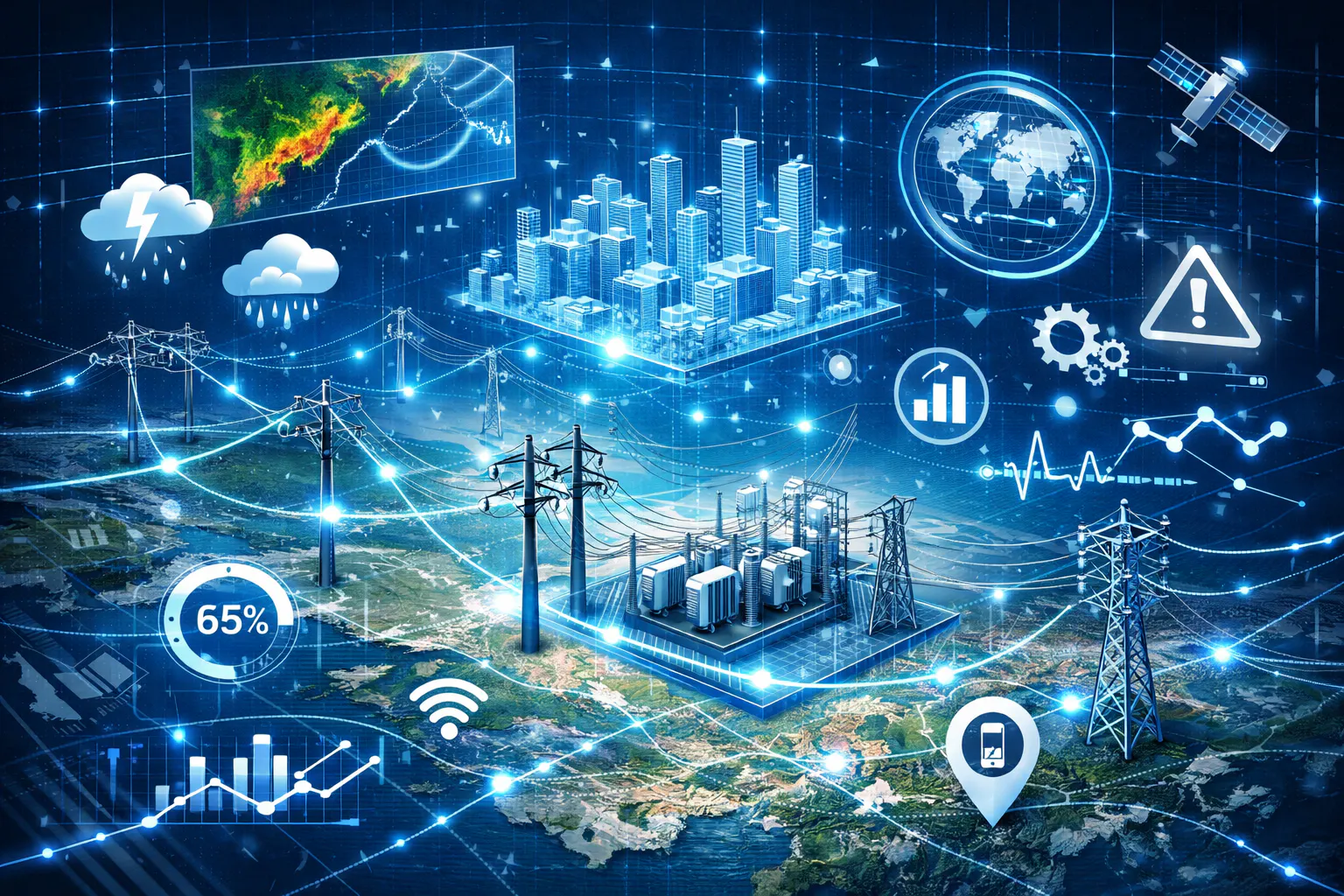
A digital twin of the grid combines several dimensions:
Physical reality: Poles, wires, substations, transformers, and customer connections
Operational data: SCADA, OMS, AMI, DER telemetry
Environmental context: Weather, vegetation, terrain, flood and fire risk
Time: Real-time status and historical performance trends
When these layers are unified in a GIS-centric digital twin, utilities gain a powerful decision-support platform that enables both situational awareness and predictive insight.
This capability is becoming essential as grids grow more complex and less centralized.
Key Grid Modernization Use Cases Enabled by GIS Digital Twins
1. Improving Resilience and Storm Response
Extreme weather is no longer an exception — it is a planning baseline. GIS-based digital twins allow utilities to overlay live weather data, asset condition, and network topology to identify vulnerable areas before a storm hits.
During an event, real-time feeds enable:
Faster fault localization
More accurate outage prediction
Smarter crew staging and routing
Post-event, the digital twin supports forensic analysis to guide hardening investments.
2. Integrating Distributed Energy Resources at Scale
As DER penetration increases, understanding localized grid behavior becomes critical. GIS digital twins enable utilities to spatially model:
Hosting capacity
Voltage and thermal constraints
DER impacts on protection schemes
Rather than relying solely on conservative planning assumptions, utilities can simulate real-world scenarios and make data-driven interconnection and upgrade decisions.
3. Advancing Predictive Asset Management
Traditional asset management often relies on age-based replacement strategies. Digital twins shift this approach toward condition- and risk-based decision-making.
By combining asset data, inspection records, environmental exposure, and historical performance within GIS, utilities can:
Predict failure likelihood
Prioritize capital investments
Optimize maintenance schedules
This results in lower lifecycle costs and improved reliability.
4. Enhancing Cross-Functional Collaboration
One often overlooked benefit of GIS-centric digital twins is organizational alignment. When planners, operators, engineers, and field crews all reference the same spatial model, decision-making improves across silos.
Interactive maps and dashboards translate complex analytics into intuitive visuals, enabling faster and more confident decisions at every level of the organization.
Why ESRI GIS Is Emerging as the Digital Twin Backbone
Many utilities are choosing ESRI’s GIS platform as the foundation for their digital twin strategy for several reasons:
Authoritative network modeling: Robust utility network models support electric, gas, and water systems
Real-time integration: Seamless connection to operational technologies and IoT data
Advanced spatial analytics: Native support for predictive modeling and AI workflows
Scalable visualization: From control rooms to mobile field devices
Importantly, GIS-based digital twins are not standalone systems — they complement existing operational and planning tools while providing a unifying spatial context.
Implementation Lessons from the Field
Utilities pursuing GIS-driven digital twins are learning a few consistent lessons:
Data quality matters more than tools. Accurate, governed asset data is essential.
Start with high-value use cases. Storm response, DER integration, or asset risk often provide quick wins.
Change management is critical. Digital twins reshape workflows, not just technology stacks.
Successful implementations tend to evolve incrementally rather than attempting a “big bang” transformation.
Looking Ahead: Digital Twins as the Grid’s Nervous System
As utilities move toward autonomous operations, advanced forecasting, and transactive energy models, GIS-based digital twins will play an increasingly central role. They are becoming the grid’s nervous system — sensing conditions, interpreting signals, and supporting intelligent action.
Grid modernization is ultimately about making better decisions faster, under growing uncertainty. By grounding those decisions in spatially accurate, real-time digital twins, utilities gain a critical advantage in navigating the energy transition.