


POWER Engineers (POWER), member of WSP, in collaboration with Idaho National Laboratory (INL) and funded by the U.S. Department of Energy, is leading efforts to demonstrate how GETs can be deployed to unlock capacity on today’s grid.
As energy demand surges, the U.S. power grid faces mounting pressure to deliver more electricity, more efficiently. This challenge is compounded by the rapid growth of renewable energy—often generated far from population centers—and the increasing electrification of industries like data centers, artificial intelligence (AI) and manufacturing.
Adding to this complexity, many new generation resources are renewable and located where their energy sources (i.e., wind and sunlight) are abundant. These often-remote locations require additional transmission capacity to facilitate new energy transfers.
In this evolving landscape, grid-enhancing technologies (GETs) are emerging as essential tools for utilities to meet demand without waiting years for new transmission lines to be built.
The U.S. Energy Information Administration expects 63 gigawatts (GW) of new utility-scale electric-generating capacity to be added to the U.S. power grid in 2025—an almost 30% increase from 2024, when 48.6 GW was installed—marking the largest annual capacity addition since 2002.
For the past two decades, aggressive transmission expansion hasn’t been a priority. But that’s changing fast.
Policies Driving Innovation
To address these challenges, the Federal Energy Regulatory Commission (FERC) is requiring transmission providers to consider alternative transmission technologies—many of which fall under the GETs umbrella. These technologies offer faster, cost-effective ways to expand grid capacity and improve performance without the long timelines and capital investment of traditional infrastructure projects.
According to the Department of Energy, the U.S. is investing in cost-effective technologies to meet the country’s growing electricity needs. However, transmission and distribution constraints remain a key barrier to meeting the growing demand of power, as evidenced by steadily rising curtailment and congestion costs across most independent system operators.
Technologies such as GETs can reduce congestion on existing lines and improve efficiency in delivering energy to customers.
Great Minds Converge
Case studies recently issued by INL and POWER, highlight technologies that help electric utilities upgrade existing infrastructure as the nation faces an urgent need for new transmission lines. These GETs can help utilities meet increasing energy demands in advance of major infrastructure upgrades.
In one of four papers co-authored with INL, titled Grid Enhancing Technologies, POWER’s senior advisor Chris Postma, and federal program manager Kevin Tetz explore a suite of innovations designed to revitalize transmission systems.
GETs are best understood as an umbrella term for various alternatives to traditional transmission expansion. These include power flow control devices—such as certain types of Flexible AC Transmission Systems (FACTS)—as well as technologies like static synchronous compensators (STATCOMs) and synchronous condensers, which enhance system performance, stability and reliability, particularly in regions facing capacity constraints.
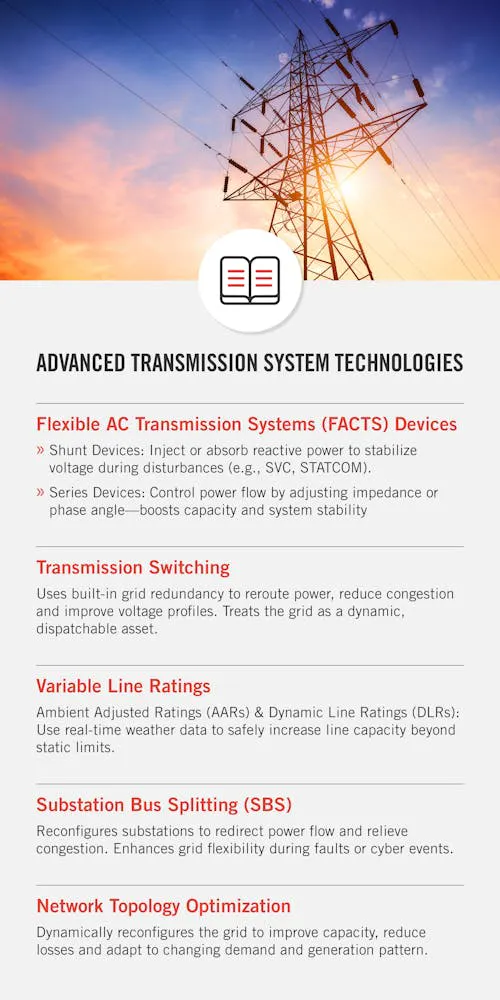
Some of the most common GETs include tower lifting, which addresses sag clearance violations and dynamic line ratings. Tower lifting helps fix sagging power lines, while dynamic line ratings use sensors to track how weather affects line capacity. For example, wind cools the lines, which lets them carry more electricity. This is especially useful for sending wind power from remote areas to cities without having to reduce generation.
Opportunities Abound
By leveraging these technologies, utilities can make better use of existing infrastructure and reduce the need for costly, time-consuming new transmission projects.
“There has never been a better time [for utilities to adopt GETs],” says Postma. “We are seeing large-scale growth from things like data centers—especially AI—and manufacturing. This is all putting new demand on the grid in a short turn—usually two years or less.”
Kevin Tetz adds: “If utilities really embrace these enhancements, there’s a lot of quick, easy projects that could hit the street without needing to wait for long-term builds.”
By unlocking hidden capacity, accelerating deployment timelines and maximizing existing infrastructure, GETs are redefining what’s possible in grid modernization. With the right mix of innovation, policy support and industry collaboration, these technologies are not just powering the grid. They’re powering the future.
POWER partnered with INL to explore how electric utilities can modernize their infrastructure in response to the growing demand for energy and the need for expanded transmission capacity. Through a series of case studies, this collaboration examines how grid-enhancing technologies (GETs) can serve as effective interim solutions while new transmission lines are being planned and built.
This article is the first in a four-part series highlighting the role of GETs in strengthening the grid and supporting utilities in meeting future energy needs.
Explore all four case studies here: