


Executive Summary
The evolution from AMI 1.0 to AMI 2.0 represents a fundamental shift in how utilities collect, manage, and rely on meter data. While AMI 1.0 architectures were largely batch‑oriented and designed to support billing and basic analytics, AMI 2.0 introduces significantly higher data volumes, faster data velocities, and greater data variety. These changes are driven by advanced grid use cases, real‑time operational needs, distributed energy resources (DERs), power quality monitoring, and bidirectional energy flows.
AMI 2.0 elevates meter data from a back‑office asset to a mission‑critical operational dependency. Near‑real‑time data feeds are increasingly used for outage management, voltage optimization, DER integration, and customer engagement. As a result, data quality issues that were once tolerable or correctable downstream now pose direct operational, financial, and regulatory risks.
Key data quality challenges in AMI 2.0 include rapid growth in data volume and velocity; tighter timing requirements; communication and network‑related data gaps; time synchronization and timestamp inconsistencies; increased noise in event and power quality data; and the added complexity of bidirectional energy flows. These challenges are not isolated to individual systems and require coordinated, end‑to‑end management across the entire AMI data lifecycle.
To address these risks, utilities must adopt an end‑to‑end AMI 2.0 data architecture that embeds data quality, observability, and resilience at every stage—from meters and head‑end systems, MDMS, data platforms, analytics, and downstream operational systems. Clearly defined interfaces, monitoring checkpoints, and standardized validation patterns ensure early detection of issues and prevent error propagation across systems.
Effective measurement of AMI 2.0 data loads and quality requires continuous monitoring of ingestion volumes, completeness, timeliness, and conformance, combined with automated validations and intelligent alerting. Robust handling of data errors, exception queues, and catch‑up or back‑load scenarios is essential to maintain trust in data during network outages, system version upgrades, and large‑scale operational events.
A centralized Data Load Monitoring Platform enables this capability by providing end‑to‑end visibility into meter data flows, role‑based dashboards, and actionable alerts. By integrating security, governance, and reliability controls, the platform supports regulatory compliance, data integrity, and cyber resilience while enabling faster and more consistent operational response.
In summary, AMI 2.0 is as much a data transformation as it is a technology upgrade. Utilities that invest in strong end‑to‑end data architecture and proactive data load monitoring will reduce operational risk, improve decision‑making, and unlock the full value of AMI 2.0 metering in a modern, distributed grid.
1. Introduction
Advanced Metering Infrastructure (AMI) has been a cornerstone of utility digital transformation over the past two decades. Early AMI deployments focused primarily on automating meter reads, improving billing accuracy, and reducing operational costs associated with manual meter reading. While these capabilities delivered measurable benefits, the scope of AMI has expanded significantly as electric grids evolve to support decarbonization goals, increasing penetration of distributed energy resources (DERs), and rising customer expectations for insight and engagement.
AMI 2.0 represents the next stage of this evolution. It extends the role of smart meters beyond consumption measurement to function as intelligent grid sensors capable of generating
high‑frequency interval data,
real‑time events,
power quality metrics, and
bidirectional energy flow information.
This data is increasingly consumed by operational systems such as Meter Data Management Systems (MDMS), Outage Management Systems (OMS), Advanced Distribution Management System (ADMS) and Customer Information System (CIS). As a result, meter data will no longer be used only for billing; it will become a foundational input for real‑time grid monitoring, outage detection, voltage optimization, and DER integration.
With this new role there will be dependency on the accuracy, completeness, and reliability of meter data. In AMI 2.0 environments, data quality issues can have immediate operational consequences, triggering false outage events, distorting load forecasts, misrepresenting DER behavior, or leading to billing disputes and regulatory exposure. Traditional data validation approaches, largely designed for batch‑oriented and lower‑frequency AMI 1.0 data, struggle to address the scale, velocity, and diversity of AMI 2.0 data streams.
This white paper focuses on the emerging challenge of meter data quality and validation in AMI 2.0 environments. It examines how data quality requirements have changed, identifies common quality issues associated with high‑frequency and event‑driven meter data, and outlines modern monitoring approaches aligned with AMI 2.0 architectures.
2. AMI 1.0 Architecture and meter data load interfaces
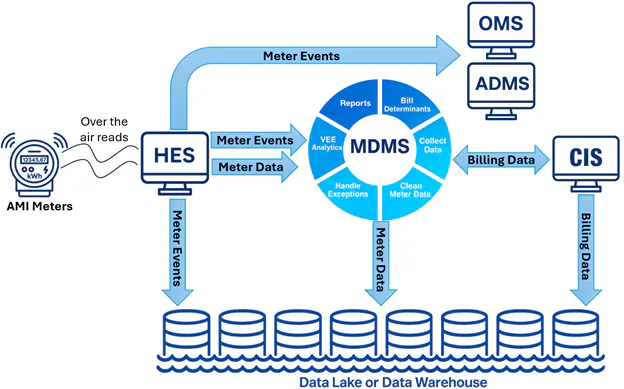
Before starting to look at the AMI 2.0 data quality challenges and data architecture, let’s look at the architecture which has served the utility billing architecture for more than 2 decades.
2.1 AMI Meters
It begins with Advanced Metering Infrastructure (AMI) Meters which can send the meter data over air. These AMI meters are intelligent field devices that form the foundation of the meter data flow by measuring customer consumption accurately with multiple time intervals like, 60, 30, 15 or 5 mins. The meters are capable to capture interval energy usage, power quality metrics, and events such as outages, tamper attempts, and voltage anomalies. Not only capturing, the AMI meters also securely transmit this data through the communication network to the Head‑End System. Beyond data measurement, AMI meters support two‑way communication, allowing utilities to remotely perform functions such as connect/disconnect, firmware updates, and diagnostics, making them a critical enabler for automated metering operations, interval billing, and grid optimization.
2.2 Head-End System
Head‑End System (HES) is the first system in the meter data flow and serves as the direct interface with smart meters. It is responsible for communicating with meters over the underlying network (RF mesh, PLC, cellular, etc.) to collect raw meter readings, events, and alarms at configured intervals or on demand. In addition to data acquisition, the HES manages meter commands such as connect/disconnect, firmware upgrades, time synchronization, and parameter configuration. The data handled by HES is typically device‑centric and high‑volume. The system must be reliable, secured and needs to perform preliminary validations before handing it over to downstream systems such as Meter Data Management system.
2.3 Meter Data Management System
Meter Data Management system (MDMS) acts as the central processing and governance layer for meter data. It performs the validation, estimation, and editing (VEE) process on meter data to ensure completeness, accuracy, and consistency. It can also handle data gaps, outliers, and corrupted readings. The MDMS transforms raw, interval‑level meter data into validated billable data. It also aggregates meter consumption data by day, month or given tariff periods. The meter historical data can also be maintained as back as the reverse re-bill can be performed. MDMS also applies business rules, supports analytics, visualizes the usage across bill periods and serves as a single source of truth for meter data. The VEE exceptions are marked as Warned or Failed Validation which can be analyzed by operators. The main purpose of MDM in AMI 1.0 architecture is to provide the meter consumption data for complex billing like Time-Of Use (TOU), etc. to billing system.
2.4 Customer Information System
Customer Information System (CIS) is the system majorly used for customer information and billing. In AMI 1.0, it has data points like customer accounts, service points, and rate contracts, etc. CIS uses aggregated meter consumption data received from MDMS and generates customer bills by applying tariffs. It manages payments, service requests, and customer inquiries. Accurate and timely data flow from MDMS to CIS ensures transparent billing, detailed usage insights, and effective communication with customers.
2.5 Advanced Distribution and Management System
In AMI 1.0 architecture, Advanced Distribution Management System (ADMS) does not typically receive raw interval meter data directly from AMI meters; instead, it consumes processed or event‑level information from upstream systems such as HES, MDM, or OMS. This includes outage indications, High/Low voltage alarms, last‑gasp messages, and feeder‑level load data aggregated from meters. ADMS applications such as Volt/VAR optimization (VVO), fault location, and load analysis rely on periodic and batch‑oriented data, with intelligence largely centralized in control center systems.
2.6 Outage Management System
Outage Management System (OMS) is one of the primary operational consumers of AMI meter events data in AMI 1.0 architecture. OMS receives outage‑related information such as Last‑Gasp, First‑Breath, Missing Meter Reads and Ping Commands notifications routed from the HES either directly or via integration layers. Using this data, OMS correlates meter events with network topology models to identify outage locations, determine affected customers, and support restoration planning (FLISR). While AMI 1.0 meters provide significant improvement over manual outage detection, the data exchange is generally event‑driven and near‑real‑time rather than continuous. OMS also feeds outage status updates to downstream systems such as CIS for customer notifications and regulatory reporting, making it a key operational bridge between AMI 1.0 infrastructure and customer‑facing processes.
2.7 Data Lake or Data Wearhouse
Utilities use Data Lake or Data Wearhouse (DW) to store raw, semi‑processed, and historical meter data extracted from HES and/or MDM systems. While MDM retains only billing‑relevant (like last 3 years of interval data) and recent operational data, the data lake preserves VEE processed interval reads, meter event logs, meter status and diagnostics information and communication performance metrics. In an AMI 1.0 context, data ingestion into the data lake is typically batch‑based (hourly, daily, or nightly). This allows utilities to retain years of meter history at lower cost while keeping core transactional systems lean. Advanced analytics like long‑term consumption trend analysis, loss and theft pattern detection, load profile forecasting models, network and transformer loading analysis, asset health and meter performance analytics, etc. enabled utilities to apply data science, machine learning, and statistical techniques without impacting production performance. Also, cross system data correction and synchronization checks are possible as the data lake pulls information from HES, OMS, ADMS, CIS, GIS, SCADA, etc.
3. AMI 2.0 Data Quality Challenges
The transition to AMI 2.0 significantly increases both the importance and complexity of meter data quality management. Compared to earlier AMI 1.0 generation, utilities now manage large volumes of data generated at higher frequencies, enriched with new data types. It’s now consumed by multiple operational systems in near real time. While this data creates opportunities for improved grid intelligence and operational efficiency, it also introduces a new set of data quality challenges that traditional frameworks struggle to address.
3.1 Increased Data Volume, Velocity, and Variety
AMI 2.0 meters generate data at much higher frequencies, often at five‑minute or one‑minute, compared to the daily or monthly reads. In addition to interval consumption data, AMI 2.0 environments include voltage measurements, power quality indicators, waveform samples, outage events, and bidirectional DER data. This combination of high volume, high velocity, and high variety places significant pressure on ingestion pipelines, validation logic, and storage systems. Even minor data quality issues, when multiplied across millions of endpoints, can quickly escalate into large‑scale operational risks.
3.2 Real‑Time and Near‑Real‑Time Data Dependencies
In AMI 2.0 environments, meter data increasingly supports operational use cases such as outage detection, voltage monitoring, and DER management. These use cases demand validated data within seconds or minutes rather than hours. As a result, delays or inaccuracies in validation processes can directly affect grid operations. For example, late or erroneous outage signals may lead to false outage identification or delayed restoration efforts. The requirement for near‑real‑time data significantly narrows the tolerance for incomplete, inconsistent, or noisy meter data.
3.3 Communication and Network‑Related Data Gaps
AMI 2.0 relies on complex communication networks that may include RF mesh, cellular, Wi‑Fi, or hybrid models. Network latency, packet loss, intermittent connectivity, and environmental interference can introduce missing intervals, duplicate records, or delayed data delivery. While AMI 1.0 environments typically handled such issues through batch estimation, the frequency and operational relevance of AMI 2.0 data make these gaps more visible and harder to remediate without advanced validation and estimation strategies.
3.4 Time Synchronization and Timestamp Issues
Accurate timestamps are critical in high‑frequency AMI 2.0 data, especially when correlating meter data with OMS, SCADA, weather systems, or DER telemetry. Clock drift at the meter, inconsistent time zone handling, or synchronization failures can lead to misaligned data intervals or incorrect event sequencing. These issues can distort load profiles, impair event correlation, and reduce confidence in analytics.
3.5 Increased Noise in Event and Power Quality Data
AMI 2.0 meters can generate large volumes of event‑driven data, including voltage excursions, power quality alarms, and momentary outage indicators. While this improves grid visibility, it also introduces the risk of false positives and noisy events caused by transient conditions, customer equipment behavior, or localized disturbances. Without robust validation and correlation mechanisms, utilities may experience alert fatigue or take unnecessary operational actions (like rolling a truck) based on unreliable signals.
3.6 Bidirectional Energy Flows and DER Complexity
The growing penetration of rooftop solar, energy storage, and electric vehicles introduces bidirectional power flows. Net metering scenarios, reverse power flow, and inverter behavior can lead to apparent inconsistencies in consumption and generation data. Inadequate handling of DER‑related data can result in incorrect billing, flawed hosting capacity analysis, and misinformed grid planning decisions.
3.7 Organizational and Systemic Impacts
Meter data quality issues in AMI 2.0 environments rarely remain isolated to MDMS. Poor‑quality meter data propagates into billing systems, operational dashboards, analytics platforms, and regulatory reports. This amplifies the impact across departments, increasing rework, customer complaints, operational inefficiencies, and compliance risks. As utilities expand the use of AMI data across the enterprise, trust in meter data becomes a foundational requirement.
4. End to End AMI 2.0 Data Architecture
When we are talking about the AMI 2.0 Architecture, following are the key changes in existing architecture.
High volumes of readings (i.e. 1- or 5- or 15-minute data interval for multiple channels like kWh, kVAR, VOLT, AMP, etc.) as well as meter events data (e.g. outage, restoration, voltage, tamper, PQ)
Events data will be as important as readings data
DER-aware (e.g. net metering, export/import, EV load signatures)
Applications supporting the continuous streaming of the data
Local buffering (store and forward) for the applications with high streaming volumes of data
Network observability (like latency, packet loss)
Analytics, AI/ML and grid intelligence will be stretched to AMI 2.0 meters data
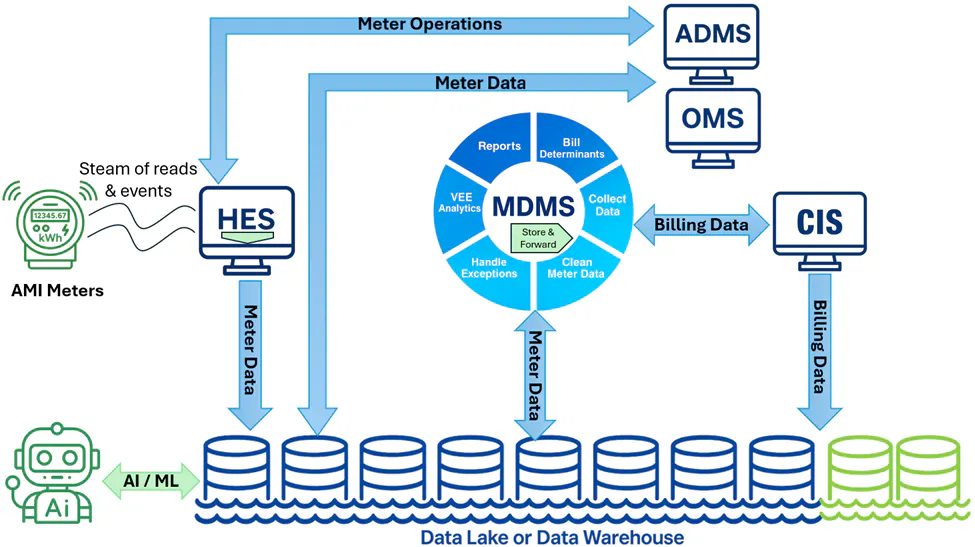
Let’s look at the new architecture with added components of AMI 2.0 architecture. The impacts are highlighted in green color and explained in detail in sections.
4.1 AMI 2.0 meters
AMI 2.0 meters are the data generator and first‑intelligence layer of this architecture. The meter data readings like kWh, kVAR, Voltage channels, Ampere channels will be captured with a 1- or 5- or 15-minute intervals. In addition to this interval data, meter events will be also captured. For DER enabled meters, in addition to consumption, generation channels data will be captures. The AMI 2.0 meters are required to make basic threshold validations and prioritize data transfers to HES. Local buffering of the data at the time of transfer is also needed as the data volume is high. When the meter is not communicating, the storage within meter can help restoring data by collecting manual meter reads.
4.2 Communication and Network Layer
The communication and network layer between AMI meters and HES provide resilient, low‑latency, bidirectional connectivity. RF mesh is the next generation network along with 5G. The hybrid network is a choice of the utility which should support continuous streaming, not just the scheduled read interrogations. QoS‑based (Quality of Service–based) prioritization ensures more critical data like outage events is transmitted, processed, and delivered ahead of less critical data like kVAR. This prioritization helps network to optimize bandwidth, computing, and system capacity. Refer [1]
4.3 Head‑End System
Head‑End System (HES) helps device control, protocol translation (DLMS/COSEM, ANSI C12, etc.), and near‑real‑time ingestion. But it’s not for long‑term storage. In AMI 2.0 architecture, HES need to be stateless and scalable, with minimal persistence and having strong API exposure. Initial sanity checks need to be performed in HES. HES is also crucial in performing the meter operations like Ping, Connect, Disconnect and Load Side Voltage (LSV) check.
4.4 Meter Data Management System
Meter Data Management System (MDMS) is still the system performing VEE (Validation, Edition and Estimation) of consumption reads but no longer just for billing. Due to high volume data, batch + streaming of usage data with data orchestration, the downstream application compatibility becomes necessary for MDMS. In AMI 2.0 architecture, MDMS should not focus on heavy analytics, long term data retention, and real-time control like threshold detection, local last-gasp message, load control relay, etc. Instead, it should focus on meter data quality.
4.5 Outage Management System
Outage Management System (OMS) is responsible for real‑time outage detection, impact assessment, restoration tracking, and customer/outage intelligence. OMS receives the sub‑second outage detection via meter events. The Storm‑scale correlation can be performed real-time with meter events data. The Ping‑on‑demand meter operation will help power restorations more efficiently. OMS will be meter event‑centric and customer‑impact focused, operating at grid scale and storm scale. Instead of having just rule-based logics in the storm scenario, probabilistic and AI‑assisted models now can be used.
4.6 Advanced Distribution Management System
Along with OMS, Advanced Distribution Management System (ADMS) is responsible for situational awareness, grid optimization, and real‑time control of the distribution network. ADMS will see and aggregate the VOLT, AMP VAR data along with grid SCADA data and sensors, IoT devices data. near-real-time load flow models, high/low voltage predictions, Voltage/VAR Optimization (VVO), Fault Location Isolation and Service Restoration (FLISR), self-healing networks, DERMS (Distributed Energy Resource Management System), grid switching are few high-level use cases with near-real-time event data.
4.7 Data Lake / Data Wearhouse
Data Lake / Data Wearhouse (DL or DW) becomes a very crucial and integral part of the AMI 2.0 architecture. It should have features like long‑term, scalable, analytics‑first meter data platform along with cloud‑native or hybrid, elastic compute, schema‑on‑read and immutable raw zones. It will store the meter data in raw interval reads, full event history, power quality data, communication history along with historical billing parameters. The data will be used for advanced analytics, AI/ML models, loss & theft detection, forecasting, regulatory audits, replay & reprocessing.
4.8 Analytics, AI/ML & Digital Grid Intelligence
Instead of creating just the executive reports, Analytics, AI/ML & Digital Grid Intelligence turns meter data into decisions and predictions. The typical use cases are Load forecasting (short & long term), Asset stress detection, Voltage compliance analytics, Customer segmentation, EV adoption modeling, Predictive outage risk, etc. these AI/MLs, consume the meter data from DL and then models them back to Control rooms or Planning teams or even the applications like MDMS or ADMS.
4.9 Customer Information Systems
Customer Information Systems (CIS) receives billing determinants and no need to have raw reads for multiple TOU rates. Dynamic tariffs, net billing, bill simulations will be easy and can be taken to customer portals & apps with near‑real‑time usage visibility, meter events data and energy insights.
4.10 Event Streaming & Integration Layer
In AMI 2.0, Event Streaming & Integration Layer cannot rely on point-to-point integration. Event streaming & integration layer becomes the backbone of AMI 2.0. Meter events (outages, restorations, voltage violations, tamper alerts, etc.) are treated as first‑class data products that multiple systems can consume independently and in near real time. Event data flow in AMI 2.0 relies on decoupling, fan‑out, replay ability, and near‑real‑time processing to transform meter events into scalable, resilient, and multi‑purpose operational intelligence. This does not compromise billing accuracy or system reliability.
5. Measuring Data Loads, Data Quality and their Alerts
Now let’s talk about the core of this article which is monitoring the streaming meter data and validating their data quality. Real‑time data loads are monitored using ingestion, processing, and infrastructure metrics, while data quality is ensured through continuous schema, completeness, validity, and duplicate checks.
5.1 Monitoring the data loads
Monitoring real‑time (streaming) meter data loads and performing data quality checks is a critical part of AMI 2.0. a real-time meter data load will continuously ingest data as it is generated with low latency rather than a scheduled batch interrogation.
Monitoring these data streams have key metrics like
Throughput (meter events / sec)
Lag or latency
Event message size
Dropped or in pipeline events
e.g. if there are 1000 meters sends 500 events per second, but the HES has processed only 450 event per second. If the lag goes more than 100 it should trigger an alert.
At job levels, monitoring these streaming jobs have following key metrics:
Events by Job Status (running, failed success, reinitiated, etc.)
End-To-End processing latency
Completion window time
Intermediate checkpoint Passed or Failed
Queue size
Error or reprocessing queue
e.g. if there are 1000 meters sending 500 events per second, in 10 seconds the 4500 events should be processed with a latency of 500 in 10 seconds. The data should get processed in 1 min and there should not be more than 5 second latency in processing an event.
The third aspect of the monitoring is infrastructural monitoring. The key metrics are
CPU and memory usage
DISK IO
Network latency
e.g. when there are multiple events happening at the same time, the CPU and memory usage to process these events can touch 100. The server administrators should be informed for such spikes so scaling of the hardware can be considered.
5.2 Data quality validations
Along with monitoring the data volumes, the data needs to be validated for quality.
A schema or structure validation check ensures
the incoming data has all mandatory fields and has non-null values,
correct data types,
field length is within limits and
schema version is compatibility.
Schema validations are marked red as data cannot be read.
The business rule validation ensures
Range and threshold checks
Valid data elements e.g. event id, meter id, etc.
Duplicate events data
5.3 Alerts and data error queue handling
Alerts are triggered based on:
Error rate > threshold
Schema mismatch
Sudden drop or spike in volume
SLA breach (latency)
The alerts are communicated with either emails or even SMS alerts on work devices. The log files, various metrics and traces are used here to find the root cause and impact assessment. An AI robot solution can also be considered here to solve analysis and further actions so that the production recovery time can be faster. As the data is real-time, the mean time to detect (MTTD) is important here.
The data with errors are always stored and a data error queue need to be maintained so that the errors can be reprocessed after correcting the error data. The error queue processing needs to have good filters so that the errors can be grouped and after data correction, can be reprocessed manually or automatically.
5.4 Catchup and back load scenarios
Due to unavoidable reasons, if the system failure occurs, the data load needs to perform catch up process. The back dated data needs to be loaded so that data gaps can be avoided, and data quality can be improved. The store and forward feature of HES play an important role in the catch-up process. Restoring this meter data load is not handled like the traditional batch process. Instead, the system relies on replay, offsets, checkpoints, and state recovery to ensure no data loss, no duplication, and correct ordering of data is achieved.
Here are the common kinds of system failures
Network outage
Stream platform failure
Job crashes
Infrastructure failures like, VM crash or restarts
Resuming processing of the streaming data from a safe point without any data loss or duplication is the primary goal here.
In case when the system downtime is more than the stream retention period, old events are deleted and cannot be replayed. This can be mitigated by increasing the retention time and persisting the meter raw data in data lake.
6. Data Load Monitoring Platform
When we want to monitor a real-time data stream, followings are important to define clearly. It’s good to document all these monitoring requirements in monitoring requirements document.
Real-time data frequency – 1 min, 5 mins, 15 mins or an hour
Meter event messages - power outage, voltage sag/swell
On-Demand reads
Firmware and diagnostic messages
Data arrival time
Volume of data
Data latency
Quality of data with failed or success in validations
SLA definition with recovery timelines
Personas like Operation team, Data engineer/scientist team, Business user team
AMI 2.0 meter data streams have massive scale, strict SLAs, regulatory impact, and unattended data quality risk.
Below is a concrete design for a AMI 2.0 real‑time data load monitoring platform.
6.1 End-To-End Meter data flow along with monitoring checkpoints
Below is the data flow for AMI 2.0 meter data flow having added components like Message Broker and Real-Time Processor.
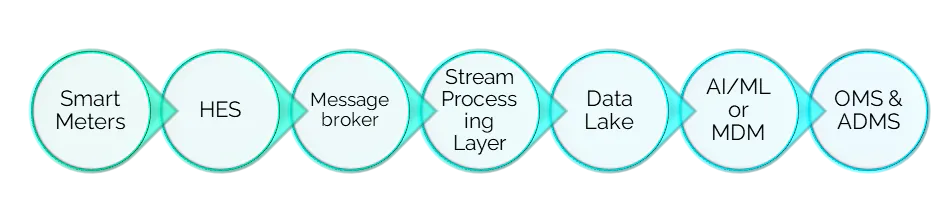
It starts with smart meters to HES. The HES is the first aggregator and control layer. HES collects the messages via RF mesh or PLC or 4g/5g network and buffers the data when the connectivity is intermittent. It retries the failed data loads and performs the light validations.
The monitoring checkpoints for HES are
Communicating meters count
Messages forwarded per interval window
Backlog messages (especially in storm situations)
Last forward timestamp per group or region
The most critical architectural boundary in architecture is HES to Message Broker. It can be named Ingestion Boundary. The message broker (like Kafka) absorbs the shocks, orders the data and controls the backpressure. The AMI data has bursty traffic in storm restoration. Millions of meters will send the data at the same time. There are multiple consumers of this data like MDM, OMS, ADMS and AI/ML. The message broker decouples HES from processing, allows independent scaling of the data and preserves events durably.
The monitoring checkpoints for message broker are
Lag vs event-time age
Throughput per feeder or region
The stream processing layer then parses the messages and normalizes the schemas. This layer helps in bucketing the meter data e.g. with regions.
The monitoring checkpoints for stream processing layer are
Count received vs expected reads per window
Measure event‑time vs processing‑time latency
Compute completeness %
Flag late, duplicate, invalid reads
The data lake store and cleanse the structured AMI meter data. It will replay the readings data to MDM, events data to ADMS and OMS. It supports the historical reads and plays a crucial role in AI/ML analysis. In addition to the raw meter data, it stores VEE processed reads, meter events and their service orders, billing determinants along with service & customer billing information and all meter and service point configuration changes.
The monitoring checkpoints for data lake are
Insert success/failure
Write latency
Records written per interval
AI/ML, MDM, OMS and ADMS become the consumer of raw or validated meter data in this platform. The data is good to consume when billing system (CIS) accepts it, VEE process successfully validates it. For meter events data, the OMS should be able to determine the outage detection successfully.
The monitoring checkpoints for these applications are
% reads accepted by MDM
VEE failed rate
Billing exception rate
OMS event timelines
6.2 Dashboards and data load validation patterns
In AMI 2.0 world as the data is with humongous quantity, the quality of data and it’s completeness is critical. The meter data will be effective and will have confidence if it’s clear with dashboards.
Here the dashboards and SLAs are not cosmetic but will have proof for billing readiness, warnings for outage blind spots, evidence for regularity audits and decision systems for AMI operations and business teams.
We can categorize the dashboard types:
Operations dashboards
Operations dashboard helps in answering the AMI data flow health. The AMI operations team, control center teams and business teams are the primary audiences for these dashboards. The primary functions of these dashboards help take decisions on which business function is impacted and how much the impact is.
It should have following checks
Overall AMI data health across applications like HES, DL, MDM, OMS, ADMS and CIS
e.g. DL is within SLA and MDM is behind by 15 mins
Data load filters for different feeders or regions
e.g. top 3 feeders lacking behind for data load by 30 mins
Active Critical Alerts
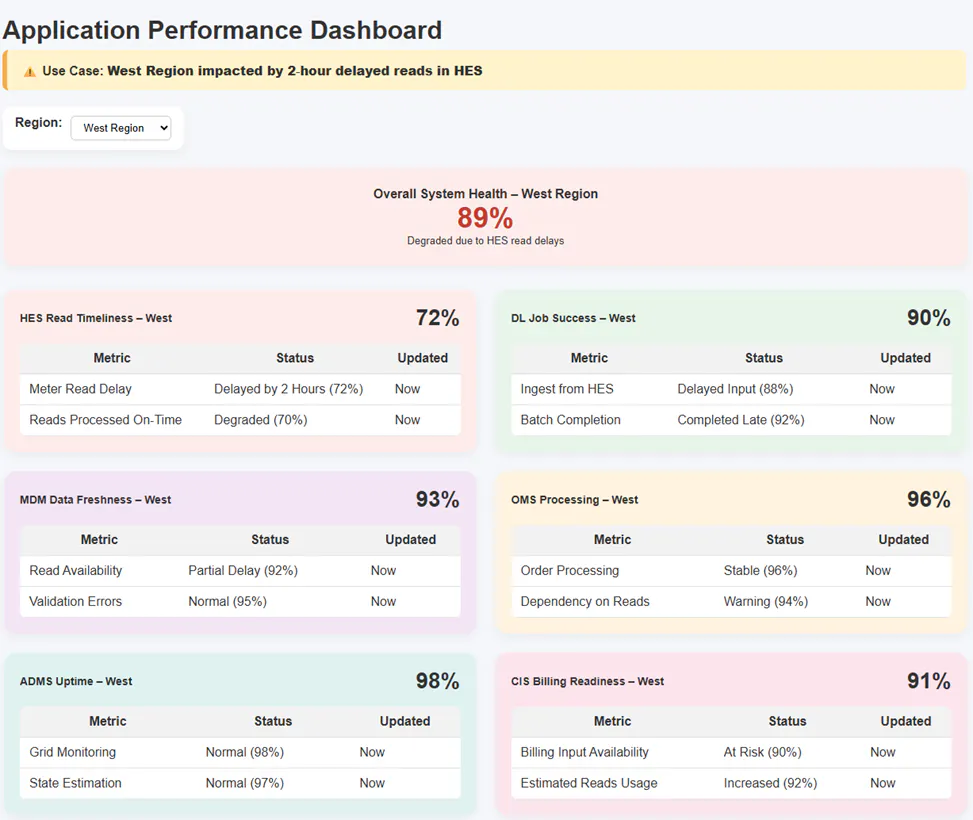
e.g. West region is impacted by 2 hour delayed reads
Here is a screen print for a dashboard with HES delayed by 2 hours for West region.
Data engineering dashboards
The data engineering dashboards try to explain how the problems might have occurred. Data engineers, platform operations team, and engineers maintain the data streams are the main users of these dashboards. The dashboards here talk about the interfaces of the applications and details about their health.
It should have following checks
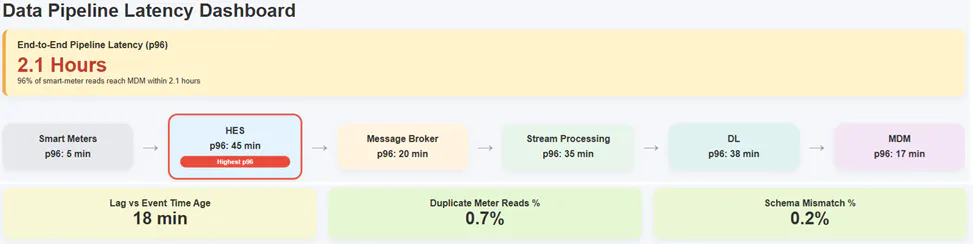
Pipeline latency breakdown across all stages of the data flow
e.g. the stream processing layer has a 95% latency.
Lag vs event-time age.
e.g. lag within acceptable range, but the event time is behind 65 mins.
Duplicate rate
Duplicate interval reads are 1.9% for today.
Schema mismatch rates
Schema is mismatched for 0.78% of the meters.
Here is a screen print for a dashboard having pipeline as Smart Meters → HES → Message Broker → Stream Processing → DL → MDM and having a p96.
Business readiness dashboards
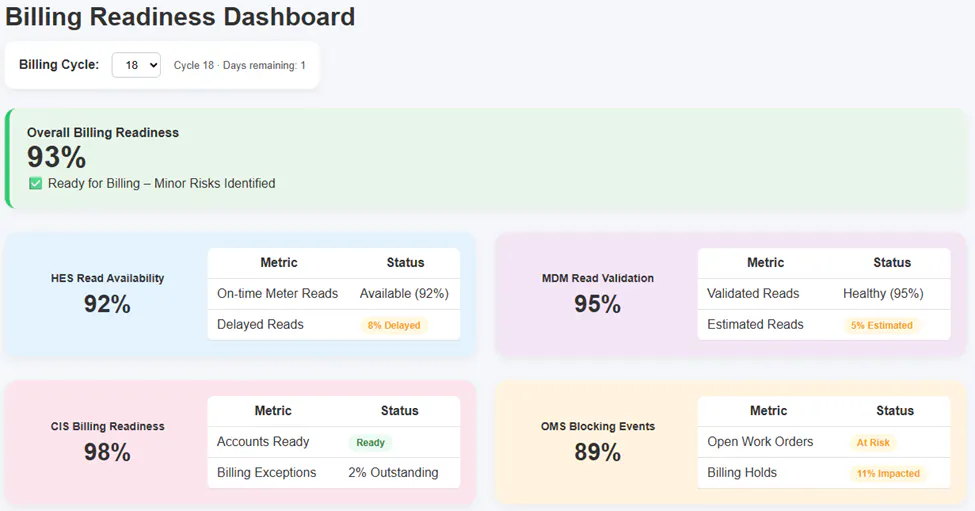
The business dashboards answer the executive level questions. The dashboards and their KPIs help business trust the meter data for billing, customer operations and grid decisions backed by MDM validation, OMS context, CIS impact, and ADMS trust. These dashboards are in between layer of operations monitoring dashboards and executive reports. They are decision oriented and not to diagnostic any of the production issue. For example, Billing Readiness is not just an MDM related issue. It is an intersection of AMI meters, HES, as well as CIS. The billing reediness check requires all these applications in green status.
The executive summary will have following checks
Billing readiness indicator
AMI data health panel
MDM acceptance and VEE checks
Missing reads with outage context
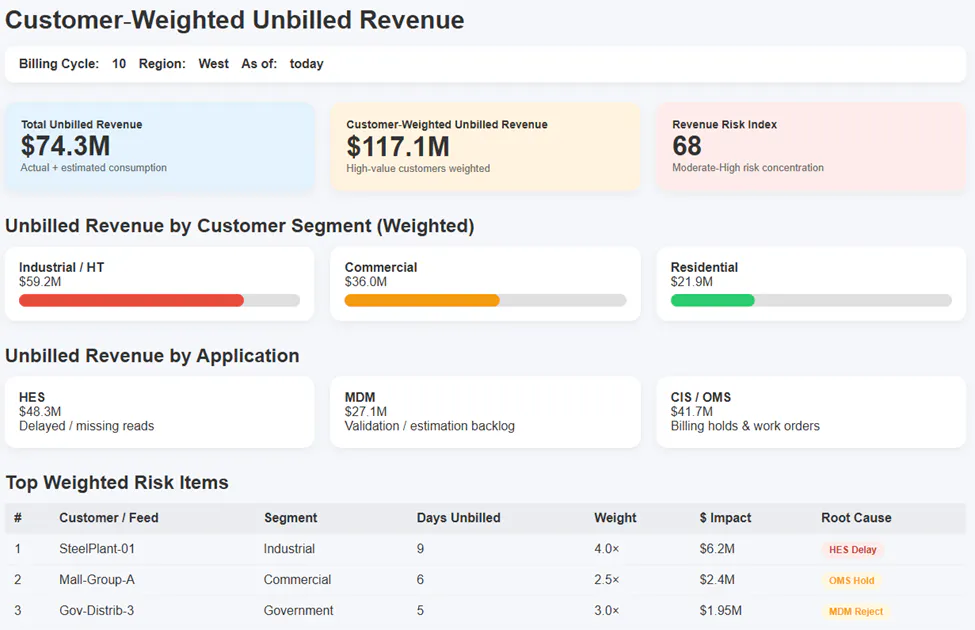
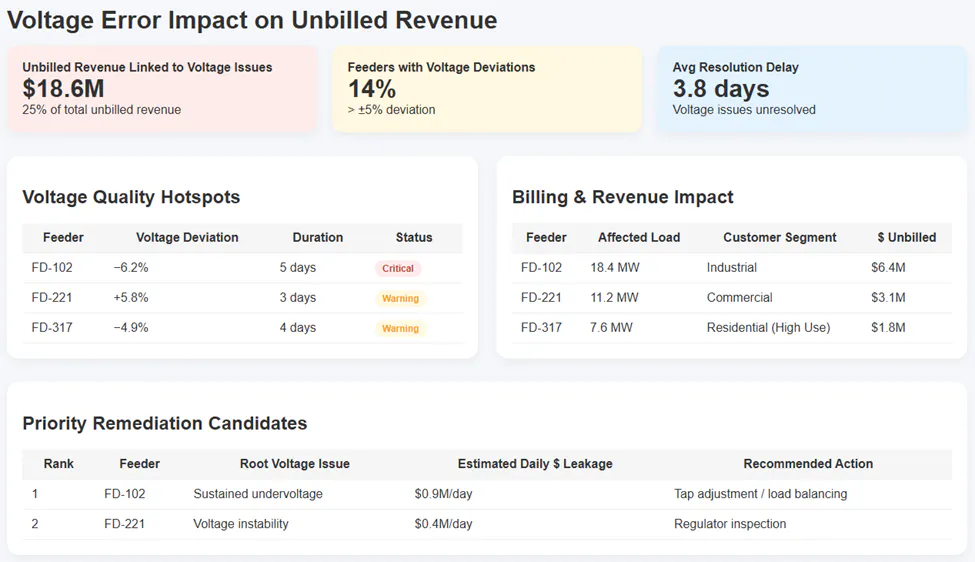
Unbilled revenue with customer weights
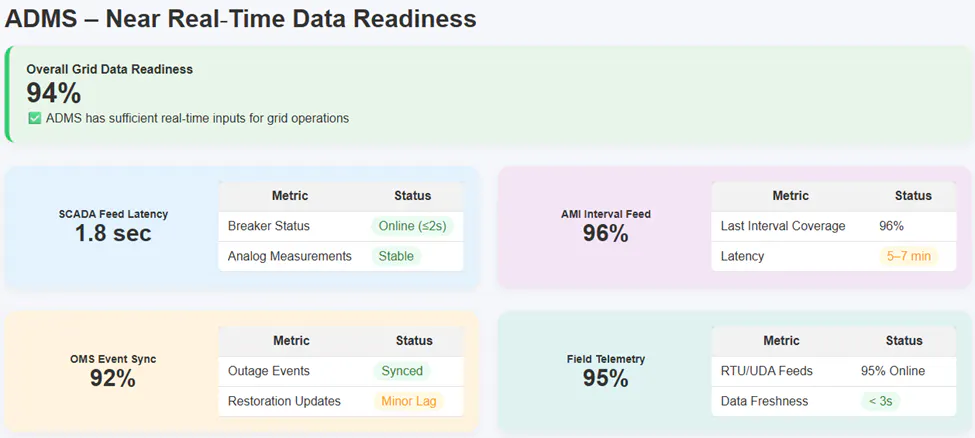
Near real-time data in ADMS for Grid operations
Voltage and load accuracy latency
Here is the screen print for Billing readiness indicator having applications
Here is an example of unbilled revenue
Here is the dashboard for Near Real‑Time Data Readiness in ADMS
And here is the Voltage error impacts on unbilled revenue
Regulatory and compliance dashboards
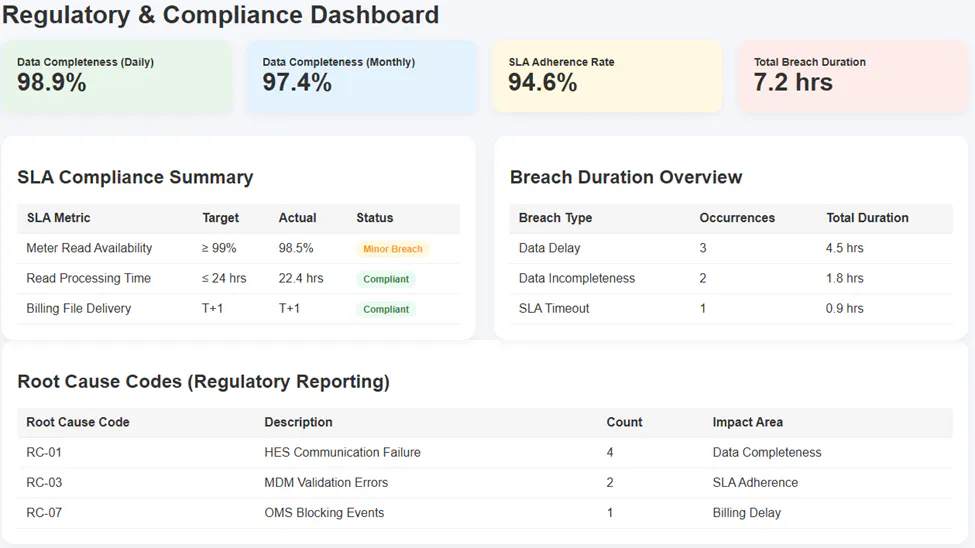
These dashboards prove compliance to regulators for the meter data. The dashboards are designed for compliance teams to be ready for audits and regulatory affairs. The dashboards need to have historical data which is immutable and traceable. The dashboards are legally defensible evidence with historical data.
The following checklist is followed for these dashboards
% data completeness per day/month
SLA adherence rate
Breach duration
Root cause code
Here is the dashboard for regularity and compliance
6.3 Security, Governance, and Reliability
Security protects trust, governance protects credibility, and reliability protects operations. Together they make AMI 2.0 data defensible, dependable, and regulator‑ready. The AMI data loading platform is operationally critical as it will be used for grid control, outage detection / correction, etc. Also, the meting data will be financially sensitive as the billing and revenue will use this data. The meter data platform is used for regularity purposes like audit and data integrity. The platform serves 24x7 and needs to be as reliable as possible. Here security failures can cause regulatory violations, governance failures can cause distrust, and reliability failures can cause business outages. Refer [7]
The AMI security must ensure
Confidentiality: data is available to the customer, and unauthorized access is prevented to the meter data
Integrity: meter reading data is not altered and is trustworthy. The monitoring data available without gaps and is truthful
Availability: in the storm like situation, the platform works and monitoring remains alive during incidences
AMI platforms require strict role separation across operational, data, and governance functions.
Following are the core roles which the platform should have
AMI Operations Role: it should have read-only access to all the dashboards, especially the real-time operational dashboards. Defining the streaming clusters, monitoring checkpoints are also the key responsibilities. The access to the raw meter data needs to be avoided for this role.
Data Engineers Role: it should have access to pipe-line configuration along with stream processing logic. The role generally defines and maintains the all types of metrics. The role should not have access for business dashboards and regularity SLA override.
Business Users: it should have access to the aggregated dashboards, readiness dashboards and SAL reports. The access to the pipeline internals and raw meter data payloads are avoided for this role.
Auditor: it should have read-only access to SLA history, evidence archives, business metrics, audit logs, security events and access anomalies. The auditor oversites the platform data independently.
One more aspect is to separate the production and non-production data. The isolation becomes mandatory as the non-prod testing data may looks like actual production outages. The metrics will loose the trust and data bridge may occur. While separating, physical and logical separations are equally important as the environments are operationally separated.
For governance of the data,
All metrics should have owner, a definite purpose, aggregation logic, SLA relevance and allowed thresholds.
All SLAs must be approved by business as well as operations, defined impact analysis methodology, time periods and audit trails.
A change management team should be defined to govern the changes in Metrics, Alert thresholds, SLA logics, and Retention policy. The version upgrades of these applications along with code changes should also be governed by this team.
The meter data will be reliable when,
Monitoring platforms targets continuous availability than AMI pipeline itself.
The recovery time for the platform is less than a minute
And the monitoring should not block the AMI data flow.
The metrics and logs data for the monitoring will be also massive and their retention should also be needs to be tiered as the same retention may not work for all data points. Below are the few metric data retention suggestions:
Data Type
Retention
Why
Raw high‑resolution metrics (1‑min)
14–30 days
Operations & debugging
Aggregated metrics (15‑min, hourly)
6–13 months
Trends & seasonal analysis
SLA summaries
3–7 years
Regulatory & audit
SLA breach events
7+ years
Dispute resolution
For log retentions,
Log Type
Retention
Notes
Pipeline logs
14–30 days
Debugging
Security audit logs
1–3 years
Compliance
Access logs
1 year
Governance
Incident logs
≥7 years
Legal evidence
7. Conclusion and next steps
An end‑to‑end AMI 2.0 data architecture, reinforced by continuous data load monitoring, enables early detection of issues before they cascade across dependent systems. Proactive measurement of data volumes, latency, completeness, and conformance, combined with structured catch‑up and back‑load handling, preserves trust in meter data during outages, upgrades, and large‑scale grid events. A centralized monitoring platform further operationalizes these capabilities by providing visibility, alerting, and accountability across stakeholders.
The introduction of an Event Streaming and Integration Layer represents a critical architectural evolution in AMI 2.0. Streaming platforms decouple data producers from consumers, support parallel real‑time and batch consumption, and enable re-playable, resilient data pipelines. This layer allows utilities to serve operational systems, analytics platforms, and traditional meter‑to‑cash workflows simultaneously—without compromising timeliness or reliability.
Ultimately, successful AMI 2.0 programs are defined not just by advanced meters or communications infrastructure, but by the utility’s ability to govern, monitor, and operate data at scale and in near real time. By adopting end‑to‑end observability, event‑driven integration, and robust data quality management as core architectural principles, utilities can reduce operational risk, improve decision‑making, and fully realize the value of AMI 2.0 as a strategic enabler of grid modernization.
By focusing on the next steps, utilities can move beyond incremental improvements and establish a resilient, scalable, and trusted AMI 2.0 data foundation which will be capable of supporting modern grid operations, regulatory confidence, and long‑term business value.
Define target AMI 2.0 data and integration architecture
Establish a clear blueprint covering meter ingestion, communication networks, streaming platforms, MDMS, analytics, and downstream integrations, with explicit responsibilities and quality checkpoints at each stage.
Implement measurable data quality and load KPIs
Standardize metrics for data volume, latency, completeness, conformance, and error rates, and align them with operational SLAs and regulatory expectations.
Go for a centralized Data Load Monitoring Platform
Deploy dashboards, alerting, and automated error handling that provide real‑time visibility across the full AMI data lifecycle, including exception, catchup, and back‑load scenarios.
Adopt an event‑driven integration strategy
Introduce or expand streaming platforms to support near‑real‑time distribution of meter reads, events, and power quality data, while enabling replay and decoupled system evolution.
Acronyms
Abbreviation
Description
ADMS
Advanced Distribution Management System
AI/ML
Artificial Intelligence and Machine Learning
AMI
Advanced Metering Infrastructure
ANSI C12
North American smart‑meter communication standard, developed by the American National Standards Institute (ANSI).
CIS
Customer Information System
DERMS
Distributed Energy Resource Management System
DL or DW
Data Lake or Data Wearhouse
DLMS/COSEM
Device Language Message Specification / Companion Specification for Energy Metering
EV
Electric Vehicle
FLISR
Fault Location Isolation and System Restoration
HES
Head-End System
LSV
Load Side Voltage
MDM/MDMS
Meter Data Management System
OMS
Outage Management Systems
OTA
Over the air
TOU
Time-Of Use
VEE
Validation, Estimation, and Editing
VVO
Volt/VAR optimization