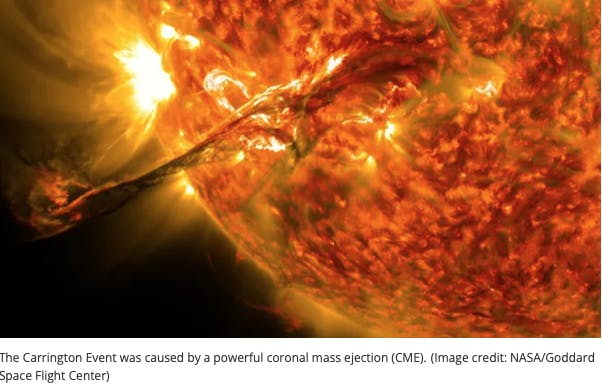
Space.com: "The Carrington Event: History's greatest solar storm." In August 1859, astronomers around world observed in fascination as sunspots on the solar disk grew in number. On 1Sep, Richard Carrington, an amateur skywatcher in Redhill, a small town near London, was dazzled by a sudden flash of light lasting about 5 minutes. What he described has been identified by NASA spaceflight as a "white light flare," a major coronal mass ejection (CME), a burst of magnetized plasma from the Sun's upper atmosphere, the corona. Usually these take multiple days to reach Earth, but in Carrington's case he recorded only 17.6 hrs had passed before the CME unleashed its force on our planet. "The day after Carrington observed the impressive flare, Earth experienced an unprecedented geomagnetic storm, with telegraph systems going haywire and auroral displays—normally confined to polar latitudes—visible in the tropics." This connection had never before been made, so it was named the Carrington Event. "According to History.com, there were reports of sparks showering from telegraph machines, operators receiving electric shocks and papers set ablaze by the rogue sparks." Telegraph workers the next day effects were still experiencing effects since the atmosphere was still charged. "Alarmingly, they found that they could unplug their batteries and transmit messages to Portland, Maine, using only the auroral current, according to Ars Technica." Researchers from Lloyd's of London and the U.S. Atmospheric and Environmental Research agency 'have estimated that a Carrington-class event today would result in between $0.6 and $2.6 trillion in damages to the U.S. alone.' "Luckily for us, solar storms like the Carrington Event happen once every 500 yrs or so, according to NOAA SciJunks."