Commercial shipping’s weather-changing ambitions are hitting formidable supply-demand headwinds.
The resulting green water over the bow is jeopardizing ocean carrier climate-change targets.
And while the long-term impact of those targets on the weather is debatable, there is no denying the challenges ahead if shipping lines are to reach the International Maritime Organization’s (IMO) ambitious decarbonization destination.
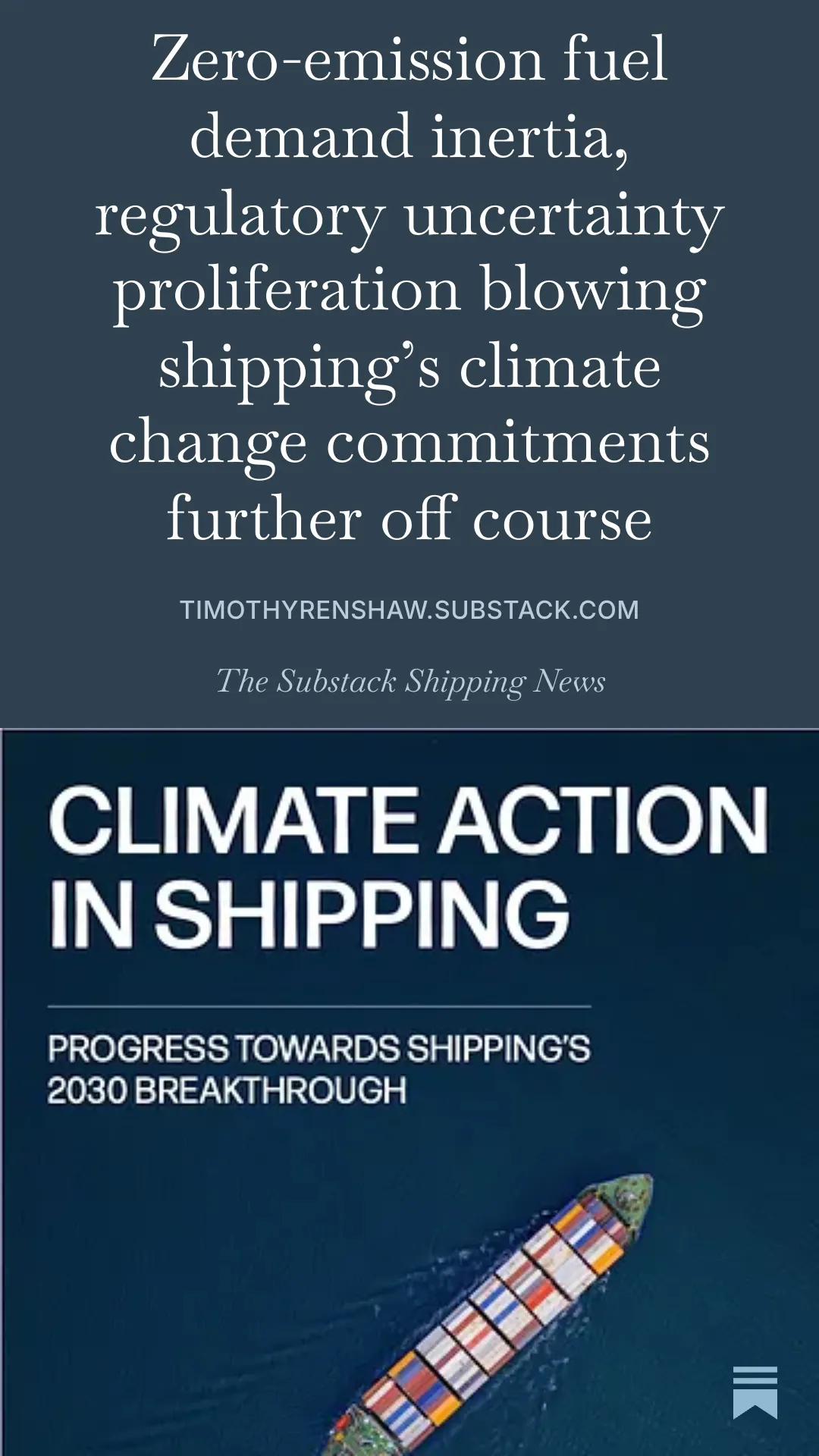
The 2026 “Climate Action In Shipping” (CAIS) report updates the inventory of challenges.
CAIS is an annual assessment of commercial shipping’s greenhouse gas emissions reduction progress on the way to achieving the IMO’s Net Zero Framework (NZF) goal of net-zero operations by 2050.
It’s produced by the UCL Energy Institute and the Getting to Zero Coalition and promises to provide “an honest account of where the sector stands.”
Honesty, especially in climate change discussions and initiatives, would be refreshing.
And sobering.
CAIS 2026 may therefore be a vexing read for climate change activists. They are not big on reality’s sobering subtleties; they prefer the black and white of political dogma.
Still, the report sees more than dark clouds on shipping’s energy transition horizon.
In the report’s foreword, Dan Ioschpe highlights some notable progress over the past 12 months.
The COP30 Climate High-Level Champion notes, for example, that the number of ports offering methanol bunkering has risen to 29 from 19, while deliveries of containerships capable of running on methanol posted a single-year record increase.
According to maritime industry risk-management company DNV, the global shipping fleet now has more than 100 methanol-capable ships, and another 300 are on order.
Methanol storage and supply, it reports, is available at 115 ports.
However, the gains outlined in CAIS 2026 do not generate enough lumens to significantly brighten the path ahead for net-zero shipping.
As the report laments, “Progress towards shipping’s 2030 breakthrough target of scalable zero-emission fuels [SZEF] accounting for 5-10% of the sector’s total fuel usage is lagging behind where it needs to be.”
How far behind, you ask?
For starters, SZEF would have to account for roughly 15 million to 30 million tonnes of heavy fuel oil equivalent annually to hit the breakthrough target. That equates to around 600 to 1,200 large containerships running on SZEF.
The number of alternative-fuel-capable ships today: approximately 440, and that dual-fuel capability does not guarantee alternative fuel use.
So, the gap between SZEF breakthrough target goals and shipping realities is wide.
CAIS also highlights the fallout from the unexpected delay in reaching the IMO’s decarbonization destination when member states voted against adopting its NZF initiative during 2025’s Extraordinary Session of the Marine Environment Protection Committee in London. The rejection of NZF, which is a cornerstone of the IMO’s greenhouse gas emissions reduction objectives, reflected growing discord over the framework and disagreement on how its carbon pricing proceeds would be collected and distributed.
Decarbonization delay dominoes continue to fall from the NZF rejection.
“Surveys conducted since the decision in October [2025],” the CAIS report says, “have revealed adverse impacts of the delay across the five levers of change, most notably in company-level decisions that were paused or cancelled when the NZF did not proceed as expected.”
Key change levers include finance and demand, “which have been negatively affected by shifts in sentiment and political leadership.”
Demand, for example, in terms of progress in container fleet SZEF compatibility, “remains off track [read: not good].”
In 2025: next to no progress; “simple stagnation,” according to CAIS.
However, the report adds that the wave of methanol-capable containerships delivered last year tripled the fleet’s methanol-capable in-service tonnage to 7.7 million gross tonnes (GT) from the previous 2.3 million GT.
Sounds impressive, but the 56 new ships totalling 5.4 million GT pushed the SZEF-capable share of the active fleet up to a mere 0.77% from 0.41%, and the ocean carrier order book for new SZEF-capable ships dropped to 5.7% of the fleet from 9.5%.
The decrease in methanol- and ammonia-compatible ship orders relative to previous years, according to CAIS, could have “serious implications if the trend continues.”
Potential SZEF demand today is equivalent to approximately 80 15,000 TEU containerships; compare that with the estimated demand equivalent of 600 needed to meet the 5% breakthrough goal in 2030.
With all the logistical, technological, infrastructure and regulatory uncertainties clouding shipping’s energy transition journey, it’s not surprising that ocean carrier lines and cargo owners are not bellying up to the bar to pay premiums to sign onto the SZEF voyage, even though the number of the industry’s Getting to Zero Coalition members offering zero-emission shipping services more than doubled to nine from four in 2025 compared with 2024.
According to CAIS, “cargo owners’ willingness to pay a premium for low-carbon shipping fell from 4.5% to 3.0%, and the share of cargo owners expecting to pay more within five years dropped from 65% to 45%.”
Prognosis: “The market alone is unlikely to drive a shift in the ordering of SZEF-compatible fleets.”
So, among the CAIS recommendations: Regional and national government policies need to “underwrite SZEF use to protect emerging early adoption.”
Reality check: Regardless of those policies, price, practicality, performance, and market pressure will determine how close shipping gets to net-zero operations by 2050.
www.linkedin.com/in/timothyrenshaw
@timothyrenshaw