


Posted originally in Substack.
A new paper asks whether the ocean’s accumulated heat can be relocated below the surface, while a small fraction is converted to useful electricity. The answer is not yet known - but it is a question?
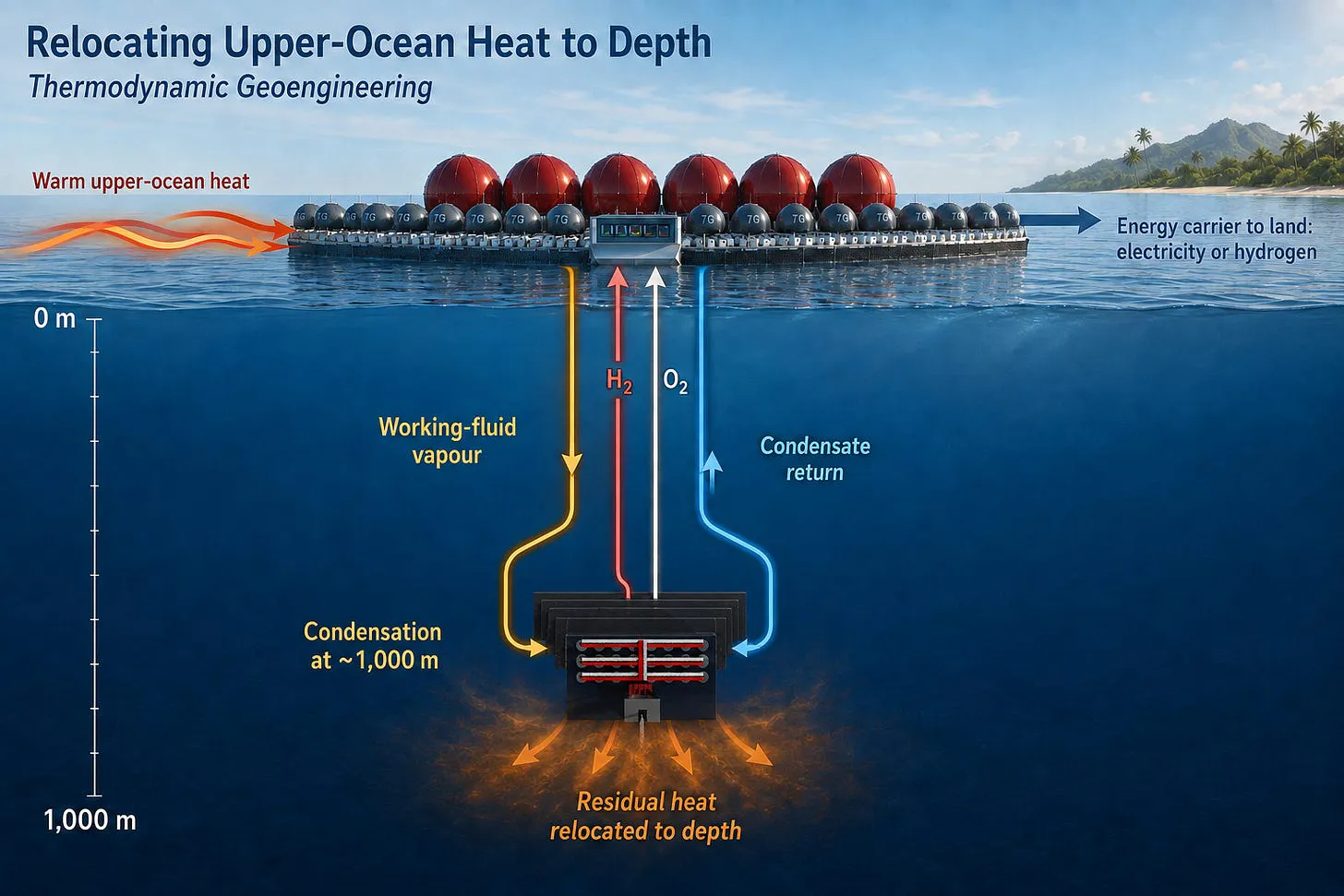
Climate change is usually described as a greenhouse-gas problem. That is true, but it is not the whole physical picture. Greenhouse gases disturb Earth’s energy balance; the result is that the planet retains more heat than it emits back to space. More than 90% of that excess heat has entered the ocean.
That fact changes how we should think about both the danger and the opportunity before us. The ocean is not simply a passive reservoir. It is where much of global warming is expressed: in rising sea-surface temperatures, marine heatwaves, thermal expansion and sea-level rise, stressed ecosystems, evaporation, humidity, and the heat available to fuel tropical cyclones. Cutting emissions remains essential because it slows the continuing addition of heat. But emissions cuts do not immediately remove the
My new preprint, Climate-Scale Implications of Relocating Upper-Ocean Heat to Depth by Thermodynamic Geoengineering, asks a deliberately simple question: could some of that upper-ocean heat be moved deeper, where it would be less directly coupled to the atmosphere, while producing useful carbon-free energy in the process?
The proposal is called Thermodynamic Geoengineering, or TG. It resembles ocean thermal energy conversion (OTEC) in one important respect: it uses the temperature difference between warm tropical surface water and cold water at depth to operate a low-temperature heat engine. But its proposed arrangement is different. Rather than pump huge volumes of cold seawater up to a near-surface condenser, TG would use a closed working-fluid loop. Warm surface water vaporizes the working fluid; the vapour travels down to a condenser near 1,000 metres; it condenses there and returns to the surface loop. Electricity can be exported to shore or used to make hydrogen. Most of the heat remains heat - but is released at depth rather than returned quickly to the upper ocean.
That distinction is the heart of the climate question.
It is vital to begin with what TG does not do. It does not destroy heat. It does not repeal the First Law of Thermodynamics. A low-temperature heat engine can turn only a small fraction of its thermal input into useful work; the rest is residual heat. And eventually the electricity, or hydrogen made from it, also becomes heat when it is used. The paper is explicit about this because discussions of climate technology can too easily slip into misleading accounting.
The possible value of TG is therefore not heat annihilation. It is heat relocation in space and time. The ocean surface is in continual conversation with the atmosphere. Heat held in the mixed layer can influence evaporation, atmospheric moisture, rainfall, marine heatwaves and storms. Heat released well below that layer may follow much slower and more complicated pathways back toward the surface. It may mix, move along density layers, be carried by currents, rise in upwelling regions, or become part of the overturning circulation. Where heat is placed, and how long it remains there, can matter as much as the total amount of heat.
This is a plausible physical idea, but it is not yet a demonstrated climate benefit. That distinction deserves emphasis. A deep heat release could have beneficial effects in one region and unwanted effects somewhere else. Cooling the surface locally could reduce evaporation and air-sea heat flux, but those changes could affect clouds, rainfall and circulation. Warming at depth could change stratification, oxygen and nutrient transport, marine ecosystems, carbon uptake, and sea level. None of these outcomes should be assumed in advance. The question is not whether a platform can be imagined; it is whether the entire coupled ocean-atmosphere system responds in a way that is measurable, persistent, safe and equitable.
The scale explains why this research cannot be treated as a narrow engineering problem. A 1-GW-net TG platform would export one gigawatt of electricity, but it would process many gigawatts of ocean heat. A future fleet would not be a simple multiplication of one unit. Its surface cooling wakes could overlap. Its deep heat plumes could share the same circulation pathways. The ocean and atmosphere could compensate for part of the imposed cooling. A configuration that appears attractive in a spreadsheet could be ineffective, counterproductive, or constrained by ecological limits when deployed in an actual basin.
The paper uses a notional 31-terawatt, 31,000-platform fleet only as a bounding exercise - a way to reveal the order of magnitude at which climate interactions would become impossible to ignore. It is not a forecast or a recommendation. The responsible route, if the idea survives early testing, would be gradual: begin with the smallest scientifically useful scale, measure what happens, compare it with a no-intervention control, and expand only if independently reviewed evidence justifies the next step. In a climate intervention, the ability to pause, modify, or stop matters as much as the ability to build.
For that reason, the paper proposes a research programme rather than a deployment prescription. The first stages are modest and falsifiable: laboratory and component tests; plume and wake studies; small, monitored field experiments; regional ocean modelling; then coupled ocean-atmosphere simulations. Each stage should have clear baselines, energy conservation checks, independent review, open data where possible, and predefined stop criteria. If the predicted cooling cannot be distinguished from natural variability, if deep heat returns rapidly in important regions, or if ecological disturbances are unacceptable, that is not a failure of science. It is the information needed to stop or redesign the concept.
One often-repeated TG intuition also needs to be treated carefully. A simple calculation suggests that heat moved to roughly 1,000 metres could take on the order of two centuries to return to the surface, compared with months for upper mixed-layer exchange. Previous discussions used an illustrative figure of about 225 years. In the paper, I state plainly that this is a hypothesis, not an oceanographic constant. The ocean has no single vertical conveyor belt. Return times vary greatly by basin, season, water mass, mixing, eddies, currents and upwelling. What is needed is not a single number but a distribution: what fraction returns after ten years, fifty years, two hundred years, and where?
The same caution applies to the suggestion that returned heat might be recovered more than once. In ideal arithmetic, a fraction of the available energy could be converted on each encounter with a suitable temperature gradient. But mathematics alone cannot show that the same heat will ever return to an accessible warm region, remain sufficiently concentrated, or meet another platform. Tagged-heat experiments in realistic circulation models must settle that issue. It is a research proposition, not a promised result.
There is, however, another potential climate pathway that should be kept separate from direct heat relocation. If TG electricity or hydrogen replaces fossil electricity, fuel, or industrial heat, the avoided greenhouse-gas emissions may reduce future radiative forcing. That is a real and important possibility - but it must not be counted twice. The thermal relocation effect and the emissions-displacement effect are different mechanisms, operating on different timescales. A credible assessment must calculate each one transparently, including the materials, construction, maintenance and end uses of the energy system.
Why investigate the idea at all? Because the world faces two linked problems. We need abundant, reliable clean energy, particularly in tropical and coastal regions, and we need better ways to manage the climate consequences of heat already stored in the ocean. Most proposed climate interventions focus on radiation or carbon removal. TG belongs in a different category: it asks whether the ocean’s vertical temperature structure can provide clean power while changing the timing and location of heat’s interaction with the atmosphere.
That does not make TG a substitute for rapid emissions reduction, adaptation, restoration, or conventional renewable energy. It does mean that we should be willing to investigate a potentially large climate-energy interaction with the seriousness it requires. The proper standard is high: independently reproducible models; rigorous oceanography; engineering realism; marine ecological safeguards; transparent governance; and an explicit willingness to reject the hypothesis if the evidence does not support it.
The most responsible conclusion today is therefore also the most interesting one. Thermodynamic Geoengineering may be able to move a bounded portion of upper-ocean heat below the surface, produce useful energy, and perhaps change the timing of climate impacts. But we do not yet know the sign, magnitude, duration or geographical distribution of the net result.
That uncertainty is not an excuse for complacency. It is a reason to ask the question carefully, openly and now - before claims harden into assumptions, and before the opportunity to examine a new class of climate-energy technology is lost.
The full preprint is available on SSRN: https://ssrn.com/abstract=7438712