


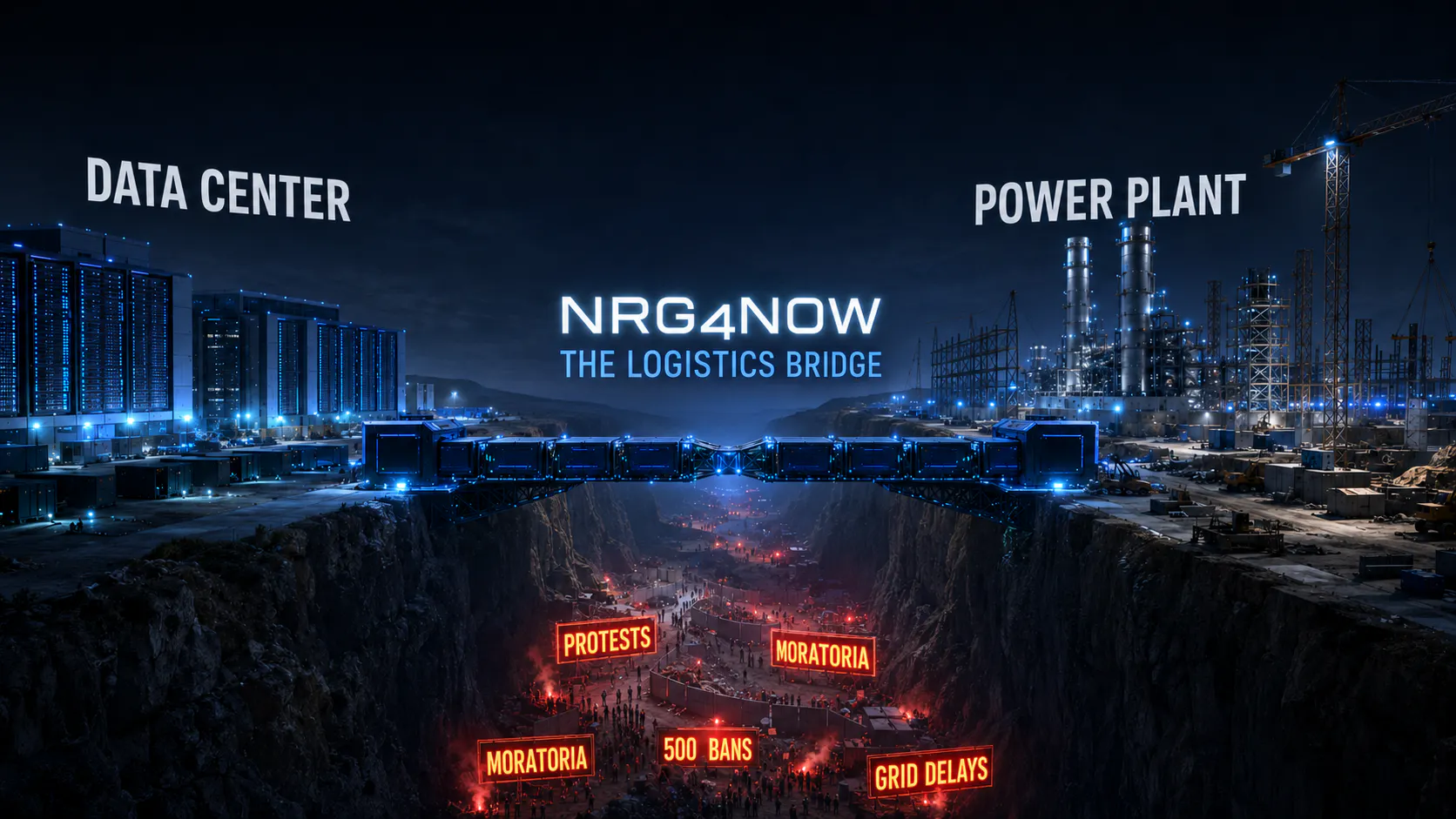
Sun Tzu understood supply lines. Henry Ford understood scalable logistics. The AI industry may need both.
The race for artificial intelligence has triggered an equally remarkable race for energy.
Gigawatts of new data-center capacity are being announced. Utilities face connection requests on a scale few grids were designed to accommodate. New gas plants, nuclear projects, renewable generation and battery systems are being discussed as if every new cluster of GPUs inevitably requires another dedicated energy factory beside it.
But what if we are asking the wrong question?
What if the central problem is no longer simply how to produce more energy, but how to make energy that already exists available at the place and time where it is needed?
Sun Tzu understood the first half of the problem
More than two thousand years ago, Sun Tzu wrote:
“We may take it then that an army without its baggage-train is lost; without provisions it is lost; without bases of supply it is lost.”
His subject was warfare, not electricity.
But the underlying physical principle is remarkably modern: resources have little operational value if they cannot reach the point where they are needed, when they are needed.
This is increasingly relevant to AI infrastructure.
A hyperscaler can procure GPUs, construct a data-center building and install computing equipment relatively quickly. But the electricity infrastructure required to operate that facility continuously may follow an entirely different timetable.
The NRG4NOW White Book examines this as the Time-to-Energy problem: modular compute infrastructure may be deployed within approximately 12–18 months, while large grid connections in North America and Western Europe can require 60–96 months.
The result is an extraordinary mismatch.
We can build the machine before we can feed it.
And the response increasingly appears to be: build another power plant.
But there is another paradox
While new data centers are searching for enormous quantities of reliable, 24/7 energy, renewable energy is being curtailed elsewhere.
Wind and solar generation are being curtailed because the grids cannot transport or absorb the available output. Renewable projects are waiting in interconnection queues. Negative electricity prices appear when generation and demand do not coincide. Short-duration batteries can shift some of a solar peak into the evening, but they cannot move August into January.
In other words:
At one location, energy cannot get out.
At another location, energy cannot get in.
That should at least raise a question before another dedicated power station is commissioned:
Do we really have an energy-production problem — or increasingly an energy-logistics problem?
Henry Ford understood the second half
Henry Ford did not solve industrial scaling by building a separate factory around every automobile.
The breakthrough was the system.
Standardized components. Defined interfaces. Repeatable processes. Coordinated movement. Continuous throughput.
The assembly line transformed the relationship between production and logistics.
This principle deserves another look in the energy sector.
Today, we still tend to treat large new energy consumers as individual infrastructure problems. A data center needs power, so we plan a new grid connection, new generation, new backup capacity and sometimes entirely new infrastructure around that particular site.
That is essentially rebuilding the energy factory again and again.
Ford would probably have asked a different question:
Where is the assembly line?
From an energy factory to an energy logistics network
This question led me to NRG4NOW.
NRG4NOW is not another battery, another gas turbine or another power plant. Nor is it intended to replace the electricity grid, pipelines, batteries or conventional generation.
It is an open architectural framework intended to connect existing energy technologies through standardized physical and digital interfaces.
The basic sequence is straightforward:
capture → store → transport → identify → dock → convert → deliver
Energy that cannot be economically used or transmitted as electricity at its source can, where technically and economically appropriate, enter a molecular-energy pathway.
Standardized storage and transport modules become movable energy inventory.
Roads, railways, inland waterways, ships and other qualified transport routes become part of the energy-delivery network.
Energy hubs provide interchange points.
Automatic identification, compatibility checks, telemetry, safety protocols and orchestration provide the coordination layer.
At the destination, the molecular carrier can provide electricity, heat, cooling, industrial feedstock or other required energy services.
The public grid remains.
The difference is that it is no longer assumed to be the only possible bridge between energy and demand.
The bridge
This is why I use a simple image to describe the problem.
On one side of the canyon stands the data center.
On the other stands available energy infrastructure.
Between them are grid delays, permitting constraints, moratoria, local opposition and infrastructure bottlenecks.
The conventional response is to wait for the canyon to disappear — or build another power plant on the data-center side.
NRG4NOW asks whether we can instead build a logistics bridge across it.
Not metaphorically, but as a standardized physical and digital supply architecture.
This also changes the data-center debate
Much of today's discussion assumes a binary choice.
Either society accepts the infrastructure required by rapidly expanding AI computing, or the expansion of data centers must slow.
But there may be a third question:
Can part of the energy infrastructure be decoupled from the location of the data center?
If energy can be buffered, transported and converted through standardized modular systems, the location of generation and the location of consumption no longer need to be tied exclusively by an immediate electrical connection.
That does not make engineering constraints disappear.
Conversion has losses. Storage costs money. Transportation costs money. Safety, permitting, redundancy, inventory requirements and economics must all be demonstrated.
The relevant economic question is therefore not whether transported molecular energy is magically cheaper than electricity from the grid.
It is:
Is earlier access to usable energy worth more than the full cost, conversion loss and execution risk of providing that energy through a complementary logistics pathway?
For a conventional industrial load, the answer may sometimes be no.
For billions of dollars of compute hardware waiting years for power while accelerator generations become obsolete, the calculation may look very different.
Sun Tzu + Ford
This brings the two historical ideas together.
Sun Tzu understood that possessing resources is not enough. Supply lines determine whether resources become capability.
Ford understood that scaling does not require reinventing production for every unit. Standardization and logistics turn individual components into a system.
The AI infrastructure race now confronts both problems simultaneously.
We have enormous new demand.
We have enormous existing and planned energy resources.
What we do not always have is the architecture connecting the two across time, distance and infrastructure constraints.
Perhaps the next major innovation in energy will therefore not be another form of generation.
Perhaps it will be the system that connects what we already have.
Sun Tzu understood the importance of supply lines.
Henry Ford understood the power of standardization.
The AI age may need both.
NRG4NOW — The World Wide Web of Energy
Energy Like Data. Anytime. Everywhere.
The underlying system analysis, architecture, evidence boundaries and proposed deployment framework are presented in the NRG4NOW Global Energy Logistics White Book.
White Book: https://doi.org/10.5281/zenodo.22051636
Project website: https://www.nrg4now.com/