


Thousands of small rooftop solar panels and home batteries, linked by software, are starting to behave like one giant power plant — and India needs them more than most countries.
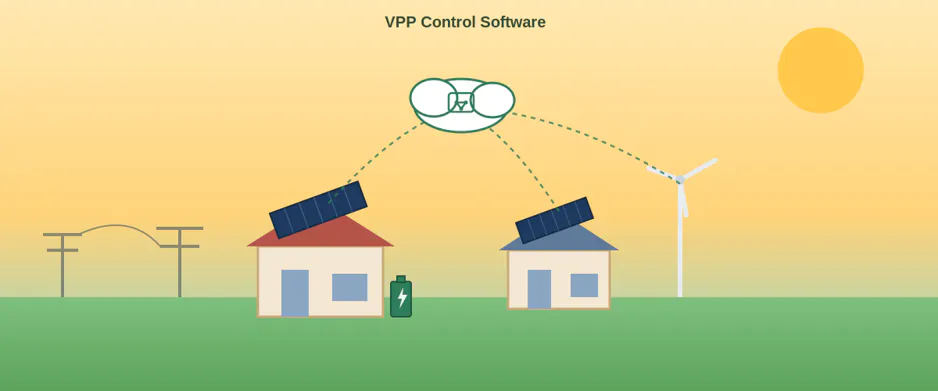
Rooftop solar, home batteries, and even wind assets — coordinated by software into a single virtual power plant.
Imagine it's a scorching May afternoon in Delhi. Every second household has switched on its air conditioner, and the power grid is groaning under the load. Normally, this is when a utility fires up an expensive backup plant — usually coal or diesel — just to survive the next few hours of peak demand.
But what if, instead, thousands of homes with rooftop solar panels and batteries could simply release their stored power into the grid at that exact moment? No new plant. No extra fuel. Just power that was already sitting quietly on someone's terrace.
That idea has a name: the Virtual Power Plant, or VPP. And it's quietly becoming one of the most important ideas in India's energy future.
So, What Exactly Is a Virtual Power Plant?
A Virtual Power Plant isn't a plant at all — at least not in the way we usually picture one, with giant chimneys and turbines. It's a network of many small energy sources spread across a city or region, all linked together digitally and controlled as if they were one large power station.
These small sources can include:
● Rooftop solar panels on homes and offices
● Home and commercial battery storage systems
● Electric vehicle batteries
● Smart air conditioners and other flexible appliances that can shift when they draw power
Individually, each of these is tiny. But when software connects thousands of them, they can behave exactly like a traditional power plant — supplying electricity to the grid precisely when it's needed most.
How Does It Actually Work?
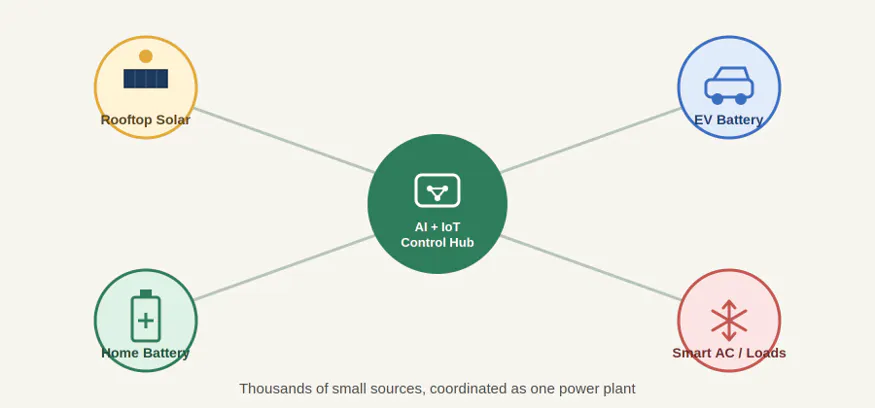
An AI + IoT control hub reads and coordinates thousands of small, distributed energy sources in real time.
Think of a VPP as a very smart conductor leading an orchestra of thousands of tiny musicians.
At the centre is a software platform powered by AI and IoT (Internet of Things). It constantly tracks how much electricity is being generated — from solar panels, for instance — and how much is being consumed across the network. Small renewable sources, distributed loads, and storage batteries at homes, offices, and even vehicles are electrically connected and balanced by these control systems.
When demand rises sharply, like that hot Delhi afternoon, the software automatically draws stored power from thousands of connected batteries and feeds it back into the grid. When demand is low, it does the reverse — storing excess solar power for later. All of this happens in real time, with barely any human intervention.
Why This Matters So Much for India
India isn't adopting VPPs just as a nice-to-have green technology — it genuinely needs them, for reasons specific to how India's power consumption is changing.
1. Air conditioners are reshaping India's demand curve
India is projected to install around 200 million new air conditioner units over the next decade, and this is shifting peak power demand from its traditional evening slot toward the afternoon, typically between 2 and 5 pm. That's a problem, because solar generation starts declining toward the end of this very same window — right when it's needed most.
2. India's renewable energy targets are ambitious
India is targeting 500 GW of non-fossil fuel power capacity by 2030, but the rapid growth of renewable and distributed energy sources brings technical and economic challenges due to intermittency and gaps in grid infrastructure. VPPs directly address this by smoothing out that unpredictability.
3. Grid stability and blackouts
By enabling renewable energy to be injected into the grid intelligently, VPPs help address power outages, blackouts, and frequency or voltage imbalances — making the power grid more reliable and sustainable.
The infrastructure doesn't need to be built from scratch. It's already sitting on rooftops across the country — it just needs to be connected.
VPPs Already Happening in India
This isn't just theory — India already has real, on-ground examples:
Tata Power Delhi Distribution Limited (TPDDL)
Has pilot VPP projects already underway, exploring how distributed solar and storage can be aggregated and managed at the distribution level.
BRPL, New Delhi (with GEAPP, IndiGrid & AmpereHour)
Commissioned India's first commercial standalone Battery Energy Storage System (BESS) project to receive regulatory approval — achieving a levelized tariff nearly 55% lower than the previous benchmark, in a region where variable renewable energy penetration already exceeds 12%.
Rajasthan's DISCOMs (Jodhpur, Jaipur & Ajmer Vidyut Vitran Nigam)
Floated tenders in 2026 for a combined 172 MW / 688 MWh of pilot-scale standalone battery storage projects across the state, on a build-own-operate model.
Other states exploring the model
Discoms in Himachal Pradesh, Assam, Gujarat, Tamil Nadu, and Maharashtra are exploring battery storage deployment — each shaped by unique grid challenges, from hydropower-heavy Himachal Pradesh to renewable-rich Tamil Nadu and Gujarat, which face high curtailment from over-generation.
The Real Benefits
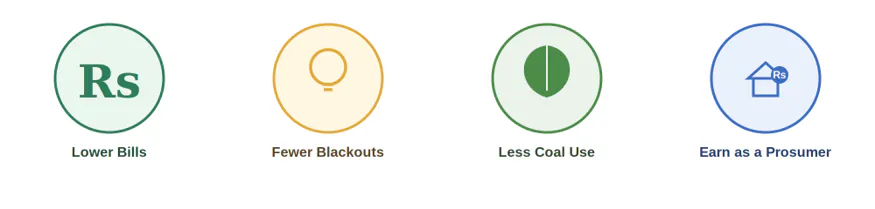
For everyday Indians and the power sector alike, VPPs offer:
● Lower electricity bills — by avoiding costly peak-hour power purchases
● Fewer blackouts — because the grid has a flexible backup source in reserve
● Reduced dependence on coal and diesel backup plants
● A new income stream for homeowners, who can sell surplus solar power back to the grid, becoming "prosumers" — a residential community with rooftop solar and battery storage can stay unaffected by outages and even supply neighbouring communities on demand
● Smarter management of the coming EV boom — VPPs are becoming critical for managing EV charging demand and integrating it smoothly into the grid
The Challenges India Still Needs to Solve
It would be misleading to suggest VPPs are a done deal in India. There are real hurdles:
POLICY & REGULATION
India currently lacks a clear, dedicated regulatory framework specifically for VPPs. The absence of clear policy and legal guidelines has led to high capital costs and limited interest from consumers, discoms, and government bodies alike.
INFRASTRUCTURE GAPS
Inadequate grid infrastructure and the high fixed costs of building communication networks make setting up storage-based systems particularly difficult.
FINANCING
Financing remains tricky, though it's improving — international partners are helping make early projects financially attractive enough for discoms to adopt.
Where Is This Headed?
VPPs won't replace India's traditional power plants overnight, and nobody is claiming they will. But they represent something powerful: a way to make India's rapidly growing rooftop solar and battery ecosystem useful at a grid scale, instead of each installation working in isolation.
As battery costs keep falling and India's regulatory bodies build clearer frameworks — as we're already seeing in Rajasthan — VPPs are likely to move from small discom pilots to a genuine part of how India keeps its lights on during its hottest, highest-demand afternoons.
Virtual Power Plants are one of the quietest but most consequential shifts in India's energy story — worth watching closely over the next few years.