


By Kennedy Maize
Recent news about Donald J. Trump’s business venture into fusion power raises a key question: is LSD back in fashion? Or could it be just another Trump-orchestrated con job to enrich his family and himself?

The merger of a company with no real money — Trump Media and Technology Group Corp. — and a company with no proven technology — TAE Technologies — touting a self-proclaimed value of “more than $6 billion” has all the attributes of a 1970’s acid trip. Add the astonishing claim that they will be producing electricity from fusion in 2030.
The deal announced with great hype earlier this month is full of speculative hyperbole: “Deal to combine TMTG’s access to significant capital and TAE’s leading fusion technology. In 2026, the combined company plans to site and begin construction on the world’s first utility-scale fusion power plant (50 MWe), subject to required approvals. Additional fusion power plants are planned and expected to be 350 – 500 MWe.” The merger is expected to close in the middle of 2026.
The announcement also produced skepticism in the mainstream media. CNN reported, “A $6 billion nuclear deal has Trump’s name all over it. It’s raising serious ethics concerns….President Donald Trump will simultaneously have a major financial interest in a company whose fortunes will be influenced by the actions of a government that Trump himself presides over.”
Let’s look first at Trump Media and Technology Group, run by Devin Nunes, a former California dairy farmer and back-bench Republican congressman. The company, incorporated in February, 2021, became publicly traded on NASDAQ in September, 2021 through a SPAC (special purpose acquisition company) with a series of dodgy Chinese financial ties. It should come as no surprise that ticker symbol is “DJT.” Trump is the largest shareholder.
When he became president for the second time, Trump transferred his DJT shares to Donald Jr., in a trust designed to reduce real or apparent conflicts of interest. Trump Jr. is now the chairman of the merged company. In January, Trump Media awarded six of its board of directors more than 25,000 shares each of DJT stock, worth more than $200,000 at the time. The six were Kash Patel, now FBI Director; Linda McMahon, now Secretary of Education; Robert Lighthizer, U.S. Trade Representative in Trump 1 and Trump’s tariff guru; Eric Swider, a financial finagler who honchoed the SPAC deal; Louisiana lawyer W. Kyle Green; and Junior. Patel, seeking Senate confirmation to the FBI job, in a questionnaire said he was declining the gift.
Trump Media has two basic lines of business: the Twitter wannabe Truth Social and a cryptocurrency trading operation aiming to become the third largest corporate bitcoin holder. The first is a major financial loser, having never turned a profit. The second is entirely speculative and Trump as president has moved to improve its prospects. In March, Trump promulgated an executive order, “Establishment of the Strategic Bitcoin Reserve and United States Digital Asset Stockpile” designed to take over the U.S. Treasury’s large bitcoin holdings.
The company’s most recent quarterly financial statement at the Securities and Exchange Commission, June 30, showed assets of $3.2 billion, liabilities of $1 billion, and a quarterly loss of $45 million.
The Wall Street Journal summarized Trump Media: “First there was Truth Social. Then a streaming platform. A suite of financial products came later, as did a multibillion-dollar deal to stockpile cryptocurrency….The primary value of Trump Media is that Trump is the president.” Peter Schiff, a longtime financial analyst and chief economist of Euro Pacific Asset Management, said, “It’s a company in search of a business.”
Is California-based TAE Technologies, built on a fusion technology that has not been commercially demonstrated, that business? It began in 1998 as Tri Alpha Energy, to promote a unique hydrogen-boron fusion technology. On its web site, the company claims it has raised “more than $1.3 billion in private capital.” According to Reuters in 2021, the company had raised $880 million by that date.
Among the company’s directors listed on its website are former Obama administration Secretary of Energy and MIT nuclear scientist Ernest Moniz and former Nuclear Regulatory Commission Chairman Richard Meserve, a Clinton appointee. It is not clear if either will be involved with the new firm.
TAE is taking a revolutionary approach to fusion, abandoning the conventional model of fusing two hydrogen isotopes — deuterium (hydrogen with two neutrons instead of one) and tritium (hydrogen with three neutrons) — to yield helium with a huge burst of energy and a flux of neurons. The problem is the neutrons, which can irradiate everything in their path and require heavy and expensive shielding. TAE proposes to fuse protons (hydrogen nuclei) and boron-11 (the atomic mass of 11 is a function of 6 neutrons and 5 protons).
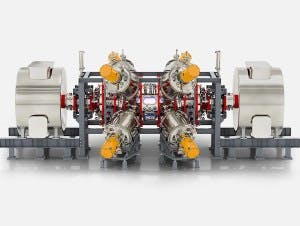
This fusion would produce three helium atoms and copious energy but no neutron flux, making it safer and easier to manage. According to multiple sources, that fusion would take a lot more energy input to get an excess out. TAE’s approach to that problem is a phenomenon first identified at the plasm physics lab at Princeton, known as “field-effect configuration.” Princeton describes it as “the novel use of radio-frequency waves that drive an electrical current and heat the plasma, and magnetic mirrors that trap the plasma particles in a to-and-fro motion.”
Nuclear physicist Edwin Lyman at the Union of Concerned Scientists, who pointed out that he’s not a plasma physics expert, told The Quad Report that the aneutronic reaction “requires far higher temperatures than conventional deuterium-tritium fusion, and there is no indication that its test machines have gotten anywhere near that temperature.”
The strange merger comes around the same time that Trump’s Department of Energy is elevating the profile of its long-standing fusion program. In October, DOE announced a new “Fusion Science and Technology Roadmap to Accelerate Commercial Fusion Power.” On November 20, DOE issued a short, anodyne press release announcing an organizational realignment, with a link to a new organization chart. The chart reveals a new “Office of Fusion.”
The Trump Media-TAE deal has raised ethical concerns. Richard Painter, former top ethics official for President George W. Bush told CNN, “There is a clear conflict of interest here.”