


By Kennedy Maize
President Trump, reaching back to his first go-round, has issued another possible ban on foreign-made equipment crucial to the bulk power system, to be administered by the Department of Energy. A likely outcome is to push up the costs of electric power, passed on to consumers.
Late last month (Aug. 26), Trump issued Executive Order 14420– “Declaring a National Emergency to Secure the United States Bulk Power System” — which he said he was issuing because “Certain foreign actors are increasingly creating and exploiting vulnerabilities in the United States bulk-power system, which provides the electricity that supports our national defense, vital emergency services, critical infrastructure, and economy.”
Although the order does not single out any particular foreign adversary, the focus is clearly on China. A White House fact sheet notes that the order provides for the Secretary of Energy, “in consultation with other members of the Cabinet, to identify bulk-power system electric equipment that may pose risks identified in the Order and prepare recommendations for the Assistant to the President for National Security Affairs to address the risks posed by that equipment.”
The fact sheet also specifies that it “does not apply to facilities used for local distribution of electric energy.”
An analysis by the Hunton Andrews Kurth law firm notes, “President Trump signed Executive Order 13920 in May 2020, establishing a similar prohibition regime. DOE’s principal action under the 2020 Order was a December 2020 prohibition order targeting certain Chinese-made equipment serving critical defense facilities. The Biden Administration revoked that prohibition in April 2021, issued a request for information on future restrictions, and ultimately allowed the underlying national emergency declaration to lapse without further rulemaking.”
The Institute for Energy Research said the new Trump “restrictions focus on components supporting large-scale U.S. electricity infrastructure, including substation transformers, grid-connected inverters, large generators, battery energy storage systems, turbines, industrial control systems, and related software.”
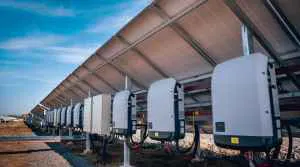
IER added that “Europe has recently taken similar actions for the same reasons, as operators discovered ‘backdoors’ and other potential vulnerabilities in Chinese-manufactured equipment….Concerns have escalated alongside the increasing deployment of grid-connected equipment, as modern solar inverters, battery-management systems, and other equipment can now generally be monitored and controlled remotely.”
IER is a Washington-based conservative-oriented policy advocacy group. Robert L. Bradley Jr., the former director of public policy analysis for Enron, is the president.
The Foley & Lardner law firm said the new order is broader than the Trump first term order: “The principal difference concerns the foreign actors involved. EO 13920 used ‘foreign adversary,’ which encompassed ‘any foreign government or foreign non-government person engaged in a long-term pattern or serious instances of conduct significantly adverse’ to U.S. national security or that of its allies, or to the security and safety of U.S. persons.
“In a later Prohibition Order issued by then-Secretary of Energy Dan Brouillette in December 2020, the only specific ‘foreign adversary’ identified was the People’s Republic of China. EO 14420 replaces that concept with ‘Covered Foreign Entity.’ That term reaches any country, or a person owned by, controlled by, or subject to the jurisdiction or direction of a government of a foreign country subject to a U.S. arms embargo or sanctions regime under [the Code of Federal Regulations]. These include China, Russia, Iraq, Iran, North Korea, and many others, updated occasionally in issuances published in the Federal Register.”
An analysis by the economic consulting firm Wood Mackenzie said, “U.S. Executive Order 14420, banning imported bulk-power equipment from certain nations, in particular China, could impact a market of more than $22 billion in imports since 2025 and test an already stressed supply chain for importers. The latest order is expected to potentially impact 24 nations. However, the largest impacted nation will be China, which represents almost all bulk power imports since the beginning of 2025.”
Woodmac research found that “power transformers and substations are already in an estimated market shortage of 15% and 8%, respectively, in 2026, and restrictions on the use of Chinese built units is going to further exacerbate the supply chain challenges.
“The market that will be most affected is 100 MVA power transformers, which has seen tremendous growth since 2023. In total, for the power transformer market greater than 10 MVA, the market has expanded nearly 300% since 2020.”
A Davis Wright Tremain law firm analysis notes a tension in the Trump order: “The policy objective of reducing the risk of foreign access to critical grid infrastructure is evident. The implementation challenge is that the Order arrives while the United States is seeking substantial expansion of electric generation, transmission, and utility infrastructure to serve advanced manufacturing, data centers, artificial intelligence, and defense production.”
The executive order may not survive the Trump administration, as occurred with the first Trump order. According to the Hunton analysis, “The Order itself may take months to bite. DOE still needs to publish implementing rules and make transaction-specific determinations. Supply chain uncertainty is likely to disrupt procurement planning, project financing, and permitting well before any formal enforcement action.”
If orders are issued, the courts are likely to get involved, extending the timeline even further.
The Quad Report, covering energy policy and politics