


By Kennedy Maize
Warrior Run Generating Station is a 26-year-old, modest 200-MW bituminous coal-fired cogeneration power plant, using modern fluidized bed combustion technology, mothballed in western Maryland, near the picturesque 20,000 population city of Cumberland in the Allegheny Mountains.
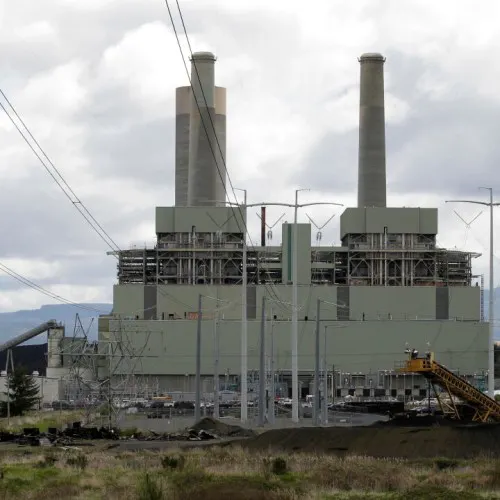
The plant is also near the historic coal fields of southwestern Pennsylvania and eastern West Virginia. Those two regions in the 19th Century provided the coal needed for the U.S. to become a dominant iron and steel producer. Through most of the 20th Century, their copious bituminous coal powered much of America’s electrical power, as coal was king of the generation mountain.
By the 21st Century, coal went into decline, natural gas usurped the “dusky diamonds,” and the green-tinged renewables started eclipsing coal.
Warrior Run can serve as a poster plant for President Donald Trump’s latest push to revive the fate of what he calls his “clean beautiful coal.” Warrior Run went out of service in 2024.
At a typically discursive Trump worship service in the Oval Office last Thursday (June 4), billed as a “press conference,” the president announced his latest plan for coal. He said, “You don’t say coal in the Trump administration unless it’s preceded by ‘clean beautiful,” although his April 2025 executive order refers to it as “beautiful clean coal.”
As Trump sat behind his desk,12 administration disciples and acolytes stood behind him in worshipful awe. It was not quite Leonardo’s Last Supper.
They were all middle aged white men in dark suits, with starched white shirts and conservative neckties. Smarmy Interior Secretary Doug Burgum stood behind Trump’s left shoulder and obsequious and obedient Energy Secretary Chris Wright was directly behind his Commander-in-Chief. Lurking behind Wright’s left shoulder was oleaginous Environmental Protection Agency Administrator Lee Zeldin.
Also in the phalanx of fan boys were Republican Govs. Mark Gordon of Wyoming and Patrick Morrisey of West Virginia, America’s two largest coal-producing states.
Trump announced a “$700 million investment” of new federal money. He said the money “will protect 13 coal plants and 42 coal mines and build two new coal plants and one new, massive export terminal.”
Trump invoked the 1950 Defense Production Act (DPA) as the legal basis for this new coal subsidy plan. A month before Thursday’s announcement, in a move that got little attention, Trump broadly cited the Korean War law as a basis for coming sweeping actions on energy, giving him effective control over much of the nation’s energy infrastructure.
Trump’s numbers were a bit dodgy and misstated. A Department of Energy news release the same day as Trump’s Oval Office extravaganza detailed the 13 plants covered by the Defense Production Act announcement. The DOE release scaled back the amount of that subsidy to $500 million.
Separately and at the same time as Trump’s White House press display, DOE announced a $350 million plan for a different set of coal subsidies, based on another legal authority, “clean energy” subsidies from the Biden administration. That money will go to two planned new power plant projects in Alaska and West Virginia, a modernization of a 510-MW coal plant in Puerto Rico, and Warrior Run. Add $175 million from the same account DOE awarded in February for six coal projects. A grand total of just over $1 billion.
Trump also bragged about the politics of his coal lust, naming the states that will benefit from his new DPA program, all of which gave him their electoral votes in 2024.
Trump didn’t name Maryland in his DPA list although he acknowledged it in passing later. The “Free State” didn’t vote for Trump. And that brings us to Warrior Run in Maryland’s Allegheny County.
The Baltimore Banner, Maryland’s online daily newspaper, reported, “It wasn’t immediately clear Thursday whether the president’s support for Warrior Run Generating Station, south of Cumberland in Allegany County, would resurrect the plant, or how owners would use the money.” The Banner said it emailed questions to the plant’s owner and did not get a response “but the company signaled to federal regulators in December that it is trying to reopen the plant.”
Non-utility generating company AES developed and owns the plant, which sold power to the local investor-owned utility Potomac Edison, a subsidiary of Akron, Ohio, giant holding company FirstEnergy. The plant was able to dispatch 72 to 180 MW of power to the PJM grid. It also was a cogenerator, producing food-grade carbon dioxide.
AES also owns and operates the coal-fired plant in Guayama, Puerto Rico identified in the DOE’s second announcement. It opened in 2002 and has been attacked locally in recent years as the territory wants to move to renewable energy. AES has plans to close the plant in 2028.
The Banner reported, “Warrior Run stopped burning coal in June 2024, a year after the utility company Potomac Edison paid $357 million to get out of its contract to purchase expensive power.” As a cogeneration facility, Warrior Run was able to get a premium price for its electric power under the terms of the 1978 Public Utility Regulatory Policies Act, becoming one of what have been called “PURPA machines.”
Well before last week’s announcement, Warrior Run’s economics looked more favorable as the push for data centers in PJM was driving up electric prices. The company told federal regulators it was considering restarting the plant well before the Trump White House announced it would subsidize the restart.
Maryland’s legal newspaper The Daily Record reported that the minority Republican caucus in the state legislature, happy with the Warrior Run move, said in a news release that it would get $85 million from DOE for the restart.