


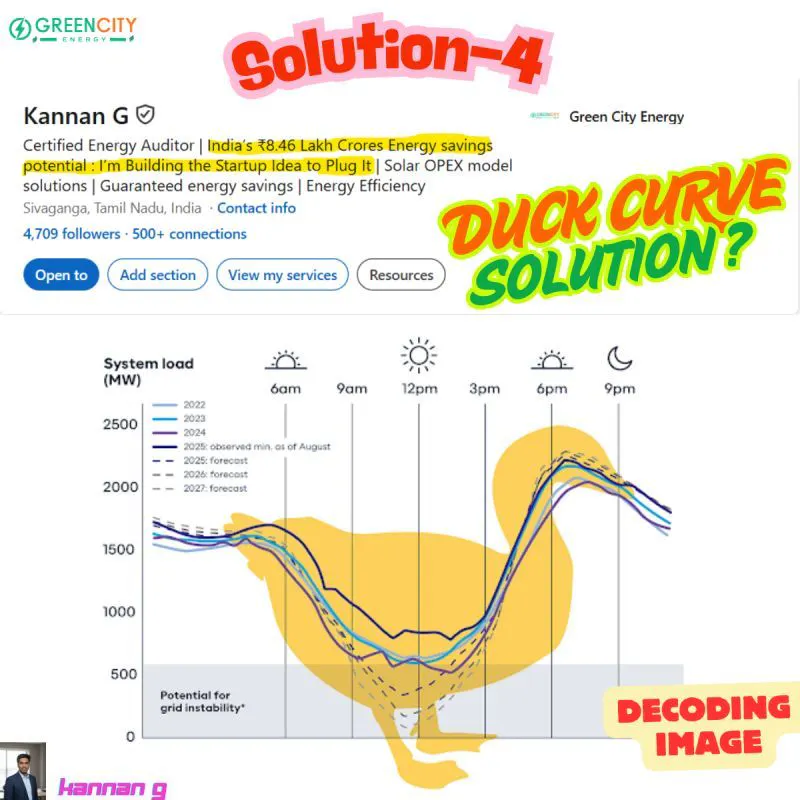
💡 The Duck Curve represents the timing imbalance between peak solar production (midday) and peak energy demand (evening).
⚡Midday (The "Belly"): Solar energy is abundant and cheap. Instead of curtailing solar or selling it back to the grid at low rates, run high-capacity compressors to charge your storage.
⚡Evening (The "Neck"): As solar production drops and grid prices spike (ToD tariffs), shut down your main compressors and draw directly from your stored high-pressure air.
💡Advantages for Indian Industrial Facilities
⚡Avoided Conversion Losses: Traditional storage
(Batteries➡️ DC➡️ AC➡️Motor ➡️Air) loses roughly 5-20% efficiency. By storing air directly, you bypass the "Round-trip Efficiency" trap of batteries.
⚡ToD (Time of Day) Arbitrage: India’s state DISCOMs often charge significantly higher rates during the evening peak (6 PM – 10 PM). Using stored air during this window drastically reduces the "Neck" of your facility's power curve.
⚡Peak Saving: Large compressors are notorious for "Demand Charges." Stored air handles sudden spikes in pneumatic demand without triggering a higher utility billing tier.
💡Implementation Strategy
⚡To maximize the ROI in an Indian context, consider these three steps:
Sizing the "Air Battery"
⚡ Your storage must be large enough to carry the facility's pneumatic load for at least 4 hours (the typical duration of the evening "Neck").
Smart Control Systems
⚡Use an AI-driven controller that monitors the real-time solar generation and the local DISCOM tariff. It should automatically "over-compress" during the solar peak and "bleed" the storage when grid costs are high.
Are you still relying on the grid during the 6 PM peak?
Let's discuss the future of mechanical energy storage in the commentshttps://files-us-east-1.t-cdn.net/files/lFPYtbVKjOKribYS9QwrX .