


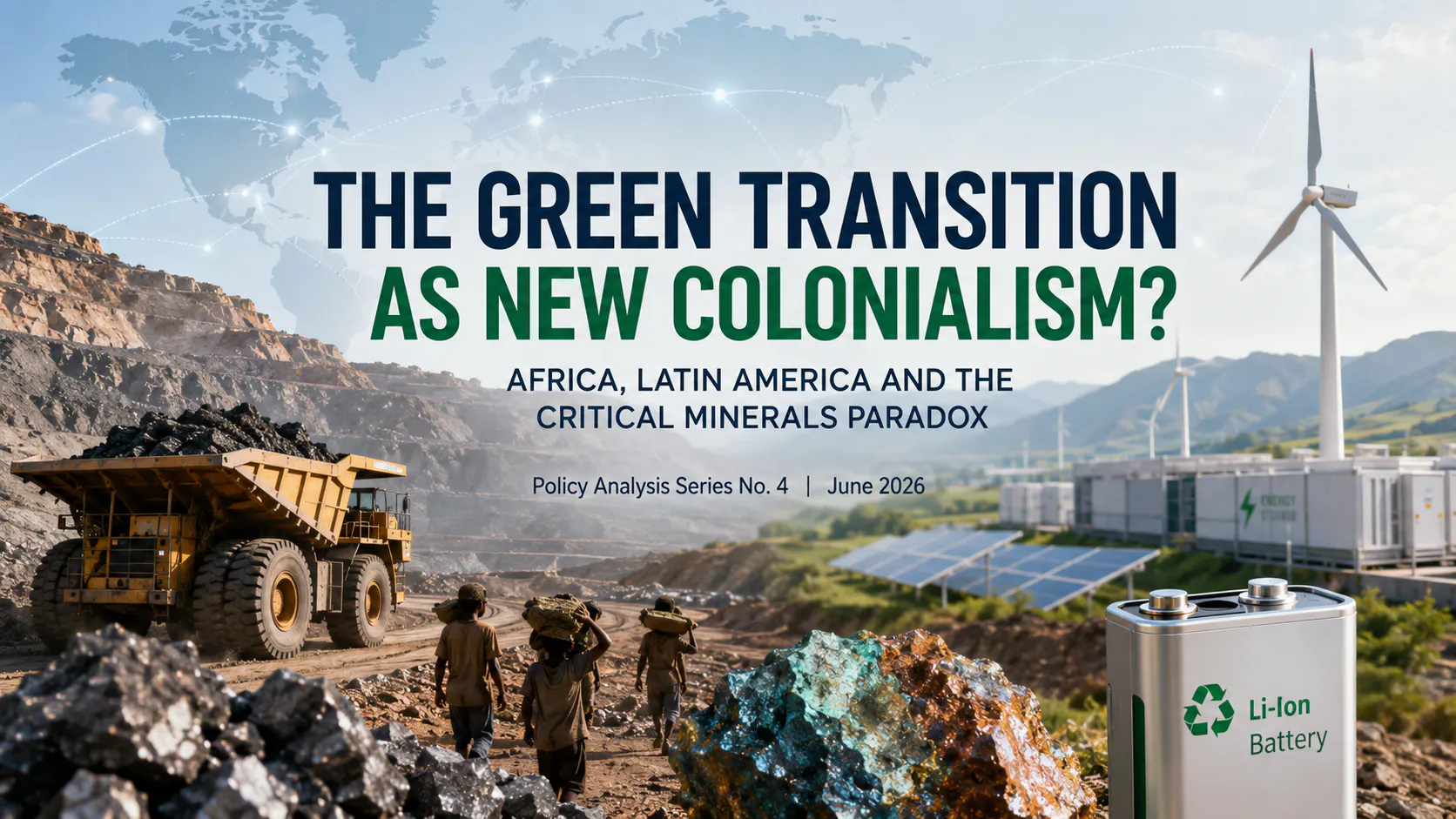
How the race for green technologies is reproducing extractive relationships in the Global South
Abstract
The global green transition — the shift from fossil fuels to renewable energy and electrified transport — requires enormous quantities of critical minerals: lithium, cobalt, manganese, nickel, rare earth elements, and platinum group metals. These minerals are overwhelmingly concentrated in the Global South, particularly in sub-Saharan Africa and Latin America. The countries that hold these resources are, in many cases, the same countries that contributed least to the carbon emissions that necessitate the transition, and that stand to suffer most from the climate change it is meant to address.
This analysis argues that the current architecture of critical mineral extraction, processing, and trade is reproducing — and in some dimensions deepening — the extractive logic of the colonial era under a green banner. The Democratic Republic of Congo mines 70% of the world's cobalt but processes almost none of it. Chile and Argentina hold 40% of the world's lithium reserves but have historically captured a fraction of its value. Rare earth elements are mined across Africa and Latin America but refined overwhelmingly in China. In each case, the same pattern emerges: resources extracted from the South, value created in the North and East, profits repatriated away from the communities that bear the environmental, social, and health costs of extraction.
This is not an argument against the green transition. It is an argument for a different transition architecture — one in which the countries that supply the raw materials of decarbonisation also capture the industrial, technological, and economic benefits of that transition. The alternative — a green transition that decarbonises the North while extracting from the South — is not merely unjust. It is strategically unstable, democratically contested, and ultimately self-defeating.
A methodological note: this analysis is written from the perspective of political economy and critical realism, examining the structural interests embedded in current critical mineral governance rather than treating the green transition as a technically neutral process. The framing is analytical, not polemical.
PART I The Colonial Template: Historical Parallels and Structural Continuities
1. The Extraction Logic, Reloaded
The Extraction Logic, Reloaded
The history of Africa and Latin America's relationship with the global economy is, in large part, a history of resource extraction. From the silver mines of Potosí to the rubber plantations of the Congo Free State, from the copper mines of Zambia to the oil fields of Nigeria, the structural pattern has been remarkably consistent: natural resources extracted from the South, processed and manufactured in the North, consumed in wealthy markets, with the profits flowing away from the communities that bear the environmental, social, and health costs of extraction.
This pattern — what dependency theorists termed the 'commodity trap' — was not merely a consequence of colonial coercion. It was embedded in the institutional architecture of the global economy: in trade rules that taxed processed goods more than raw materials, in finance structures that directed capital toward extraction rather than manufacturing, in technology regimes that kept industrial capacity in the North, and in governance arrangements that prioritised the interests of extractive corporations over those of producing communities.
The global green transition does not, on current trajectories, break this pattern. It intensifies it. The minerals required for solar panels, wind turbines, electric vehicle batteries, and grid storage systems are overwhelmingly concentrated in the Global South. The technologies that use those minerals — and the patents, manufacturing capacity, and value chains associated with them — are overwhelmingly concentrated in the Global North and, increasingly, in China. The result is a new iteration of an old structural relationship: the South supplies raw materials; the North and China supply technology, capital, and manufactured goods; the developmental benefit flows upward and outward.
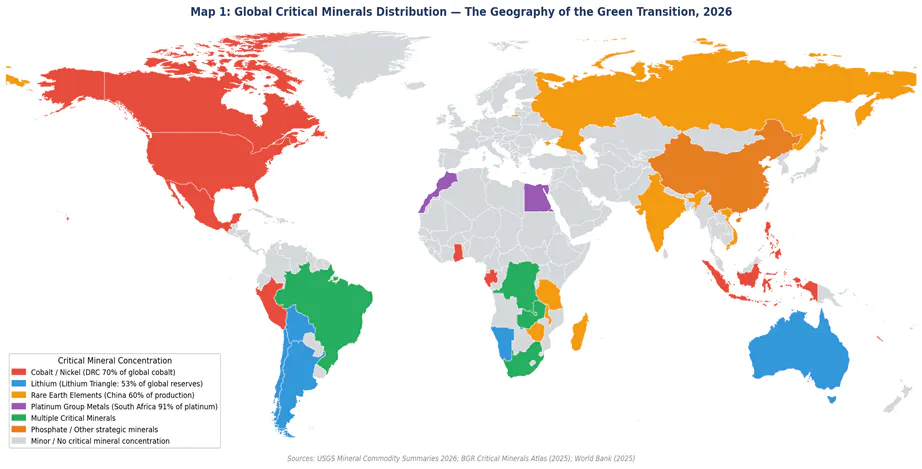
Map 1: Global Critical Minerals Distribution — The Geography of the Green Transition, 2026. The minerals essential to solar panels, EV batteries, and wind turbines are overwhelmingly concentrated in the Global South. Sources: USGS 2026; BGR (2025)
The Commodity Trap 2.0: From Coal to Cobalt
The term 'commodity trap' describes the structural disadvantage of economies that export unprocessed raw materials rather than manufactured goods. Raw commodity prices are volatile, driven by global demand cycles over which producing countries have no influence. The value added through processing, manufacturing, and technology development accrues elsewhere. And the environmental costs — land degradation, water contamination, air pollution, biodiversity loss — remain in the country of extraction.
In the colonial and post-colonial era, this trap was maintained by tariff structures that penalised processing in producer countries (escalating tariffs), by technology monopolies that prevented Southern countries from developing manufacturing capacity, and by financial systems that directed foreign investment toward extraction rather than industrialisation.
In the green transition era, the same structural mechanisms operate under different names. The EU's CRMA explicitly targets 10% domestic mining, 40% domestic processing, and 15% domestic recycling of critical minerals by 2030 — targets that are designed to ensure European value capture, not African or Latin American industrialisation. Trade agreements that the EU is negotiating with mineral-rich countries offer market access in exchange for raw material supply, without joint technology co-development mandates or processing requirements. And the patent system that governs green technology — solar cells, battery chemistries, electrolyser designs — concentrates intellectual property in the Global North and China, ensuring that producing countries must pay licence fees to deploy the very technologies that their minerals enable.
The 2025 AU-EU Luanda Summit reaffirmed political commitments to 'strategic partnerships' in critical minerals — but, as the SWP Berlin's February 2026 analysis documented, European initiatives continue to lose ground to China, the Gulf States, and the US precisely because they offer access to raw materials in exchange for market access, rather than genuine value chain integration for African partners.
PART II The Critical Minerals Map: Who Owns What
2. The Critical Minerals Map: Who Owns What
The Geographic Concentration of Green Transition Resources
The raw material geography of the green transition is stark. Six minerals — lithium, cobalt, nickel, manganese, rare earth elements, and platinum group metals — are essential to the battery, motor, and catalyst technologies at the heart of electrification. Their distribution is extraordinarily concentrated, creating structural dependencies that are reshaping geopolitical relationships at the same time that climate policy demands their rapid scaling.
Cobalt: The Democratic Republic of Congo holds approximately 50-55% of proven global cobalt reserves and produces approximately 70% of current global supply. Of the DRC's 19 major cobalt-producing mines, 15 are owned or co-financed by Chinese entities. The cobalt is exported — overwhelmingly unprocessed — to China, where 80% of global cobalt refining capacity is located. The DRC, one of the world's poorest countries despite its mineral wealth, captures approximately 2-3% of the final value of the cobalt in an electric vehicle battery.
Lithium: The 'Lithium Triangle' of Argentina, Bolivia, and Chile holds approximately 53% of global lithium resources. Australia is the current leading producer, but the South American triangle's reserves are far larger. China controls approximately 60% of global lithium processing capacity, and Chinese companies — including CATL, BYD, and Ganfeng Lithium — have made aggressive investments in all three Lithium Triangle countries.
Rare Earth Elements: Africa holds significant REE deposits in countries including South Africa, Tanzania, Malawi, Namibia, and Madagascar. China mines approximately 60% of global REEs and refines approximately 85-90%. Western attempts to develop alternative REE supply chains have made limited progress against Chinese dominance of processing technology and capacity.
Rare Earth Elements: Africa holds significant REE deposits in countries including South Africa, Tanzania, Malawi, Namibia, and Madagascar. China mines approximately 60% of global REEs and refines approximately 85-90%. Western attempts to develop alternative REE supply chains have made limited progress against Chinese dominance of processing technology and capacity.
Platinum Group Metals: South Africa holds approximately 91% of proven global platinum reserves and approximately 75% of palladium. These metals are essential for hydrogen fuel cell technology and catalytic converters. South Africa's mining sector is dominated by a small number of large corporations — Anglo American Platinum, Impala Platinum, Sibanye-Stillwater — operating under conditions that have changed less than the industry discourse suggests since the end of apartheid.
Manganese: South Africa and Gabon together hold approximately 80% of global manganese reserves, essential for lithium-manganese battery chemistries. The processing and refining of manganese ore into battery-grade material occurs overwhelmingly outside Africa.
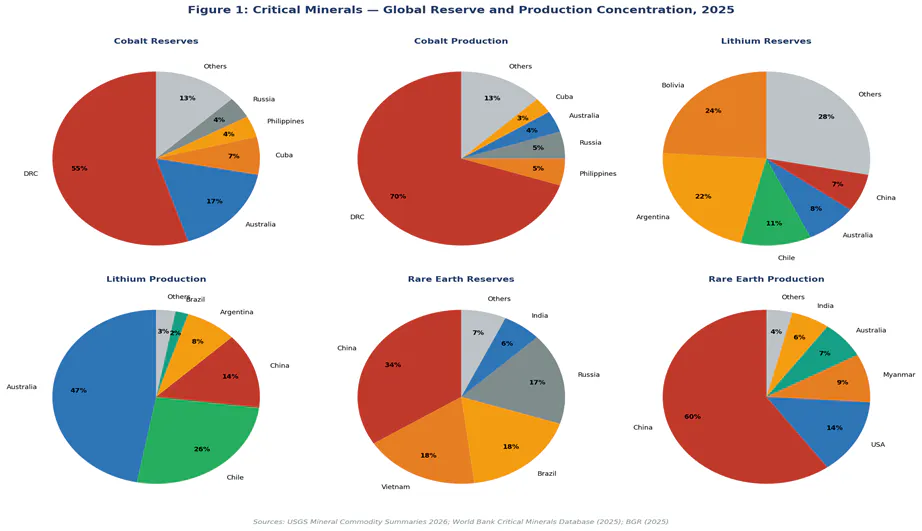
Figure 1: Critical Minerals — Global Reserve and Production Concentration, 2025. DRC holds 55% of cobalt reserves; Lithium Triangle holds 53% of lithium; China refines 85-90% of rare earths. Sources: USGS Mineral Commodity Summaries 2026; BGR (2025)
The Value Chain Paradox: Where Resources Go vs Where Value Is Created
The critical minerals value chain moves through several stages, each representing a significant step-up in value: raw ore extraction, concentration and processing, refining to battery-grade material, cathode and anode production, cell manufacturing, battery pack assembly, and integration into end products. The difference in value between the first stage and the last is enormous.
A tonne of raw cobalt ore is worth approximately USD 30-50. A tonne of refined cobalt metal is worth approximately USD 30,000-50,000. The cobalt content of a fully assembled electric vehicle battery pack is worth several hundred times the value of the raw ore. The entire value chain from extraction to electric vehicle integration represents a 500-1,000x value multiplication — virtually none of which, under current arrangements, accrues to the DRC or other mineral-producing countries.
The African Development Bank estimates that if African countries processed their critical minerals to intermediate products before export, the continent's mineral export revenues could increase from approximately USD 11 billion per year to USD 44 billion per year — a fourfold increase. Processing to battery precursor materials could yield USD 271 billion. Full battery cell manufacturing integration could yield over USD 1 trillion annually.
These numbers are not merely aspirational — they represent the difference between a green transition that contributes to African industrialisation and one that perpetuates African extractivism. The institutional question is whether the global critical minerals governance architecture is designed to facilitate that transition or to prevent it.
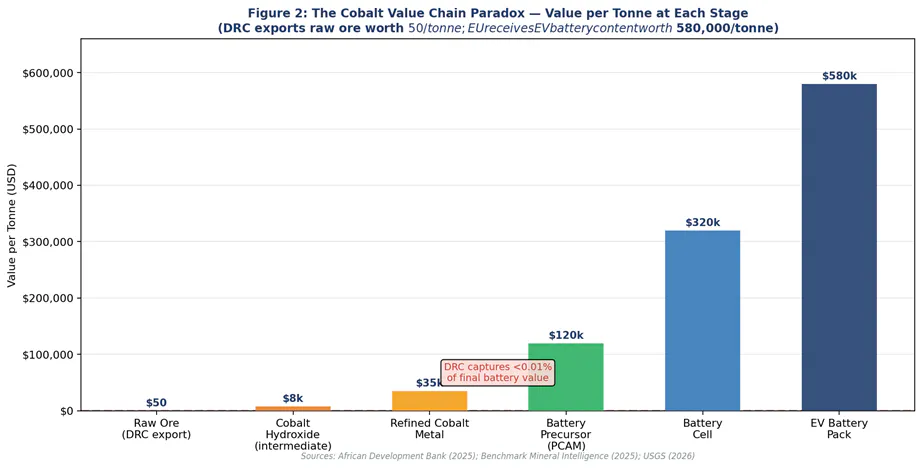
Figure 2: The Cobalt Value Chain Paradox — Value per Tonne at Each Stage. DRC exports raw ore at ~$50/tonne; the cobalt content in an assembled EV battery pack is worth ~$580,000/tonne equivalent. . Sources: AfDB (2025); Benchmark Mineral Intelligenc
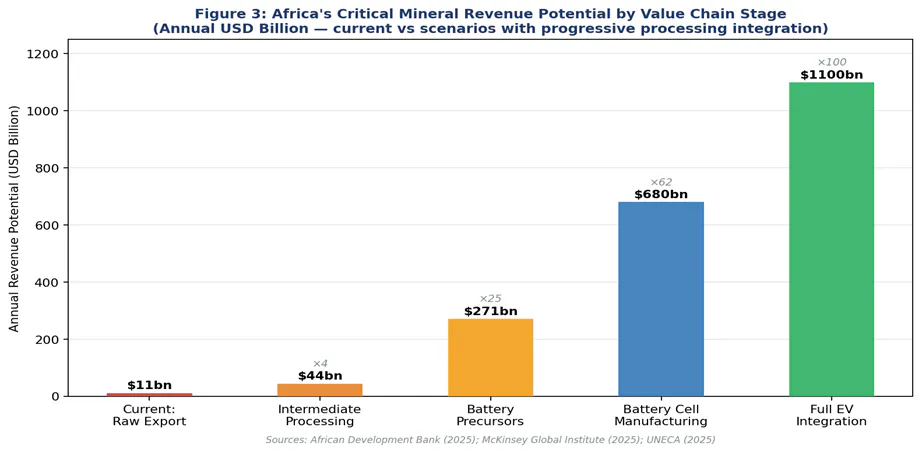
Figure 3: Africa's Critical Mineral Revenue Potential by Value Chain Stage (Annual USD Billion). Under current raw export arrangements, Africa earns ~$11bn/year. Sources: African Development Bank (2025); McKinsey Global Institute (2025); UNECA (2025)
PART III The Geopolitics of Green Resource Control
3. The Geopolitics of Green Resource Control
The EU's Critical Raw Materials Act: Industrial Policy or Resource Imperialism?
The EU's Critical Raw Materials Act (CRMA), adopted in December 2023 and in full implementation from 2026, is the most significant European attempt to secure critical mineral supply chains for the green transition. Its stated objectives — reducing supply chain vulnerability, decreasing dependence on China, and building European processing capacity — are legitimate industrial policy goals. Its implementation, however, raises fundamental questions about whether European 'strategic partnerships' in Africa and Latin America represent genuine development cooperation or a more sophisticated form of resource extraction.
The CRMA establishes ambitious domestic targets: 10% of EU annual consumption mined in the EU, 40% processed in the EU, and 15% recycled by 2030. To supply the remaining 60-90%, the EU has embarked on a programme of 'strategic partnerships' with mineral-rich countries. By mid-2026, partnerships have been signed with Canada, Kazakhstan, Namibia, and Ukraine; deals with Argentina and Chile are in advanced negotiation.
The structural problem with these partnerships, as the SWP Berlin's 2026 analysis documented, is that they are designed around European supply security rather than partner country industrial development. The CRMA's '40% processed in Europe' target explicitly envisions African and Latin American countries supplying raw or intermediate materials for processing in Europe — reproducing the colonial-era tariff escalation structure that penalised processing in producer countries. The EU's Global Gateway programme, which is supposed to finance critical mineral infrastructure in partner countries, has a €60.5 billion Sub-Saharan Africa allocation that must compete with migration management, humanitarian assistance, and other priorities — leaving it structurally underfunded for genuine value chain integration.
As the ECDPM's analysis concluded, the EU's approach to energy transition risks reproducing patterns of colonial appropriation in its engagement with Africa's resource sectors: securing access to raw materials in exchange for market access, without the joint technology co-development mandates, processing investment, or value chain integration that would allow African partners to capture industrial benefit from their mineral endowments.
The US IRA: Domestic First, Allies Second, Global South Never
The United States' Inflation Reduction Act (IRA), passed in August 2022, is the most significant climate investment legislation in American history — and one of the most consequential pieces of industrial policy for critical mineral supply chains. Its electric vehicle tax credit provisions require batteries to contain a specified percentage of minerals mined or processed in the US or in countries with US free trade agreements — a provision explicitly designed to redirect mineral supply chains away from China and toward US-aligned suppliers.
For Global South mineral-producing countries without US free trade agreements — which includes most of Africa — the IRA's domestic content requirements effectively exclude them from US clean energy supply chains. The DRC, the world's dominant cobalt producer, has no free trade agreement with the United States. Neither does Zambia, South Africa, or most other major African mineral producers. Latin American countries are in a more complex position: Chile and Peru have FTAs with the US, while Bolivia and Argentina do not.
The IRA's critical mineral provisions have triggered a global race among major consumer economies — the US, EU, Japan, Korea, and Australia — to lock up supply chain access through bilateral agreements that prioritise supply security for wealthy consumers over development benefit for producing countries. This 'friends-shoring' of critical mineral supply chains is, from the Global South's perspective, a form of geopolitical coalition-building that reproduces the asymmetric power relationships of the colonial period in the language of supply chain resilience.
China's African and Latin American Positions: Partner or Predator?
China's presence in African and Latin American critical mineral supply chains is dominant and deepening. Chinese state-owned and private companies control approximately 80% of DRC cobalt output, 60% of global lithium processing capacity, and 85-90% of global rare earth refining. The Belt and Road Initiative has financed mining infrastructure across Africa and Latin America, giving Chinese companies preferential access to mineral assets in exchange for infrastructure investment.
China's critical mineral strategy is more sophisticated than a simple extraction play. Chinese companies have invested in processing capacity in producer countries — Zhejiang Huayou Cobalt's $400 million lithium sulphate refinery in Zimbabwe, CATL's $1 billion direct lithium extraction partnership in Bolivia, BYD's cathode plant investment in Chile — in ways that Western companies have generally been unwilling to match. This investment in downstream processing creates genuine local employment and value-added capacity, but it also creates deep technological dependency: African and Latin American countries that process minerals using Chinese technology, financed by Chinese capital, and sold to Chinese battery manufacturers are not escaping the commodity trap — they are entering a new version of it.
The critical analytical distinction is between value chain integration that builds genuine domestic capacity — including technology transfer, skills development, and ownership structures that allow local players to capture and retain value — and value chain integration that creates Chinese-owned processing facilities in Southern countries that serve Chinese supply chains rather than domestic development objectives. Both exist in China's African and Latin American footprint; which predominates depends on the negotiating power and regulatory capacity of the host country.
In late 2024, Bolivia's agreement with CATL, BRUNP, and CMOC for $1 billion in direct lithium extraction investment — with the Bolivian state retaining a 51% stake — represents an attempt to capture value while attracting Chinese technology. But as a July 2025 congressional session in Bolivia descended into chaos, with lawmakers throwing water and protesting deals with Chinese and Russian firms worth approximately $2 billion, the political economy of resource nationalism is clearly contested: communities that bear the environmental costs of extraction are not automatically convinced that Chinese investment serves their interests better than Western investment.
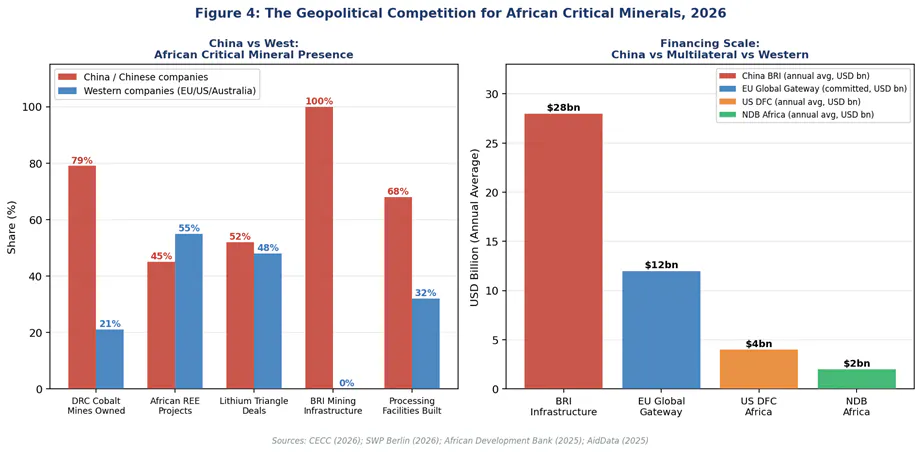
Figure 4: The Geopolitical Competition for African Critical Minerals, 2026. China controls 79% of DRC cobalt mines and outspends the US and EU combined in African mining infrastructure. Sources: CECC (2026); SWP Berlin (2026); AfDB (2025)
3.4 China's Vertical Integration vs the Western Regulatory Empire
The geopolitical competition for African and Latin American critical minerals is not merely a contest over who controls raw material assets — it is a contest between two fundamentally different models of engagement. China's model is characterised by vertical integration: Chinese entities control the full value chain from mine ownership through cobalt hydroxide processing, cathode active material production, cell manufacturing, battery pack assembly, to integration in Chinese-brand electric vehicles. This vertical integration gives China structural leverage at every stage of the supply chain simultaneously, allowing it to cross-subsidise upstream losses with downstream margins and to secure supply by ownership rather than by contract.
The Western model — particularly the EU's approach through the CRMA and the Corporate Sustainability Due Diligence Directive (CSDD) — operates as a regulatory empire rather than an investment empire. The EU and its member states expect ESG compliance, child labour elimination, environmental impact assessments, governance transparency, and supply chain due diligence from mining operations in Africa and Latin America. These requirements are legitimate — the conditions in DRC artisanal cobalt mines would be criminal in any EU jurisdiction. But they are imposed without commensurate financing: the EU exports regulatory standards but does not bring to the table the fast, large-scale, patient capital required to build the physical processing infrastructure that would make those standards economically viable.
The practical consequence, as the SWP Berlin documented in early 2026, is that African and Latin American governments face a choice between a Chinese partner that offers immediate, cash-intensive infrastructure investment and turnkey processing facilities (without ESG conditions) and a Western partner that offers market access and regulatory compliance frameworks (without sufficient capital). The Lobito Corridor notwithstanding, this asymmetry explains why Western initiatives continue to lose ground: Gulf states (UAE, Saudi Arabia) are increasingly entering the same space with Gulf sovereign wealth fund capital, replicating the Chinese speed-capital model with Middle Eastern money. The Global South's critical mineral governance challenge is not merely choosing between East and West — it is navigating a three-way competition in which each bidder offers a different combination of capital, conditionality, and commitment.
3.5 The Lobito Corridor and the Infrastructure Competition
The geopolitical competition for African critical minerals has a concrete physical dimension: the race to build the transport infrastructure that determines which minerals flow to which markets. The most significant current example is the Lobito Corridor — a railway project connecting the copper and cobalt mines of the DRC and Zambia to the Angolan port of Lobito on the Atlantic coast, designed to provide an alternative export route to the Chinese-controlled Dar es Salaam corridor on the Indian Ocean.
The Lobito Corridor was announced as a joint US-EU initiative at the 2023 G7 summit, with a total projected cost of approximately USD 2.5 billion. It represents the most concrete Western attempt to compete with China's BRI infrastructure in Africa — and it is explicitly designed to redirect DRC and Zambian cobalt and copper toward Western markets rather than Chinese refineries. As of mid-2026, the railway rehabilitation component is under construction, but financing gaps remain and the political commitment of both US and EU partners has been complicated by the Trump administration's Africa policy and EU budget pressures.
The infrastructure competition in Africa — Lobito Corridor (US-EU) vs the Chinese-supported TAZARA railway and port investments — illustrates the fundamental tension in Western critical mineral strategy: the US and EU want African minerals for their own green transitions, but they are unwilling to finance the scale of infrastructure, processing investment, and technology transfer that would make African countries genuine partners rather than suppliers.
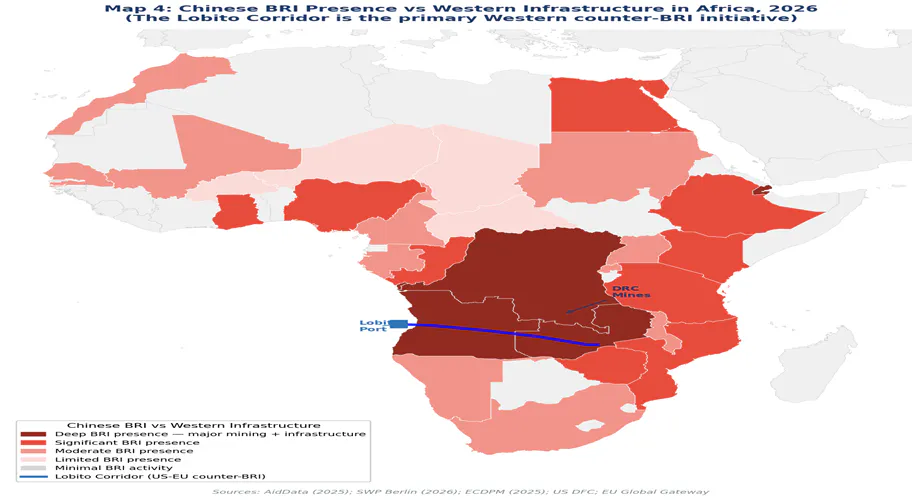
Map 4: Chinese BRI Presence vs Western Infrastructure in Africa, 2026. The Lobito Corridor (US-EU, shown in blue) is the primary Western counter to China's dominant BRI infrastructure position. Sources: AidData (2025); SWP Berlin (2026); ECDPM (2025)
3.6 The Transatlantic Sub-Competition: IRA vs CRMA and the North-North Fault Line
The analysis of critical mineral geopolitics is typically framed as a North-South or West-China confrontation. A structurally important but underanalysed dimension is the sub-competition within the Global North between the United States and the European Union — two allies whose critical mineral strategies are, in significant respects, mutually contradictory.
The IRA's free trade agreement requirement for electric vehicle battery content effectively creates a two-tier critical mineral world: FTA partners (Canada, Mexico, Chile, Peru, Australia, Japan, Korea) whose minerals qualify for US clean energy subsidies, and non-FTA countries (most of Africa, Bolivia, Argentina, Indonesia) whose minerals do not. This architecture is designed to redirect supply chains away from China — but it simultaneously excludes European processing of FTA-ineligible minerals from US subsidy access. The IRA's domestic content bonuses have drawn European battery and EV manufacturing investment toward the US at Europe's expense, creating what European industry has characterised as an existential threat to EU battery manufacturing competitiveness.
The result is a triangular competition for limited Global South critical mineral capacity: the US and EU are simultaneously competing with China for African and Latin American mineral access, and competing with each other for the same Chilean, Argentine, and Peruvian lithium capacity. Chile's lithium, in particular, has become a contested resource between Washington and Brussels — both of which are negotiating supply agreements while Chile's National Lithium Strategy seeks maximum value capture from whichever bidder offers the best processing integration terms. This plurilateral complexity — in which the Global South can play competing Northern bidders against each other — is one of the few genuine structural advantages that mineral-rich developing countries currently possess. Whether they can convert that advantage into durable industrial policy gains before substitute technologies erode their leverage is the central strategic question of the decade.
PART IV African and Latin American Agency: Interests, Strategies, and the Development Dilemma
4. Agency, Strategy, and the Development Dilemma
Resource Nationalism as Development Strategy
The Global South's response to the critical minerals rush is not passive. A wave of resource nationalism — state assertion of control over critical mineral assets, export restrictions on unprocessed minerals, demands for local processing before export, and negotiation of value chain integration requirements in foreign investment agreements — is reshaping the global critical minerals landscape.
Zimbabwe banned all exports of unprocessed lithium in December 2022, following Indonesia's successful export ban on nickel ore — a ban that accelerated Chinese investment in Indonesian nickel processing and contributed to Indonesia's emergence as a major battery supply chain player. Zimbabwe's ban has attracted significant Chinese investment in local lithium processing, including a $300 million investment from Chengxin Lithium and Zhejiang Huayou Cobalt's refinery — Africa's first lithium sulphate processing facility.
Tanzania has implemented a 'beneficiation policy' requiring minimum levels of mineral processing before export. Namibia has moved to restrict exports of unprocessed lithium. The DRC has sought, with limited success, to negotiate processing requirements into its Chinese mining contracts. South Africa's Mineral Resources Development Bill includes beneficiation provisions — though their implementation has been contested by the mining industry.
In Latin America, Chile's National Lithium Strategy (announced April 2023, revised April 2025) requires future lithium concessions to be structured as public-private partnerships with majority state participation, and aims to move Chile up the value chain into cathode and battery production. Bolivia's lithium nationalisation has been turbulent — the July 2025 congressional chaos over Chinese investment deals illustrated the political complexity of resource nationalism when communities bear environmental costs but the economic benefits are disputed. Argentina, under the Milei administration from 2024, has moved in the opposite direction — opening lithium assets to foreign investment under deregulated conditions, prioritising capital attraction over value capture.
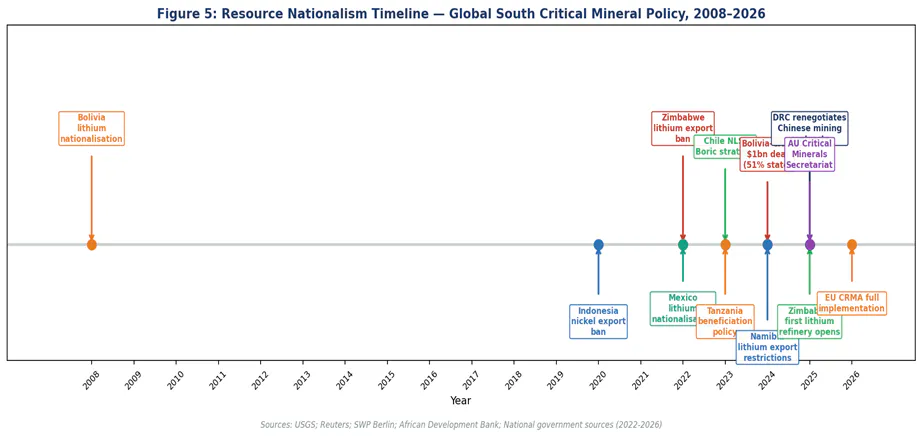
Figure 5: Resource Nationalism Timeline — Global South Critical Mineral Policy, 2008–2026. Sources: USGS; Reuters; SWP Berlin; government sources (2022-2026)
The African Union's Critical Minerals Strategy
The African Union's Framework for Critical Minerals, developed through the AU's African Minerals Development Centre, represents an attempt to coordinate African negotiating positions and develop a continental approach to the critical minerals opportunity. The framework's core ambition is to move African countries from raw mineral exporters to value chain participants — echoing the African Mining Vision of 2009, which made similar aspirations without achieving them.
The AU-EU Luanda Summit (November 2025) produced political commitments on both sides to 'mutually beneficial' critical minerals partnerships, with EU pledges of Global Gateway financing for processing infrastructure in Africa. The SWP Berlin's February 2026 assessment was sobering: European initiatives are losing ground to China, the Gulf States, and the US precisely because they offer less — less financing at speed, less technology transfer, and less willingness to accept African ownership structures in processing facilities.
The AU's strategic challenge is the same as it has been throughout the post-colonial period: African countries negotiate individually with much more powerful counterparties, limiting their collective bargaining power. The AU's Critical Minerals Secretariat — proposed but not yet fully operationalised — is designed to provide technical support and coordinate negotiating positions, but it faces the fundamental problem that individual African governments face immediate fiscal pressures (debt servicing, budget deficits, social spending demands) that create incentives to sign whatever deal is on the table rather than hold out for better terms.
4.3 Case Study: DRC — The Cobalt Paradox
The Democratic Republic of Congo is the world's cobalt capital — and one of its poorest countries. This paradox is not accidental; it is structural. The DRC's cobalt wealth has been governed, since the colonial period, in ways that prioritised external extraction over domestic development.
The DRC produces approximately 70% of global cobalt supply. Cobalt is essential for lithium-ion battery cathodes and is projected to see demand growth of 150-200% by 2030 as electric vehicle production scales globally. The DRC's cobalt revenues — currently approximately USD 2-3 billion per year — represent a small fraction of the value created from DRC cobalt in global battery and EV supply chains.
The human cost of this extraction is severe. An estimated 25,000-40,000 children work in artisanal cobalt mines in the DRC, some as young as six or seven years old. The US Department of Labor's 2024 assessment confirmed that over three-quarters of artisanal miners may be operating under forced labour conditions involving coercion, debt bondage, or involuntary arrangements. Environmental degradation — deforestation, soil contamination, water pollution — affects communities surrounding mining operations. Yet the DRC remains indispensable to the global green transition, and the scale of extraction is projected to increase dramatically as EV demand grows.
Chinese dominance of DRC cobalt is comprehensive: 15 of the DRC's 19 cobalt-producing mines are owned or co-financed by Chinese entities. The Lobito Corridor initiative represents the most significant Western attempt to compete — but it is a transport infrastructure project, not a processing or value capture initiative. The DRC government's attempts to negotiate processing requirements into mining contracts have been resisted by Chinese operators with significant success.
The DRC cobalt paradox — maximum resource endowment, minimum developmental benefit — is the clearest illustration of why the current green transition architecture replicates rather than disrupts colonial extraction patterns.
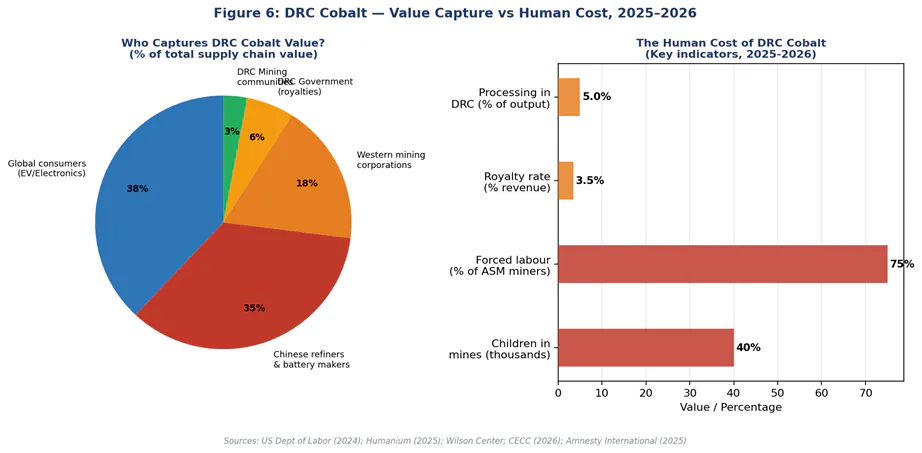
Figure 6: DRC Cobalt — Value Capture vs Human Cost, 2025–2026. The DRC captures 3% of cobalt supply chain value, while 40,000 children work in artisanal mines and 75% of miners operate under forced labour conditions. Sources: US Dept of Labor (2024)
4.4 Case Study: Zimbabwe — The Export Ban Experiment
Zimbabwe's December 2022 ban on unprocessed lithium exports — following Indonesia's nickel export ban model — represents the most significant African attempt to leverage resource nationalism to capture value chain benefits from the green transition. Zimbabwe holds some of the world's highest-grade lithium deposits; the Arcadia lithium mine alone, owned by China's Huayou Cobalt, is one of the largest hard rock lithium operations outside Australia.
The ban's early results are mixed but instructive. On the positive side, it has attracted significant Chinese investment in local lithium processing: Zhejiang Huayou Cobalt's lithium sulphate refinery — Africa's first — began operations in 2025, and Chengxin Lithium has committed USD 300 million to processing facilities. On the negative side, the processing facilities are Chinese-owned, integrated into Chinese supply chains, and employ predominantly Chinese technicians in senior positions — creating local employment but limited local technological capacity.
Zimbabwe's lithium strategy illustrates both the potential and the limitations of export ban resource nationalism. The ban successfully attracted downstream investment that would not otherwise have come. But without complementary policies — joint technology co-development mandates requirements, local equity participation provisions, training and skills development mandates, and export diversification — the risk is that Zimbabwe trades Chinese-controlled extraction for Chinese-controlled processing, without fundamentally altering its position in the value chain.
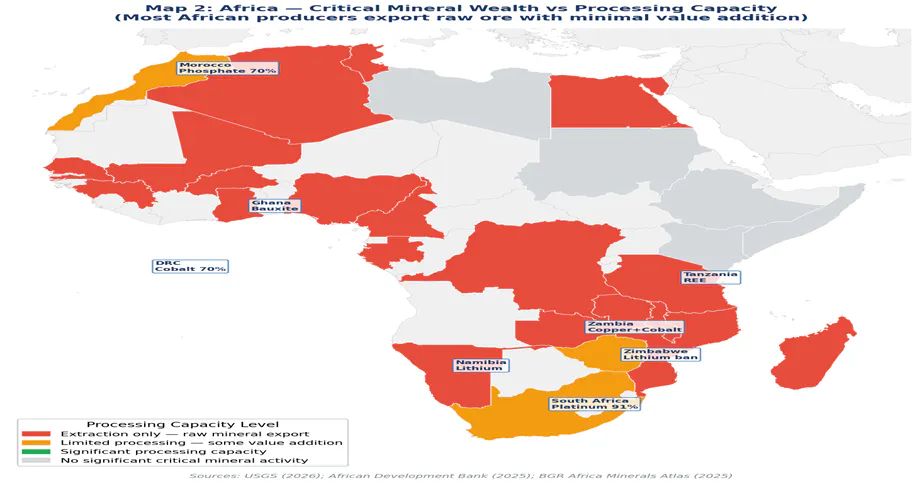
Map 2: Africa — Critical Mineral Wealth vs Processing Capacity. The continent is overwhelmingly an extraction zone; processing capacity exists only in fragments (South Africa, Morocco, Zimbabwe's emerging sector). Sources: USGS (2026); AfDB (2025)
4.5 Case Study: South Africa — Platinum, Just Transition, and Inequality
South Africa holds 91% of global platinum reserves — a mineral essential for hydrogen fuel cell technology and, potentially, for the green hydrogen economy that both the EU and the Global South are positioning as a key part of the post-fossil-fuel energy system. South Africa is also a major producer of manganese, chrome, vanadium, and other battery-relevant minerals. Its position in the global critical minerals landscape is unique: it is simultaneously a major mineral producer, an upper-middle-income economy with significant industrial capacity, and a country with profound structural inequality and an energy system still heavily dependent on coal.
South Africa's just transition challenge is the most complex in Africa: it must decarbonise an economy built on coal while capturing the economic opportunities of the green transition in mining and processing, while managing the social impact of coal mine closures on communities in Mpumalanga and KwaZulu-Natal. The Political Declaration on Just Energy Transition (JETP) for South Africa — agreed with the G7 at COP26, with USD 8.5 billion committed — has been slow to disburse and contested in its conditionalities.
In the platinum sector, the emergence of green hydrogen as a potential major application creates an extraordinary opportunity: South Africa's platinum could power a domestic green hydrogen industry, capturing value far above current raw platinum export prices. But realising this opportunity requires investment in electrolyser manufacturing, hydrogen infrastructure, and downstream industries — all of which require technology transfer and patient capital that the current investment climate has not provided at scale.
4.6 Case Study: Morocco — Phosphates, Green Hydrogen, and the North African Corridor
Morocco occupies a unique position in the global critical minerals and green transition landscape. Through OCP Group — the world's largest phosphate company, state-owned — Morocco controls approximately 70% of global phosphate reserves, an essential input for fertilisers and, increasingly, for lithium iron phosphate (LFP) battery cathodes. This phosphate dominance gives Morocco structural leverage in global food security as well as green transition supply chains.
Morocco has positioned itself aggressively as a green hydrogen export hub for European markets — the Moroccan government's 'Green Hydrogen Roadmap' targets 3 GW of electrolyser capacity by 2030 and significant hydrogen export volumes to Europe through the planned MEDHYDRA pipeline corridor. As analysed in Volume 3 of this series, the CBAM's extension to hydrogen creates structural asymmetries in the value chain that risk concentrating economic benefit in European buyer markets rather than Moroccan production communities.
Morocco's phosphate leverage creates a different dynamic from other African mineral producers. As global food security pressures intensify — driven partly by climate change disruptions to agricultural systems — phosphate's strategic value increases. OCP Group's investment in integrated fertiliser production (rather than raw phosphate export) is the most advanced example of an African state-owned enterprise successfully moving up the value chain in a critical mineral sector.
4.7 Case Study: Bolivia and Chile — The Lithium Triangle Dilemma
The Lithium Triangle of Argentina, Bolivia, and Chile holds approximately 53% of global lithium resources — the largest concentration of any energy transition mineral in a single region. How these three countries govern their lithium assets will substantially determine whether Latin America captures developmental benefit from the green transition or replicates the commodity trap that has characterised its resource history.
Bolivia holds the world's largest lithium reserves — approximately 21 million tonnes — concentrated in the Salar de Uyuni salt flat. President Morales nationalised lithium in 2008 and established Yacimientos de Litio Bolivianos (YLB) as the state lithium company. Despite enormous reserves, Bolivia has struggled to develop commercial-scale lithium production due to the technical challenges of the brine's high magnesium content and political instability. In late 2024, Bolivia signed a $1 billion agreement with a Chinese consortium including CATL to build direct lithium extraction plants, with the state retaining a 51% stake. The July 2025 congressional session that devolved into chaos — with lawmakers throwing water and protesting Chinese and Russian investment deals — illustrated the deep political contestation around resource nationalism when communities bear environmental costs but the distribution of economic benefits is disputed.
Chile is the world's second-largest lithium producer and holds extensive high-quality reserves in the Atacama salt flat. President Boric's National Lithium Strategy (announced April 2023, revised April 2025) requires future concessions to operate as public-private partnerships with majority state participation through CODELCO and ENAMI. The strategy aims to move Chile up the value chain toward cathode and battery production — a stated industrial policy objective whose implementation has been complicated by political resistance from the mining industry, Indigenous rights disputes in the Atacama, and the abandonment (as of 2025) of the proposed National Lithium Company.
Argentina, under the Milei administration (from December 2023), has moved sharply in the opposite direction from Chile and Bolivia — deregulating lithium investment, eliminating export taxes, and prioritising foreign capital attraction over state participation or value chain capture. The Argentina-Chile-Bolivia divergence illustrates that 'resource nationalism' is not a single strategy but a spectrum of approaches, and that domestic political economy — class interests, electoral calculations, and ideological commitments — shapes which approach individual countries adopt.
4.8 The Water-Energy-Mineral Nexus: Physical Appropriation of Nature
The environmental dimension of the Lithium Triangle extraction economy requires more than passing mention — it represents a form of 'green colonialism' that is physical and existential, not merely economic. Lithium brine extraction in the Atacama Desert is extraordinarily water-intensive: producing one tonne of lithium carbonate requires the evaporation of approximately 2 million litres of brine, drawing down water tables in one of the world's driest ecosystems. The Atacama's indigenous communities — Atacameño and Lickanantay peoples — have documented the progressive shrinkage of wetlands, flamingo habitats, and agricultural water sources over two decades of mining intensification.
A 2024 study by the Atacama Water Consortium documented that lithium brine extraction in the Salar de Atacama has reduced the water available to local communities by an estimated 65% since 2000. The Chilean government's environmental review process has been repeatedly criticised by indigenous rights organisations for prioritising mining concession approvals over prior consultation requirements under ILO Convention 169. In Bolivia's Salar de Uyuni, similar concerns apply — the high water intensity of lithium extraction in a country that already faces significant water scarcity creates a structural conflict between export-oriented mineral development and domestic food and water security.
In the DRC, the environmental dimension of cobalt extraction takes a different but equally severe form: acid mine drainage from cobalt and copper mining operations has contaminated the Kafue River and its tributaries in Zambia, and artisanal mining sites in Katanga province have left widespread soil contamination affecting agricultural land and drinking water sources. A 2025 investigation documented that a Chinese-owned mining company's tailings discharge into the Kafue River system — one of Zambia's most important water sources — constituted a severe environmental violation that had not been meaningfully sanctioned by either the Zambian government or the Chinese parent company.
The theoretical significance of this water-energy-mineral nexus is that it extends the 'green colonialism' framework beyond economic value extraction into the domain of physical resource appropriation. The green transition, as currently structured, requires the Global North to appropriate not merely the mineral wealth of Southern countries but the water, soil, and ecological systems of the communities living adjacent to extraction sites — with those communities bearing the physical costs of a transition whose climate benefits accrue primarily to the wealthy consumers whose demand drives it. This is not green solidarity. It is green extraction.
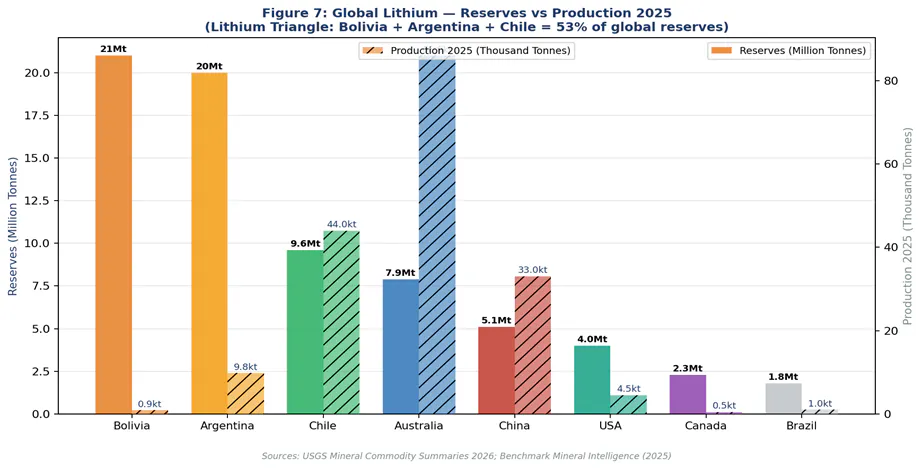
Figure 7: Global Lithium — Reserves vs Production, 2025. The Lithium Triangle holds 53% of reserves but produces a smaller share. Sources: USGS 2026; Benchmark Mineral Intelligence (2025)
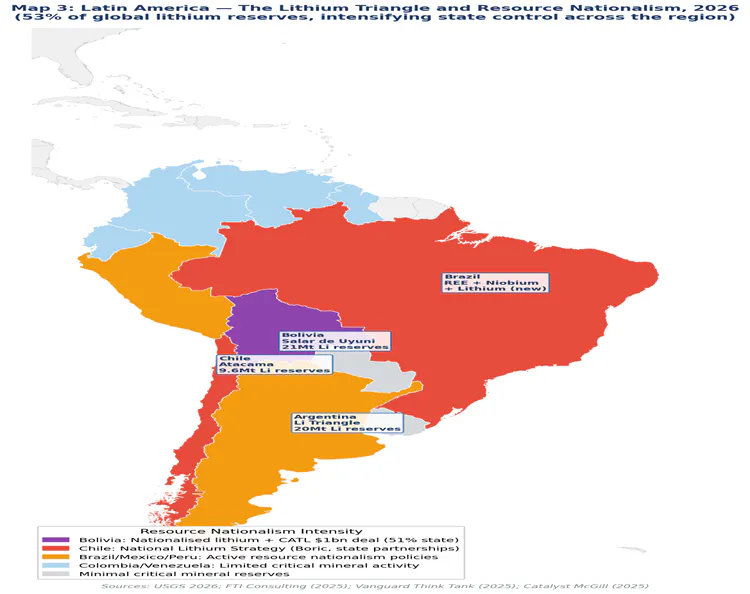
Map 3: Latin America — The Lithium Triangle and Resource Nationalism, 2026. Sources: USGS 2026; FTI Consulting (2025); Catalyst McGill (2025)
4.9 The Bargaining Power Window: A Strategic Time Constraint
The wave of resource nationalism analysed in section 4.1 — export bans, processing requirements, state participation mandates — is predicated on an assumption that is correct today but may not remain correct for long: that the Global North and China are structurally dependent on specific minerals from specific Southern countries. This dependence is real in 2026, but it has a technological expiration date.
The primary technological threat to current mineral leverage is the rapid development of substitute battery chemistries that reduce or eliminate the need for the most geographically concentrated critical minerals. Sodium-ion (Na-ion) batteries — which require no lithium, cobalt, or nickel — are moving from laboratory to commercial scale faster than most projections anticipated: CATL began commercial Na-ion cell production in 2024, and multiple Chinese manufacturers are scaling Na-ion capacity for applications where energy density requirements are lower (short-range urban EVs, stationary storage). Solid-state batteries, which can dramatically reduce or eliminate cobalt requirements, are projected to reach commercial viability in the 2027-2030 window for high-end applications. If Na-ion achieves cost parity with lithium iron phosphate chemistry — currently projected for the late 2020s — the demand implications for lithium and cobalt would be profound.
The strategic implication for mineral-producing countries is stark: the window for converting raw material leverage into durable industrial capacity is measured in years, not decades. Estimates from the IRENA and Benchmark Mineral Intelligence suggest a 5-10 year window before substitute technologies begin materially eroding the demand premium for lithium and cobalt. If Bolivia, Zimbabwe, the DRC, and Chile use this window to establish domestic processing, manufacturing, and technology capacity — the Indonesia nickel model — they can build industrial bases that remain valuable regardless of what happens to the underlying mineral demand. If instead they use this window for protracted export restriction negotiations without converting leverage into industrial investment, they risk being left with devalued mineral assets at the moment their bargaining power was highest.
The political economy of this time constraint is difficult. Maximising short-term royalty revenues from raw mineral export often generates more immediate government revenue than investing in processing infrastructure, which requires patient capital, technology transfer, and tolerance for short-term losses. The countries that will successfully navigate this transition are those whose governments can resist the revenue capture temptation of raw export and invest in the longer-term industrial policy that converting mineral wealth into manufacturing capacity requires.
The Bargaining Power Window — Key Strategic Insight
Current mineral leverage window: estimated 5-10 years before substitute technologies (Na-ion batteries, cobalt-free solid-state) materially erode demand.
Na-ion commercial production: CATL began 2024; multiple manufacturers scaling for urban EV and stationary storage applications.
Solid-state batteries (cobalt-reduced): projected commercial viability 2027-2030 for high-end applications.
Strategic imperative: mineral-rich countries must convert export restriction leverage into domestic processing and manufacturing capacity within this window — not merely extract maximum royalties from raw mineral exports.
The Indonesia model: nickel export ban (2020) + Chinese processing investment = Indonesias emergence as a major EV supply chain player. The time to replicate this model is now.
PART V Breaking the Pattern: Towards a Just Transition Architecture
5. Breaking the Pattern: Towards a Just Transition Architecture
Value Addition and Processing: The Missing Industrial Policy
The central policy lever for transforming Global South countries from raw mineral exporters to value chain participants is industrial policy for mineral processing. The evidence from the few success cases — Indonesia's nickel processing boom following the 2020 export ban, Zimbabwe's emerging lithium sulphate industry, Morocco's integrated phosphate operations — is that export restrictions alone are insufficient. They create the incentive for downstream investment, but realising that investment in ways that build genuine domestic capacity requires a comprehensive industrial policy package.
The essential elements of effective critical minerals industrial policy for the Global South include: joint technology co-development mandates provisions in mining and processing investment agreements; local equity participation requirements that ensure domestic actors capture value rather than merely receiving royalties; training and skills development mandates that build domestic technical capacity in processing rather than relying on imported technicians; export diversification policies that prevent single-buyer dependency (whether Chinese or Western); environmental and social safeguards that internalise the costs of extraction into the economics of mining projects; and patient, concessional financing for processing infrastructure from development banks (MDBs, NDB, Afreximbank) rather than commercial terms that make projects unviable.
The African Development Bank's 2025 'Made in Africa' critical minerals initiative — which aims to finance processing infrastructure in 12 African countries through a dedicated USD 1.5 billion facility — is the most significant multilateral attempt to provide this kind of support. Its scale is insufficient relative to the investment required, but its model — concessional lending for processing infrastructure with local value capture requirements — is directionally correct.
Technology Transfer and the Patent Problem
As analysed in Volume 3 of this series, the IPR regime governing green technologies is a structural obstacle to Global South industrialisation in critical mineral processing. Battery chemistries, refining processes, electrolyser designs, and rare earth separation technologies are heavily patented — overwhelmingly in the Global North and China. A country that wishes to move from raw mineral export to processed battery material must either license the required technology (paying royalties to Northern or Chinese patent holders) or develop indigenous technology (an enormous R&D investment over many years).
The TRIPS Agreement provides some flexibility — compulsory licensing for public interest purposes, parallel imports, limited research exceptions — but these flexibilities have rarely been applied to clean energy technologies. The climate emergency arguably justifies applying TRIPS flexibility to battery and processing technologies in the same way that public health emergencies justified flexibility on pharmaceutical patents (the Doha Declaration model): a 'Doha for Clean Energy' framework that would allow developing countries to access critical mineral processing technologies on compulsory licence terms.
The political obstacles to such a framework are significant — the US, EU, Japan, and South Korea are all major technology-holding jurisdictions with strong pharmaceutical and technology lobbies. But the precedent exists, the legal framework permits it, and the equity argument is compelling: if Global South countries are being asked to supply the raw materials of the green transition, they should not simultaneously be required to pay licence fees to process those materials using technologies they did not develop.
5.3 Reform Framework
Reform Framework: Towards a Just Critical Minerals Architecture
1. Value chain integration requirements: all critical mineral supply agreements negotiated by the EU, US, and G7 countries must include binding minimum local processing requirements — a minimum 30% value addition in the producer country before export by 2030, rising to 50% by 2035.
2. Technology transfer mandates: mining and processing investment agreements must include joint technology co-development mandates provisions, local skills development targets, and requirements for joint ventures that build genuine domestic technological capacity — not merely locally-sited Chinese or Western facilities.
3. Royalty and revenue reform: critical mineral royalty rates in producing countries must be renegotiated to reflect the strategic value of minerals in the green transition context. Current royalty rates (typically 2-5% of revenue) were negotiated in a different market context and do not reflect the quadrupled strategic value of lithium, cobalt, and REEs since 2020.
4. Development bank financing for processing: MDBs (World Bank, AfDB, IADB, NDB, Afreximbank) should establish dedicated critical minerals processing facility financing with concessional terms (below 3% interest rates), local equity participation requirements, and environmental/social safeguards. Target: USD 50 billion in processing facility financing by 2030.
5. 'Doha for Clean Energy' compulsory licensing: G20 governments should negotiate a framework allowing developing country governments to issue compulsory licences for critical mineral processing technologies where commercial licensing is unavailable or unaffordable — modelled on the Doha Declaration's pharmaceutical licensing framework.
6. Environmental and social accountability: a binding Critical Minerals Due Diligence regulation (extending the EU's existing CSDD framework) must apply to all critical minerals imported into the EU, US, and other major markets — with meaningful enforcement, not just disclosure requirements.
7. African Union coordination support: G7 and multilateral development institutions should provide technical and financial support to the AU's Critical Minerals Secretariat, enabling African countries to coordinate negotiating positions and develop continent-wide value chain strategies rather than negotiating individually with much more powerful counterparties.
The Just Transition Imperative
The concept of a 'just transition' has been applied primarily to the workers and communities whose livelihoods depend on fossil fuel industries — coal miners in Poland, oil workers in Nigeria, LNG workers in Australia — who face economic dislocation as those industries decline. This is an important dimension of transition justice. But the just transition concept must also apply to the countries and communities that supply the raw materials of the green transition.
A just critical minerals transition requires: that the environmental costs of extraction — land degradation, water contamination, biodiversity loss, community health impacts — are borne by the corporations and consumers that benefit from the minerals, not by the communities adjacent to mines; that the economic benefits of the green transition — jobs, value added, technology development, tax revenues — are distributed to mineral-producing countries and communities, not concentrated in processing and manufacturing centres in the Global North and China; that the communities whose land, water, and livelihoods are affected by mining have genuine, prior, and informed consent in decisions about extraction — not merely consultation processes that rubber-stamp corporate investment decisions; and that the transition timetable respects the development needs of producing countries, rather than imposing extraction rates driven by Northern consumer demand without regard for local environmental or social capacity.
The alternative — a green transition that decarbonises wealthy country energy systems by extracting resources from poor country communities under conditions that would not be legally or socially acceptable in the consumer countries themselves — is not a solution to the climate and equity crises simultaneously afflicting the planet. It is a choice to solve one crisis by deepening another.
6. Conclusions
The global green transition is necessary. The world must decarbonise, and doing so requires enormous quantities of critical minerals. These are not disputed claims. What is disputed — and what this analysis has argued must be contested — is the current architecture of critical mineral extraction, processing, and trade, which is reproducing the extractive logic of the colonial period under climate-compatible branding.
The Democratic Republic of Congo mines the cobalt that powers European electric vehicles, under conditions that would be criminal in Europe. Chile's Atacama is depleted to supply lithium for German car batteries. Bolivia's salt flats are politically turbulent as external powers compete for access to its reserves. Morocco's phosphates and renewable resources are being positioned as a European energy security asset. Zimbabwe experiments with export bans while Chinese investors capture the processing value its government sought to retain. In each case, the pattern is familiar: the South supplies; the North consumes; the developmental benefit flows upward and outward.
This pattern is not inevitable. Indonesia's nickel example shows that export restrictions, combined with investment attraction and technology requirements, can shift value chain positioning. Morocco's OCP Group demonstrates that state-owned enterprises with long time horizons can successfully move up the value chain. Chile's regulatory capacity shows that environmental and social standards are compatible with mineral investment attraction. What is missing is not examples of alternatives — it is the political will, in both producing and consuming countries, to build a critical minerals architecture that serves the green transition and the development imperative simultaneously.
Volume 5 of this series — Climate Security and the NATO Green Turn — will examine how the security dimension of the green transition is reshaping military alliance structures and defence investment priorities, and whether climate security frameworks can be designed to serve Global South interests alongside NATO member security objectives.
The 2026 Iran war and its oil price shock — analysed in depth in Volume 6 of this series — adds a further urgent dimension to the critical minerals geopolitical equation. As Brent crude surged above USD 120 per barrel in March 2026, Western governments facing simultaneous energy price inflation and accelerating climate commitments confronted an intensified imperative to accelerate electrification. This desperation accelerates the race for critical minerals — but in a way that is likely to override, not reinforce, the ESG, Just Transition, and value chain integration commitments that responsible mineral governance requires. When Western governments face simultaneous energy security crises and domestic political pressure on energy costs, the temptation to secure mineral supply at any cost — overlooking child labour in DRC mines, bypassing indigenous consultation in the Atacama, ignoring acid mine drainage in Zambia — becomes a structural pressure rather than a marginal exception. The tension between the geopolitical urgency of decarbonisation and the ethical requirements of just mineral extraction is the deepest fault line in the green transition's political economy — and it will become acutely visible as the Iran war's economic shockwaves propagate through the global energy system in 2026 and beyond.
Series Overview: Geopolitics & Climate Change (6 Volumes)
No. 1 (published): The Climate Multiplier — Sahel, Middle East, South Asia.
No. 2 (published): The Arctic — The New Great Game.
No. 3 (published): Climate Finance and the Global South Revolt.
No. 4 (this volume): The Green Transition as New Colonialism? — Africa, Latin America and the Critical Minerals Paradox.
No. 5 (forthcoming): Climate Security and the NATO Green Turn.
No. 6 (forthcoming): The 2026 Iran War and Climate Policy Consequences.