


Oil, Power, and the Invisible Line of Global War
Germán Toro Ghio
CEO at Germán & Co | Corporate Communication and Policy Consultant
September 7, 2025, Karlstad, Sweden
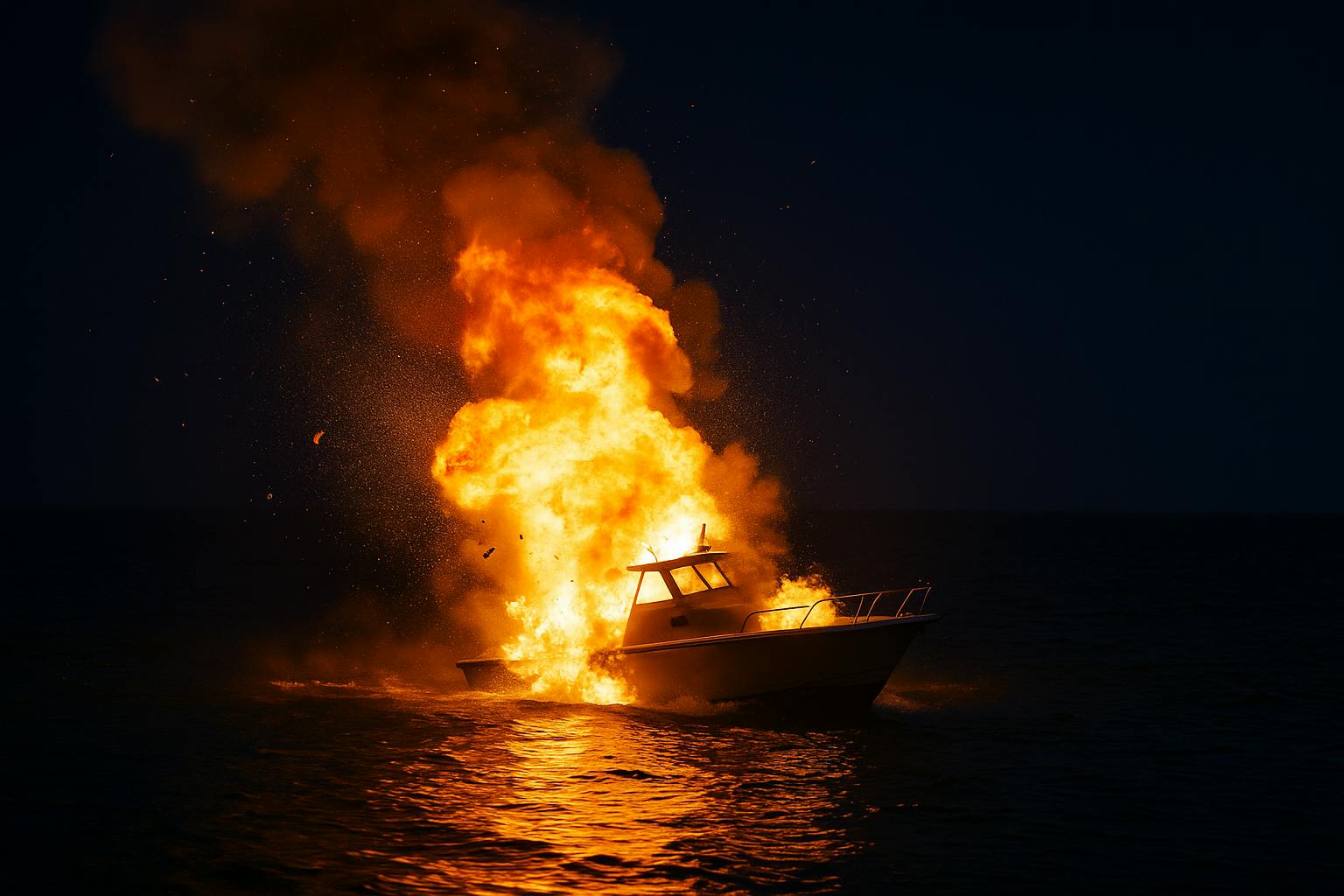
In the Caribbean’s tumultuous maritime crossroads—where trade lanes converge with drug routes and oil deliveries—a split-second decision can tilt the world’s balance of power. Recently, the U.S. Navy destroyer USS Jason Dunham destroyed a fast, unidentified speedboat in international waters with a missile, while choosing not to fire on two Venezuelan F-16s that aggressively buzzed the ship in “a highly provocative maneuver.”¹ This sharp contrast raises a question: Why blow up the boat, yet spare the fighter jets?
The answer lies beyond naval tactics—in a tangled web of oil interests, criminal networks, and global geopolitical leverage, where a missile can mean legitimate defense—or the spark of global conflict.
1. The Scene: Provocation vs. Restraint
The incident occurred amid a U.S. operation officially described as an anti-narcotics mission, targeting Venezuela’s Cartel of the Suns and the Tren de Aragua, organizations tied to the country’s security forces. During this mission:
Two Venezuelan F-16s flew low over the Jason Dunham in international waters, simulating a hostile act.²
Simultaneously, a fast, unidentified boat closed in at great speed—a pattern seen in narco-trafficking or potential suicide attacks.
Result:
The speedboat was destroyed immediately by missile strike, under the rules of self-defense.
The F-16s were met with warnings only—no exchange of fire.
Trump later stated, “If they come near again, they will be shot down.”³ But for now, the Pentagon has drawn the line short of open conflict.
2. Speedboat: Legitimate Self-Defense
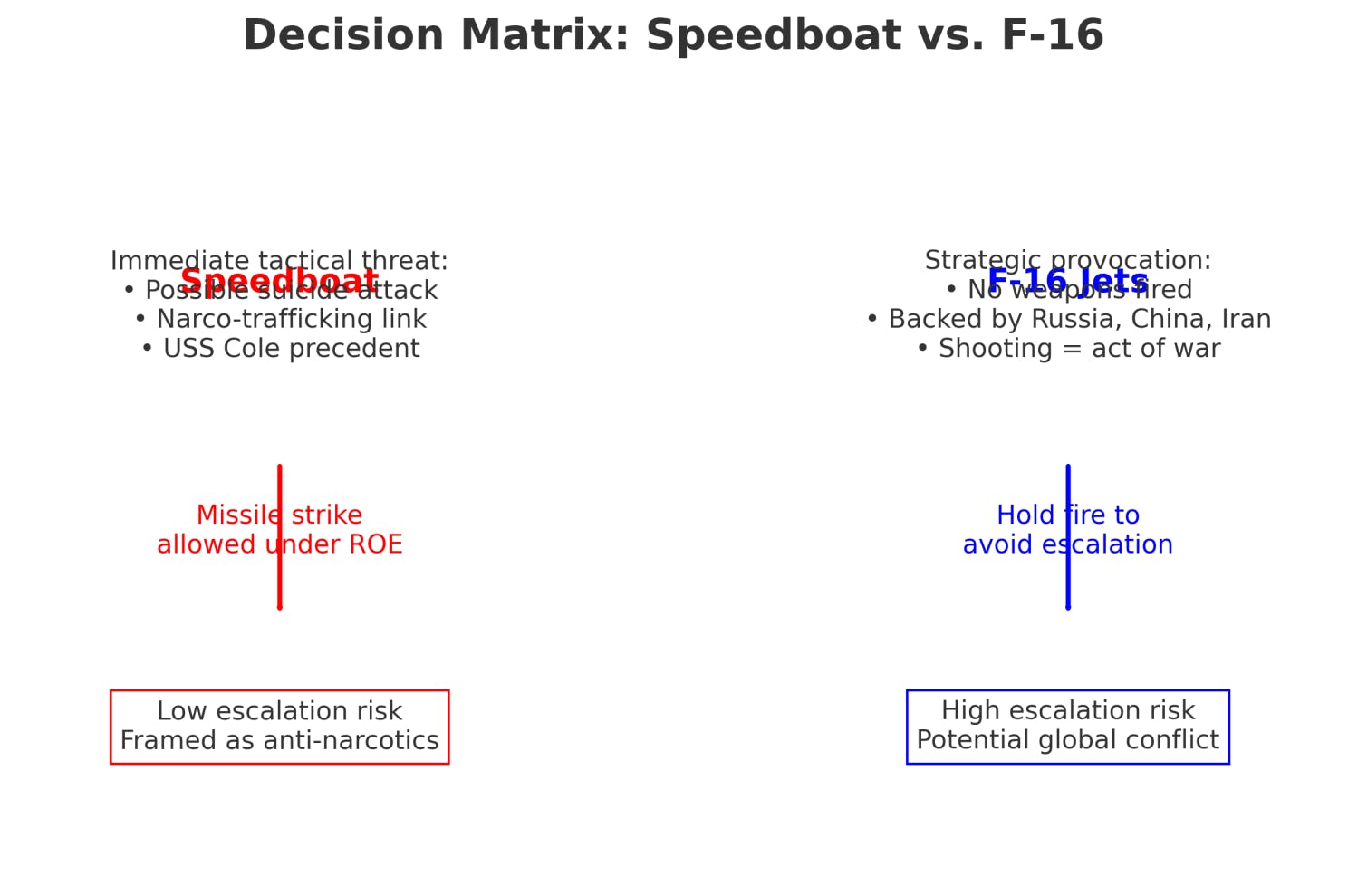
At sea, danger is counted in seconds: a small craft can ram, detonate explosives, or open fire at close range. In response to the 2000 bombing of the USS Cole in Yemen, the U.S. Navy updated its Rules of Engagement (ROE): any unidentified vessel posing an imminent threat may be destroyed without political approval.⁴ In this case, the strike on the speedboat was seen as legitimate tactical self-defense, not a political gesture. And, crucially, framed within the rhetoric of combating organized crime, it avoids accusations of aggression.
3. The F-16s: Calculated Political Provocation
The Venezuelan fighters represented a wholly different risk vector:
Although menacing, they did not fire weapons, lock targeting systems, or breach sovereign U.S. airspace. Shooting them down would equate to a formal declaration of war under current ROE.⁵
Moreover, Venezuela is not isolated:
Russia supplies military advisers, S-300 defense systems, and advanced fighters.⁶
China underwrites a major portion of Venezuela’s debt, purchases most of its oil, and provides diplomatic cover.⁷
Iran contributes drones and technical military support.⁸
Had the U.S. downed those F-16s, Maduro would have wielded the perfect victim narrative and summoned direct support from his allies, potentially triggering reprisals in Ukraine, the Middle East, or the South China Sea—unless American forces were ready for a global conflict.
4. Maduro’s Hybrid Regime: Guns, Gangs, and Guerrillas
Maduro governs via de facto military and criminal dominance:
A carefully rotated military elite ensures loyalty.
The Bolivarian Militia—millions strong—enforces control on the ground.
The Cartel of the Suns finances the regime through narcotrafficking.
Additionally, the Colombian guerrilla group ELN maintains permanent bases in Venezuela, especially in border states like Apure and Zulia. As reported by Semana, the ELN serves as a para-military defensive force, ready to counter foreign or domestic threats, while commanding lucrative illicit economies.⁹ Venezuela thus functions as a hybrid state, where governance, organized crime, and foreign guerrillas intertwine.
5. Oil: The Artery of Crisis
The underlying battleground isn’t military—it’s energy. Venezuela holds the world’s largest proven oil reserves, making it central to global energy power dynamics.¹⁰
China: Energy Partner and Geopolitical Trustee
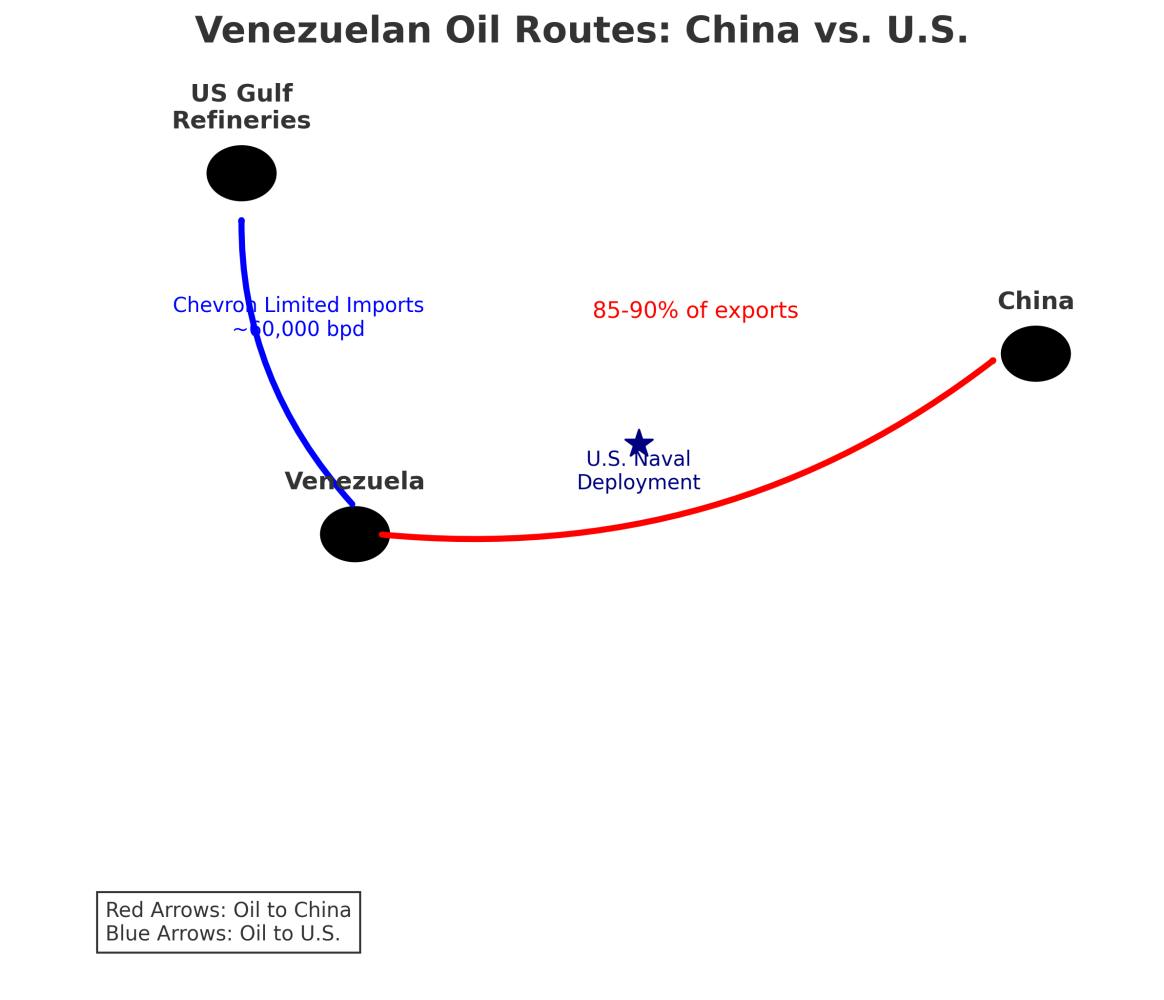
China absorbs between 85% and 90% of Venezuelan oil exports.¹¹
This supply ensures China’s energy diversification and shields it from Middle East volatility.
Venezuela repays some Chinese debt in oil, reinforcing Beijing’s influence.
Each shipment to China is a lifeline for the Maduro regime and a geopolitical anchor for Chinese strategy.¹²
United States: Chevron & Strategic Ambiguity
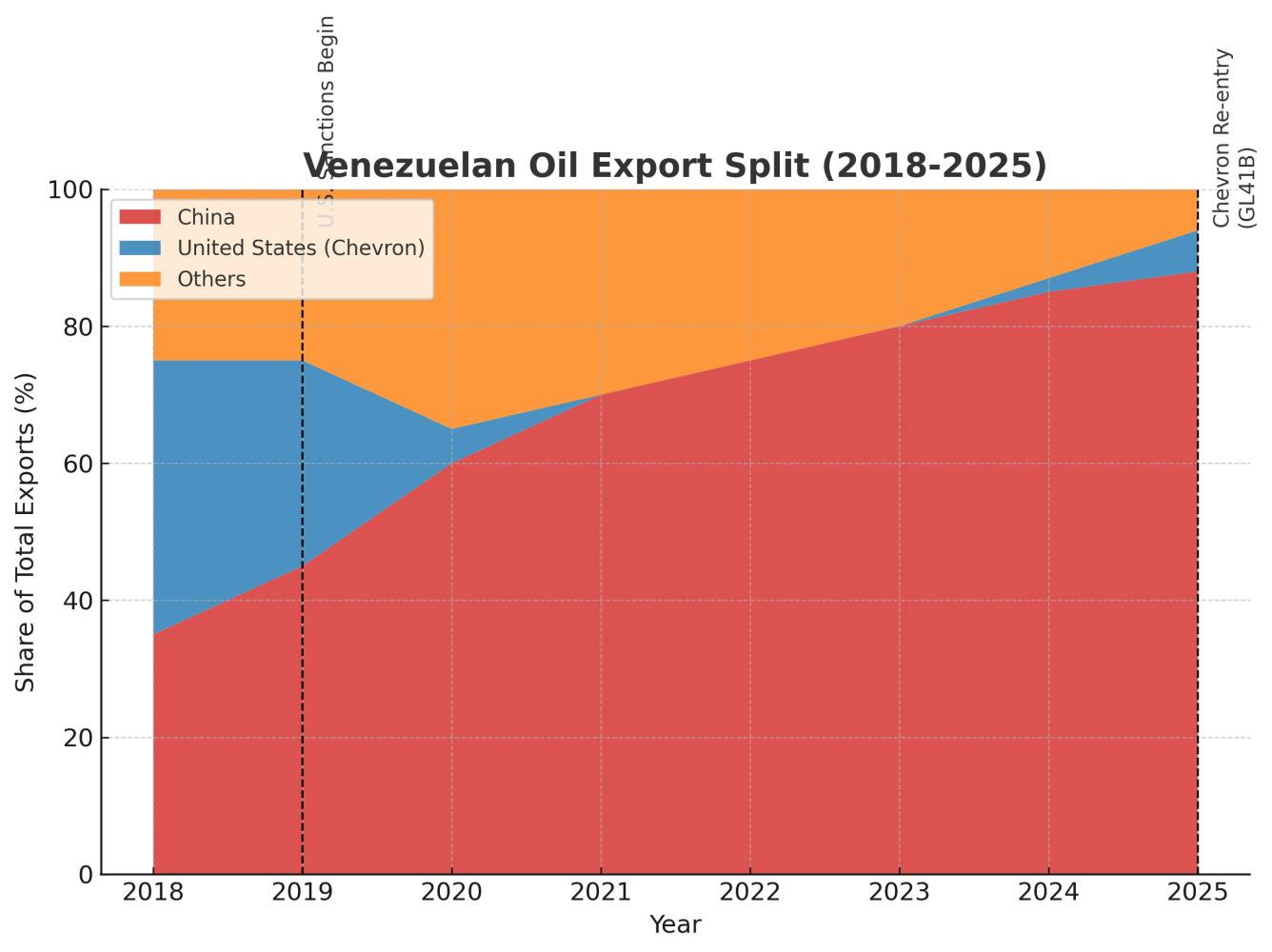
Prior to the 2019 sanctions, the U.S. was Venezuela’s top oil customer.
In 2025, the U.S. Treasury reinstated limited licensing to Chevron, allowing it to operate and export Venezuelan crude to U.S. refineries. Exports increased to roughly 60,000 barrels per day in August, up from zero, while China remained the dominant buyer with 85% of exports, down from 95% the previous month.¹³
Chevron’s operations are constrained by General License 41B, which forbids expansion or direct financial benefit to PDVSA.¹⁴
The license is capped through May 27, with restrictions on dividends, royalties, and sales beyond the U.S.¹⁵
These arrangements preserve a modest U.S.–Venezuela oil channel, providing internal U.S. stability and strategic flexibility.¹⁶
Trump has vacillated—for instance, cancelling Biden-era sanctions only to reauthorize Chevron under tuition restrictions, post prisoner exchanges—shaping an approach blending economic pressure with controlled re-engagement.¹⁷
6. Naval Deployment: Dual Mandate
While publicly presented as an anti-narcotics mission, the U.S. deployment serves a second purpose: oiling global pressure points. By asserting control over Venezuelan maritime routes, the U.S. sends a clear signal that, should the situation escalate, Washington can choke off the oil supply flowing to China without crossing into open warfare.
7. Trump’s Strategic Ambiguity
Rather than labeling Venezuela’s elections as “fraudulent,” Trump termed them merely “weird”, skirting the line between disapproval and provocation.¹⁸ This vagueness allows him to escalate or retreat politically as needed, avoiding the political and economic repercussions of full-scale intervention or recognition—especially amid escalating tariff wars and global crises.
8. Why the Speedboat, Not the F-16s
Speedboat destroyed in lawful self-defense (anti-narcotics). Geopolitical risk low: Russia/China neutral, F-16s untouched, avoiding war declaration. Escalation risk is high: potential for global allied retaliation.
Conclusion: The Caribbean’s Invisible Frontier
The incident crystallizes the entangled geopolitics of the modern era:
The U.S. must project power without igniting a global conflict.
Maduro, backed by major powers and hybrid forces, leverages provocation for regime preservation.
China, dependent on Venezuelan crude, watches carefully.
Russia and Iran exploit Venezuela as a forward pressure point against the U.S.
Here, the difference between a speedboat and an F-16 is the difference between tactical assertiveness and global war. Destroying the boat is permissible. Destroying a fighter jet is not.
Endnotes
Reuters, “Venezuela’s oil exports rise to 9-month high as cargoes return to US,” Sept. 3, 2025.¹¹
Al Jazeera & CBS News coverage of the F-16 flyover, Sept. 5, 2025.²
Public statement by President Trump at press briefing.³
U.S. Navy ROE updates post-USS Cole incident.⁴
Analysis of ROE and war declaration thresholds.⁵
PRC military support: systems like S-300, Su-30.⁶
China–Venezuela oil and financial ties.⁷
Iran’s technical and drone support.⁸
Semana magazine on ELN presence in Venezuela.⁹
Al Jazeera, “Venezuela has the world’s most oil…” Sept. 4, 2025.¹⁰
Reuters, Aug. 3, 2025 report: 85% to China, 60k bpd to U.S.¹¹
Analysis of Venezuela–China oil as geopolitical lifeline.¹²
Reuters, “Oil exports rise…Cargoes return to U.S.,” Sept. 3, 2025.¹³
OFAC General License 41B (March 24, 2025).¹⁴
Federal Register notes to General License 41B.¹⁵
Energy markets: Chevron imports stabilize U.S. refineries.¹⁶
Reports of Trump’s license revocations and reauthorizations.¹⁷
Trump’s “weird elections” comment in public transcript.¹⁸
Chilean filmmaker Juan Forch, a key figure in Chile’s historic 1990 “NO” campaign, which was later brought to life in Pablo Larraín’s Oscar-nominated film No, once praised Toro Ghio’s narratives for “enriching our understanding of history beyond traditional battlefields and royal courts,” seamlessly transitioning “from the discomfort of a Moscow hotel to the exhilaration of the Nicaraguan jungle.”
With over 250,000 readers worldwide and nearly 30,000 in just three days on LinkedIn, this work reveals the hidden connections where geopolitics intersects with energy—driven by research, licensed data, and a dedication to clarity in a noisy world.
.....................................................................................................................................................
Yet the Work Burns Bright
In 2025, over 250,000 readers accessed this work, a distillation of extensive research uncovering hidden patterns at the intersection of geopolitics and energy. Rigorous analysis, licensed data, and a commitment to clarity ensure its continued relevance in a noisy world. However, even the brightest flame needs fuel.
Sometimes that fuel is as small as a single pound, euro, yen, franc, mark, crown, or rupee. Supporting this work is not impossible. It is what keeps the lights burning.
Support our work
PayPal: [email protected]
Wire (IBAN): SE18 3000 0000 0058 0511 2611
Swish: 076 423 90 79
Remitly: Nordea, 33005805112611
Stripe: via our webpage